진안 지역에 분포하는 변성퇴적암류의 지질연대 및 지질학적 의의

초록
한반도 남부 영남육괴와 옥천대의 경계부를 따라 분포하는 시대미상의 변성퇴적암류의 층서적 의의 및 고생대 지층으로의 귀속 여부에 관한 논의가 지속되어 왔으나 이를 뒷받침할 지질연대학적 연구는 아직 부족하다. 본 연구는 전북 진안 지역에 분포하는 이질 및 사질 천매암에 대한 쇄설성 저어콘 U-Pb 연대분석 및 미량원소 분석을 실시하여 최대퇴적시기, 인접 지질단위와의 기원지적 연관성을 검토하였다. 쇄설성 저어콘 입자는 뚜렷한 화성기원의 내부구조 및 미량원소 특성을 나타내며 신시생대의 다소 약한 연대 피크(2.5 Ga)와 고원생대 라이악스기(2.3-2.1 Ga)부터 오로세이라기 말기(2.05-1.95 Ga)에 강한 연대 피크를 보이며, 가장 젊은 저어콘 연대 군집의 가중평균연대는 이질 천매암에서 약 1933 Ma, 사질 천매암에서 1956 Ma로 나타났다. 이러한 특성은 옥천대를 따라 분포하는 고생대 퇴적암 및 변성퇴적암류와 상이하여 상호간 기원지적 친화성이나 층서적 연관성이 확인되지 않았다. 한편 인접한 영남육괴의 변성퇴적암류 기반암과 일부 연대군 및 연대피크를 공유하나, 세부적 구성 비율에서는 차이를 보였다. 이러한 결과는 영남육괴-옥천대 경계를 따라 분포하는 변성퇴적암류의 층서적 연관성에 대한 면밀한 검토와 향후 영남육괴 고원생대 층서 재확립의 필요성을 시사한다.
Abstract
Stratigraphic implications and the potential Paleozoic assignment of age-unknown metasedimentary rocks along the boundary along the Okcheon Belt in Korea have been subjects of ongoing debate. However, geochronological constraints remain insufficient. This study presents detrital zircon U–Pb and trace element data for pelitic and psammitic phyllites in the Jinan area to evaluate their maximum depositional age, provenance affinity, and geological implications. The analyzed zircon grains exhibit well-developed igneous zoning patterns and trace element compositions, typical of magmatic origin. The studied phyllites show a subordinate late Neoarchean peak (ca. 2.5 Ga) with strong Paleoproterozoic Rhyacian to Orosirian peaks (2.3–2.1 Ga and 2.05–1.95 Ga). The weighted mean age of the youngest zircon clusters are ca. 1933 Ma for the pelitic phyllite and ca.1956 Ma for the psammitic phyllite. These geochronological characteristics are distinct from those of the Paleozoic sedimentary and metasedimentary rocks in the Okcheon Belt, indicating a lack of provenance affinity or stratigraphic correlation. Although the studied rocks share certain age groups and peaks with the Paleoproterozoic metasedimentary basement of the Yeongnam Massif, they differ in the relative proportions of these components. These results suggest the need for a detailed reassessment of the stratigraphic relationships among metasedimentary units along the Yeongnam Massif–Okcheon Belt boundary and a refined Paleoproterozoic stratigraphic framework for the Yeongnam Massif.
Keywords:
Yeongnam Massif, Okcheon Belt, geochronology, metasedimentary rocks키워드:
영남육괴, 옥천대, 지질연대, 변성퇴적암1. 서 론
1990년대 이후 저어콘 U-Pb 연대측정 기법의 발전은 한반도 지질계통에 대한 기존의 틀을 보완하는 한편 새로운 해석을 가능하게 하였다. 예로써, 경기육괴와 영남육괴의 형성이 시생대 뿐만 아니라 고원생대에 걸쳐 이루어졌음이 밝혀졌고(e.g., Lee, S.R. et al., 2000; Lee and Cho, 2012; Lee, B.C. et al., 2014; Cho et al., 2017; Kang et al., 2023), 한반도 지질계통에서 부재하거나 매우 제한적이었다고 인식되었던 중원생대, 신원생대, 페름기 등의 화성활동 역시 활발히 보고되었다(e.g., Yi et al., 2012; Kim, M.J. et al., 2016; Kim, S.W. et al., 2018; Lee, B.Y. et al., 2023). 나아가 흔히 태백산 분지에 주로 분포하는 것으로 인지되어 온 고생대의 지층들 역시 옥천대를 따라 산출되며(e.g., Lim et al., 2005, 2006, 2007; Jang et al., 2024 and references therein), 홍성-임진강대와 경기육괴 및 영남육괴 내에서도 잇따라 확인됨에 따라 한반도 지질 진화사에 대한 포괄적 재해석이 요구되고 있다(Kee et al., 2008; Cho et al., 2010; Cho, 2014; Kim, S.W. et al., 2017; Lee, B.C. et al., 2024; Jeong et al., 2025; Kwak et al., 2025).
옥천대의 남서부에는 영남육괴와의 경계를 따라 북동-남서방향으로 변성퇴적암류가 널리 발달하며, 이 중 탄층 및 식물화석을 배태하는 지층들은 삼척 및 영월 등지에 나타나는 평안누층군과 대비된다(e.g., Kim, Y.B. et al., 2001; Kim, D.Y. et al., 2015; Kim and Lee, 2017, 2018 and references therein). 반면 이들과 인접하고 호남전단대를 따라 산재하는 운모편암, 석영-백운모편암, 규암, 대리암 등으로 구성된 변성퇴적암류는 층서가 불명확하였으며, 과거 시대 미상층으로 간주되거나 선캄브리아기에 형성되었을 것으로 추정되었다(e.g., Kinosaki, 1929; Chang and Kim, 1967; Choi and Yoon, 1968; Kim et al., 2001). 이들은 지역에 따라 용암산층, 영전층, 갈두층, 설옥리층 등의 층명이 부여되었으나, 지역간 대비도 일관적으로 이루어지기 어려웠으며 비교적 변성퇴적암류의 노출이 양호한 해남 지역에서 일부 층서가 정리된 것에 그친다(Kim et al., 2001).
최근 전남 영광-장성, 영암-강진-해남 지역의 갈두층(Kim et al., 2001)에 해당하는 영역에서 쇄설성 저어콘 U-Pb 연대 측정 결과 약 379-246 Ma의 최대퇴적연령이 산출되고 연대분포 특성 또한 평안누층군과의 유사성을 보여 이들 중 일부는 후기 고생대 내지 중생대 전기 트라이아스기에 퇴적되었을 것으로 해석되었다(e.g., Ha, 2014; Choi et al., 2015; Kim et al., 2015). 그러나 이들과 인접한, 곡성-임실-진안으로 연장되는 변성퇴적암의 일부는 현재까지 층서적 단서가 부재하며, 최신 1:1,000,000 지질도에서 최대퇴적연대(508 Ma)에 기반하여 상부 고생대층으로 추정되었다(Kee et al., 2019).
상기 지층의 지리적 연장선상에 놓이는 진안 지역에도 유사한 산상을 보이는 변성퇴적암이 분포한다. 기존 연구에서는 이 변성퇴적암이 선캄브리아시대 선각산 화강편마암(Kim, 1990)의 후기산물로 보이는 페그마타이트 암맥에 관입당하였다는 야외 관찰을 근거로 이 변성퇴적암을 선캄브리아시대로 해석하였다(Ahn et al., 1997). 그러나 진안 지역의 변성퇴적암이 지역에 따라 천매암 수준의 낮은 변성도를 보이며, 상술하였듯 유사한 산상의 변성퇴적암류가 고생대 내지 전기 트라이아스기의 지층으로 재해석되는 최근의 연구 결과들과 상충한다. 아직까지 진안지역에 발달한 변성퇴적암류의 형성시기를 입증할 만한 지구연대학적 자료는 보고되지 않은 바, 본 연구는 해당 변성퇴적암류에 대한 저어콘 U-Pb 연대 자료를 제공하고자 한다. 이를 바탕으로 기존의 층서적 해석에 대해 재고찰하는 한편, 옥천대-영남육괴 경계부의 시대 미상 변성퇴적암류의 층서를 재검토하기 위한 단서를 제시한다.
2. 지질개요
한반도의 변성복합체는 북으로부터 남으로 관모육괴, 낭림육괴, 경기육괴 및 영남육괴로 구분된다(그림 1a). 가장 남부에 분포하는 영남육괴는 주로 선캄브리아시대 변성퇴적암류(이질, 사질, 석회질 기원 등)와 규장질 내지 고철질의 변성화성암류로 구성된다. 쇄설성 저어콘 연대측정 결과에 의하면, 변성퇴적암류들은 약 2000 Ma 이전에 퇴적되었으며(e.g., Lee et al., 2011; Lee and Cho, 2012; Kee et al., 2019), 약 2000-1860 Ma에 산성 내지 염기성의 변성화성암류가 관입하였다(e.g., Kim et al., 2009; Lee et al., 2019; Cheong et al., 2020; Cho et al., 2020). 이후 이 암석들은 약 1870-1840 Ma에 고도의 변성작용을 경험한 것으로 알려져 있다(e.g., Kim et al., 1994; Oh et al., 2000; Park et al., 2000; Lee et al., 2017; Lee and Cho, 2020).
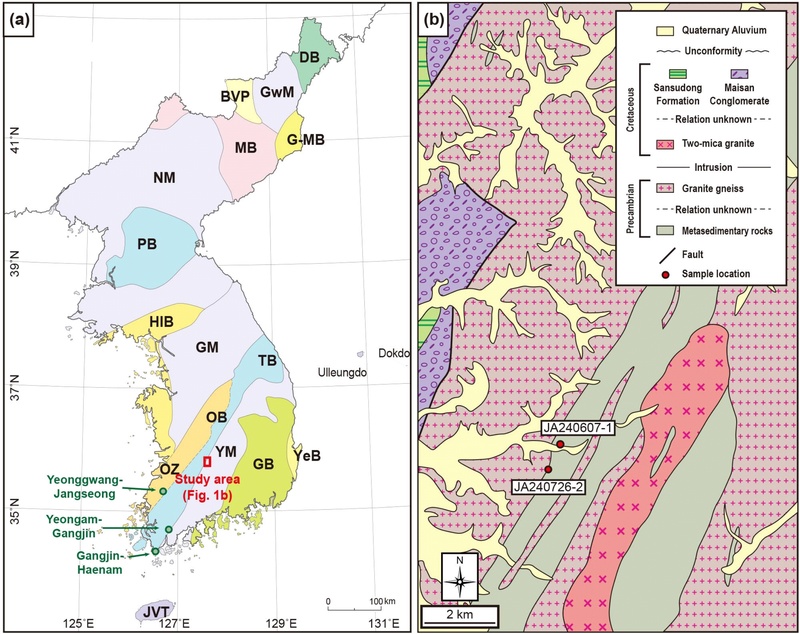
(a) Tectonic province map of the Korean Peninsula (1:1,000,000 scale) (modified from Kee et al., 2019). (b) Geological map of the Jinan area (modified from Shimamura, 1924). Red circles represent sample locations. Abbreviations: DB, Dumangang Belt; BVP, Baekdusan Volcanic Plateau; GwM, Gwanmo Massif; G-MB, Gilju-Myeongcheon Basin; MB, Macheollyeong Belt; NM, Nangrim Massif; PB, Pyeongnam Basin; HIB, Hongseong-Imjingang Belt; GM, Gyeonggi Massif; OB, Okcheon Belt; OZ: Okcheon Zone; YB, Yeongnam Massif; GB, Gyeongsang Basin; YeB, Yeonil Basin; JVT, Jeju Volcanic Terrain.
연구 지역은 진안군 일대로 영남육괴 북중부에 위치하고 있으며, 1:50,000 지질도 기준 진안 도폭에 해당한다(Shimamura, 1924). 진안군의 기저부는 선캄브리아시대 변성퇴적암류 및 화강편마암으로 구성되며, 이들을 백악기 화성암 및 퇴적암이 피복하고 있다(그림 1b). 연구 대상인 변성퇴적암류는 선캄브리아시대 화강편마암 내 패치상으로 고립되어 분포하며 진안군 백운면 부근에서 진안군 평촌 부근에 걸쳐 북동-남서 방향으로 발달한다. 주로 운모편암으로 구성되나 일부에서는 변성도가 낮은 천매암으로 나타나며(Shimamura, 1924), 곡성군 옥과면에 나타나는 설옥리층의 연장으로 간주된 바 있다(Kim et al., 1984; Ahn et al., 1997).
주변의 화강편마암은 일부 페그마타이트 등의 조직이 연구대상 변성퇴적암을 관입하였다고 여겨지기도 하였으나(Shimamura, 1924; Kim et al., 1984; Kim, 1990; Ahn et al., 1997), 페그마타이트의 기원 등에 대한 암석학적 연구는 수행되지 않았으며, 변성퇴적암에 비해 변성도가 높아 기반암일 가능성이 있다고 판단된다. 화강편마암은 대개 조립질에 암회색 내지 담홍색을 띠나, 일부에서는 장석 반정 혹은 백운모를 함유하기도 한다(Shimamura, 1924). 이들 변성퇴적암 및 화강편마암은 백악기 복운모 화강암에 의해 관입당하였다. 이 암체는 진안군 백운면 부근에만 나타나며, 조립의 백운모 및 흑운모를 가지는 것이 특징이다(Shimamura, 1924).
연구 지역의 서편에는 백악기 퇴적암류인 산수동층과 마이산 역암층이 나타난다. 산수동층은 셰일 및 사암이 호층으로 나타나며, 마이산 역암층에 부정합으로 피복된다고 여겨졌으나(Shimamura, 1924), 이후 동시기에 쌓인 지층으로 해석되었다(Lee, 1992; Lee et al., 2020). 마이산 역암층은 부귀산, 마이산 등의 고봉을 형성하고, 주로 역암으로 구성되며 얇은 중립질 사암이 협재한다. 역암의 역은 둥글거나 각진 형태를 보이며, 그 종류는 화강암, 셰일, 천매암 등으로 다양하다(Shimamura, 1924; Lee, 1992).
3. 암상기재
연구대상 암체는 전북특별자치도 진안군 백운면 노촌리 노촌저수지 일대에 분포하는 이질 천매암(시료 JA240607-1: 35°42'43.88"N, 127°25'50.81"E) 및 사질 천매암(시료 JA240726-2: 35°42'30.20"N, 127°25'45.70"E)이다.
이질 천매암(시료 JA240607-1)은 전체적으로 담회색 내지 암회색을 띠며, 벽개와 엽리가 잘 발달하고 진주 광택을 보이는 것이 특징이다(그림 2a, 2b). 엽리면의 주향은 북동(N25°E)이며, 경사는 북서(55°NW)이다. 야외관찰결과 세립질의 석영 및 운모류로 구성되어 있으며, 황철석이 함께 나타난다. 일부에서는 이질 기원의 층과 사질 기원의 층이 얇게 교호하며 나타난다. 박편 관찰결과 세립질의 석영, 흑운모, 백운모, 불투명광물이 주 구성광물로 나타나며, 백운모와 흑운모는 한방향으로 배열하여 뚜렷한 엽리구조를 보인다(그림 2c, 2d). 흑운모와 백운모는 대개 서로 독립된 층에서 우세하게 발달하는 양상을 보이나, 부분적으로는 백운모가 우세한 층 내에 흑운모가 발달하는 양상을 보이기도 한다(그림 2c, 2d).
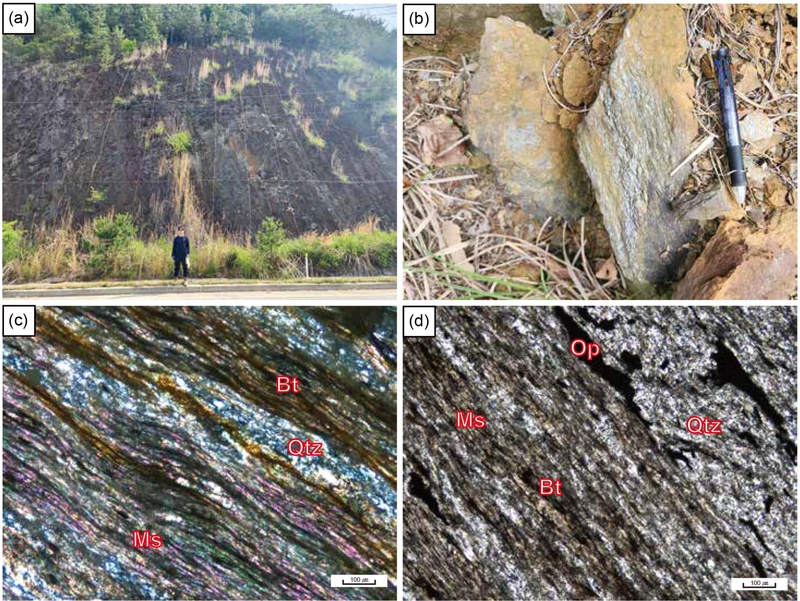
Outcrop photographs (a, b) and thin-section photomicrographs (c, d) of pelitic phyllite (sample JA240607-1) in the Jinan area. (a) Field occurrence of the pelitic phyllite; (b) Close-up view showing nacreous luster and well-developed foliation; (c, d) Photomicrographs showing muscovite-quartz-biotite dominant layers under plane- and cross-polarized light, respectively. Abbreviations: Bt, biotite; Ms, muscovite; Qtz, quartz; Op, opaque minerals.
사질 천매암(시료 JA240726-2)은 전체적으로 담회색 내지 암회색을 띠며 뚜렷한 편리구조가 발달하였다(그림 3a, 3b). 박편 관찰결과 세립질의 석영, 흑운모, 백운모, 불투명광물이 주 구성광물로 나타나고, 사질 기원의 석영질 영역과 이질 기원의 운모질 영역이 분리되어 교호하는 엽리를 보인다(그림 3c, 3d). 특히 석영질 영역이 두껍게 발달하여, 이질 천매암 시료(JA240607-1)에 비해 운모질 영역의 발달이 미약하다. 백운모와 흑운모는 한방향으로 배열하여 뚜렷한 엽리구조를 보이며, 흑운모는 독립된 층으로 발달하지 못하고 백운모가 우세한 층 내에 발달하는 양상을 보인다(그림 3c, 3d).
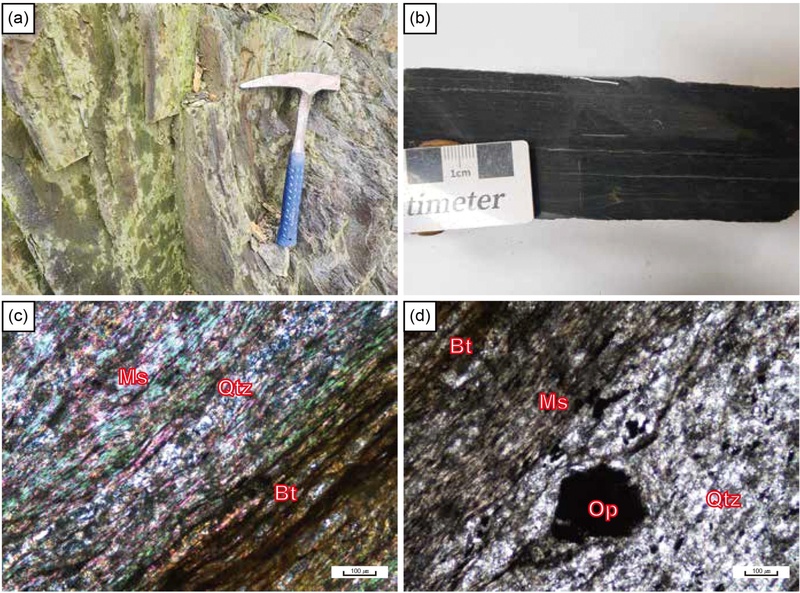
Outcrop photographs (a, b) and thin-section photomicrographs (c, d) of psammitic phyllite (sample JA240726-2) in the Jinan area. (a) Outcrop showing prominent foliation; (b) Hand specimen showing thick quartz-rich layers intercalated with minor mica-rich layers; (c, d) Photomicrographs of quartz-rich and mica-rich layers under plane- and cross-polarized light, respectively. Abbreviations: Bt, biotite; Ms, muscovite; Qtz, quartz; Op, opaque minerals.
4. 분석방법
저어콘 U-Pb 연대측정을 하기 위해서 Cho (2004)가 제시한 중광물 분리 방법을 따랐으며, 암석 시료를 조분쇄기(jaw crusher)로 분쇄한 이후 미분기(pulverizer)를 이용하여 분말로 만들고 물을 이용하여 가벼운 광물을 제거하였다. 이후 네오디뮴 자석을 이용하여 자성 광물 제거 후 중광물만을 농집시켰으며, 실체현미경을 이용하여 수선별을 진행하였다. 선별된 저어콘은 저어콘 표준물질(standard zircon)과 함께 에폭시 수지에 고정하여 연마하였다. 이후 저어콘 내부구조를 확인하기위해 주사현미경(JEOL JSM-6610LV)으로 음극발광(cathodoluminescence)과 후방산란전자(backscattered electron) 영상을 획득하였다.
이질 및 사질 천매암(시료 JA240607-1 및 JA240726-2)의 저어콘 U-Pb 및 미량원소 분석은 중국 후베이성 우한시에 위치한 우한 샘플 솔루션 분석 기술회사의 레이저삭박시스템(Laser ablation, LA; GeoLas HD)이 부착된 다검출기 유도결합플라즈마 질량분석기(Multi-collector Inductively Coupled-Plasma Mass Spectrometer, MC-ICPMS; Agilent 7700)를 이용하여 분석하였으며, GJ-1 (609 Ma; Jackson et al., 2004), Plešovice (337.1 Ma; Sláma et al., 2008) 및 Tanz (566.16 Ma; Hu et al., 2021) 저어콘 표준물질과 NIST610 glass 표준물질을 이용하여 보정하였다. 분석된 저어콘 표준물질 연대는 각각 GJ-1에서 603.5 ± 1.2 Ma (n = 34, MSWD = 0.94, probability = 0.33), Plešovice에서 336.9 ± 0.79 Ma (n = 24, MSWD = 0.37, probability = 0.55) 및 Tanz에서 565.8 ± 1.3 Ma (n = 23, MSWD = 1.6, probability = 0.20)이며, 이는 앞서 언급한 각 표준물질에 대해 보고된 연대와 잘 일치한다. 저어콘 U-Pb 동위원소에 사용된 레이저 빔 직경은 24 ㎛ 및 32 ㎛이며, 주파수는 6 Hz이다. 보통 납 보정의 경우 204Pb을 직접 측정하여 보정하였다. 204Hg에 의한 간섭효과는 LA 시스템에 wire signal-smoothing 및 mercury-removing 기기를 부착하여 제거하였다(Hu et al., 2015).
분석된 데이터는 ICPMSDataCal 10.7 소프트웨어 프로그램을 이용하여 보정하였으며, Isoplot (ver. 4.15; Ludwig, 2012) 소프트웨어를 이용하여 연대계산을 실시하였다. 저어콘 U-Pb 연대는 207Pb/206Pb 연대를 적용하였으며, ± 5% 이하의 불일치도를 보이는 분석결과만을 이용하였다.
5. 분석 결과
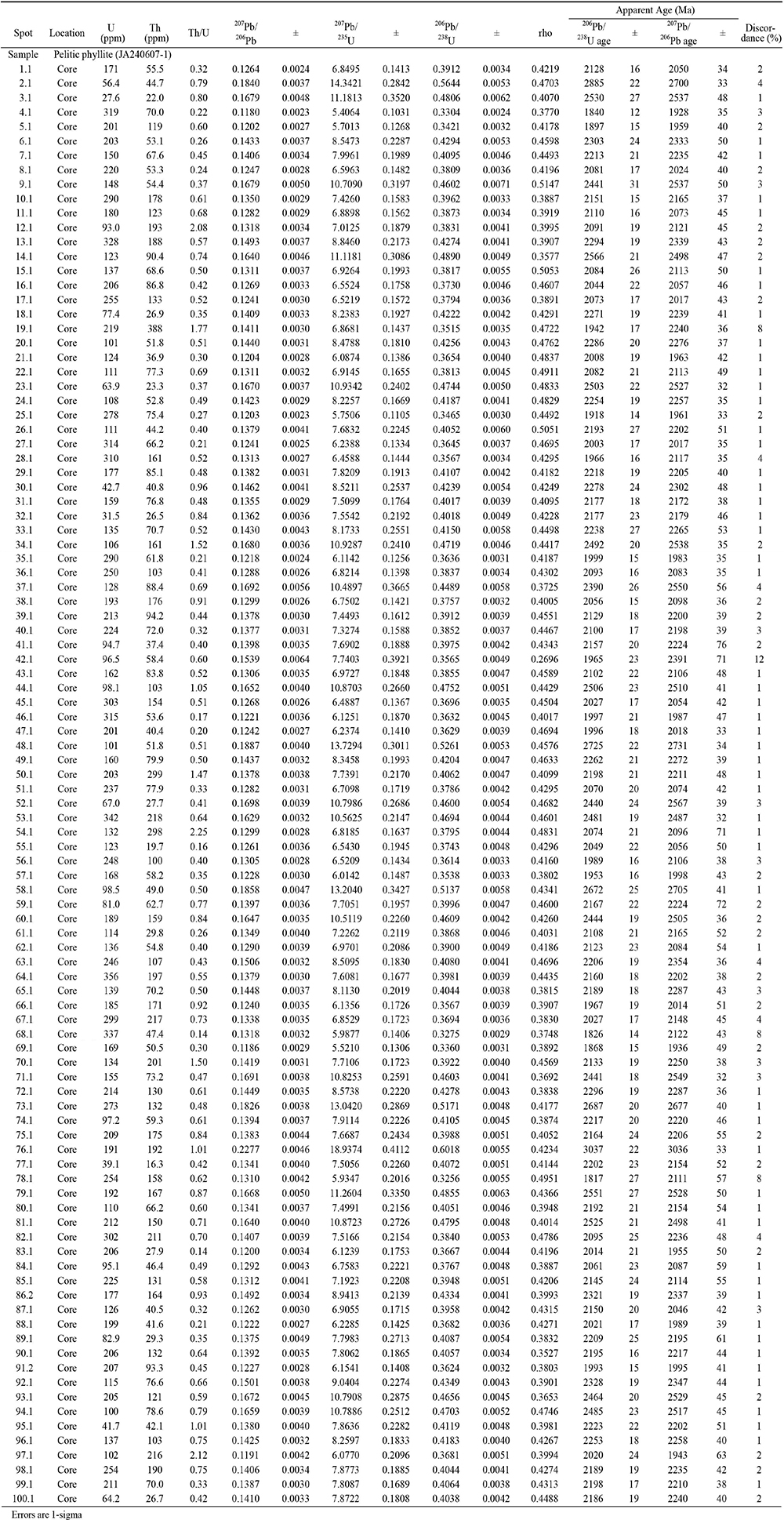
이질 천매암(시료 JA240607-1)에서 분리한 저어콘의 크기는 50-100 ㎛에 해당하며, 아원형-아각형의 외형을 보이고 흔히 가장자리가 마모되어 있다(그림 4a). 음극선발광영상에서 저어콘 중심부는 담회색 내지 밝은 색을 띠며, 진동누대구조, 호상구조 등 다양한 구조가 나타난다(그림 4a). 일부 저어콘 중심부 주변에는 과성장 또는 재결정 조직을 보이는 저어콘 외연부가 발달 되어있으나, 분석 가능한 수준의 면적을 확보하지 못했다. 저어콘 외연부는 흑색 혹은 옅은 회색을 보이며, 누대구조는 발달하지 않는다(그림 4a). 저어콘 중심부에서 100개의 분석점을 선택하여 분석을 진행하였다. 불일치도가 낮은 저어콘 중심부(96점)과 불일치도가 높은 저어콘 중심부(4점)의 U 농도는 각각 28-356 ppm 및 97-337 ppm, Th 농도는 각각 16-299 ppm 및 47-388 ppm이며, Th/U 비는 각각 0.14-2.25 및 0.14-1.77의 값을 가진다(표 1).
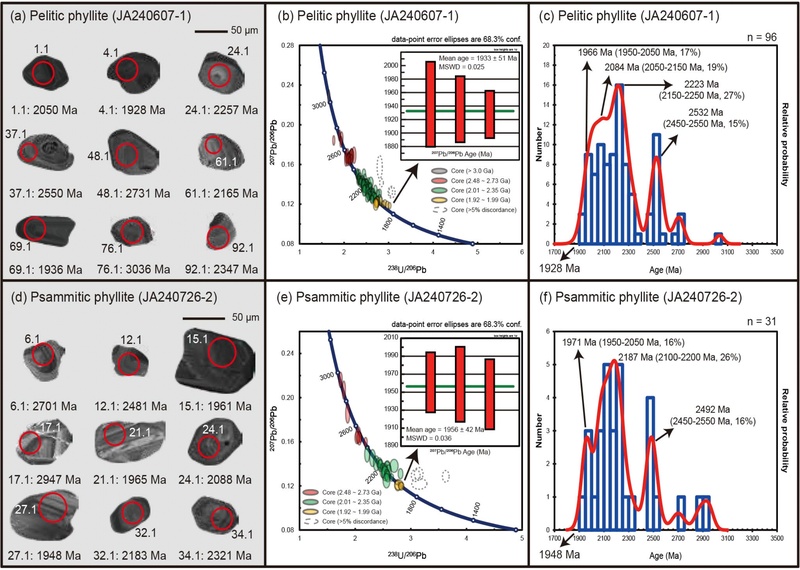
LA-MC-ICP-MS U-Pb results for detrital zircons from the Jinan area. Pelitic phyllite (sample JA240607-1): (a) representative CL images, (b) Tera-Wasserburg concordia diagram, and (c) age probability density diagram. Psammitic phyllite (sample JA240726-2): (d) representative CL images, (e) Tera-Wasserburg concordia diagram, and (f) age probability density diagram.
총 100개 점에 대한 분석결과를 Tera-Wasserburg 일치곡선에 도시하였다(그림 4b). 불일치도가 낮은(<5% discordance) 저어콘 중심부에서 3036-1928 Ma, 불일치도가 높은 저어콘 중심부에서 2391-2111 Ma의 207Pb/206Pb 겉보기 연대가 측정되었다(표 1). 가장 젊은 단일 저어콘 입자(4.1)의 연대는 1928 ± 35 Ma로 나타났으며, 이를 포함한 불일치도가 낮은 저어콘 중심부에서 얻은 가장 젊은 세 연대의 가중평균 연대는 1933 ± 51 Ma (MSWD = 0.025, n = 3)로 계산되었다(그림 4b). 불일치도가 낮은 저어콘 중심부를 이용하여 확률 밀도 다이어그램을 작도한 결과 2532 Ma (2550-2450 Ma 범위, 15%), 2223 Ma (2250-2150 Ma 범위, 27%) 및 2084 Ma (2050-1950 Ma 범위, 17%)의 연대 피크를 얻었다(그림 4c).

LA-ICP-MS U - Pb zircon data for pelitic phyllite (JA240607-1), Jinan area.
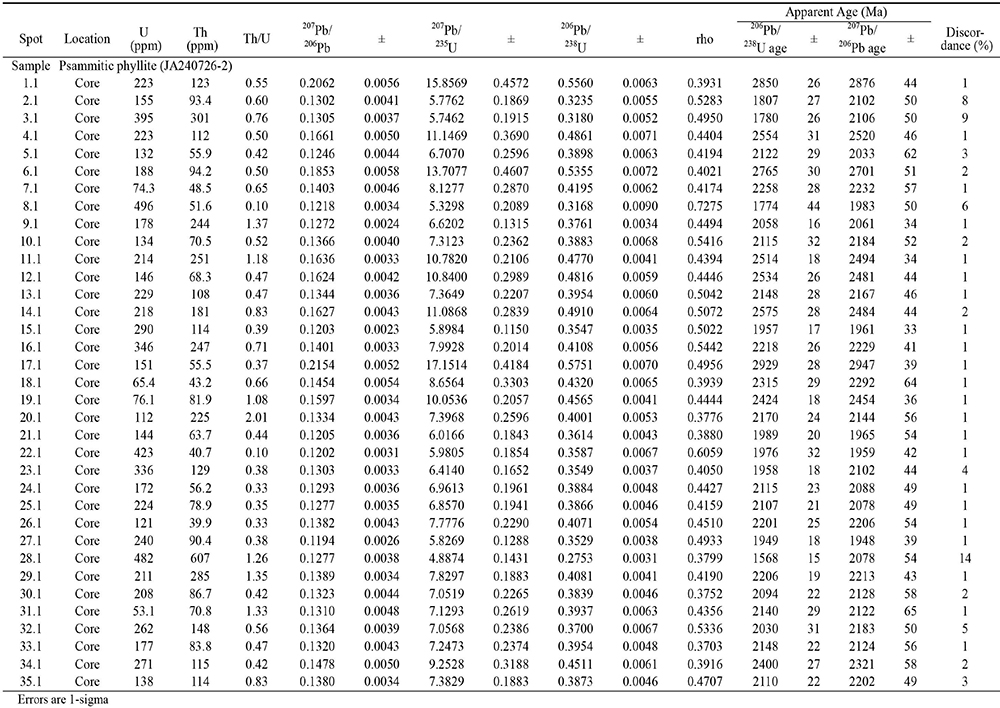
사질 천매암(시료 JA240726-2)에서 분리한 저어콘의 크기는 50-130 ㎛에 해당하며, 아원상-아각형의 외형을 보이고 흔히 가장자리가 마모되어 있다(그림 4d). 음극선발광 영상에서 저어콘 중심부는 담회색 내지 밝은 색을 띠며, 진동누대구조, 호상구조 등 다양한 구조가 나타난다(그림 4d). 저어콘 중심부에서 35개의 분석점을 선택하여 분석을 진행하였다. 불일치도가 낮은 저어콘 중심부(31점)와 불일치도가 높은 저어콘 중심부(4점)의 U 농도는 각각 53-423 ppm 및 155-496 ppm, Th 농도는 각각 40-285 ppm 및 52-607 ppm이며, Th/U 비는 각각 0.10-2.01 및 0.10-1.26의 값을 가진다(표 2).
LA-ICP-MS U - Pb zircon data for psammitic phyllite (JA240726-2), Jinan area.
총 35개 점에 대한 분석결과를 Tera-Wasserburg 일치곡선에 도시하였다(그림 4e). 불일치도가 낮은 저어콘 중심부에서 2947-1948 Ma, 불일치도가 높은 저어콘 중심부에서 2106-1983 Ma의 207Pb/206Pb 겉보기 연대가 측정되었다(표 2). 가장 젊은 단일 저어콘 입자(27.1)의 연대는 1948 ± 39 Ma로 나타났으며, 이를 포함한 불일치도가 낮은 저어콘 중심부에서 얻은 가장 젊은 세 연대의 가중평균 연대는 1956 ± 42 Ma (MSWD = 0.036, n = 3)로 계산되었다(그림 4e). 불일치도가 낮은 저어콘 중심부를 이용하여 확률 밀도 다이어그램을 작도한 결과 2492 Ma (2550-2450 Ma 범위, 16%), 2187 Ma (2200-2100 Ma 범위, 26%) 및 1971 Ma (2050-1950 Ma 범위, 16%)의 연대 피크를 얻었다(그림 4c).
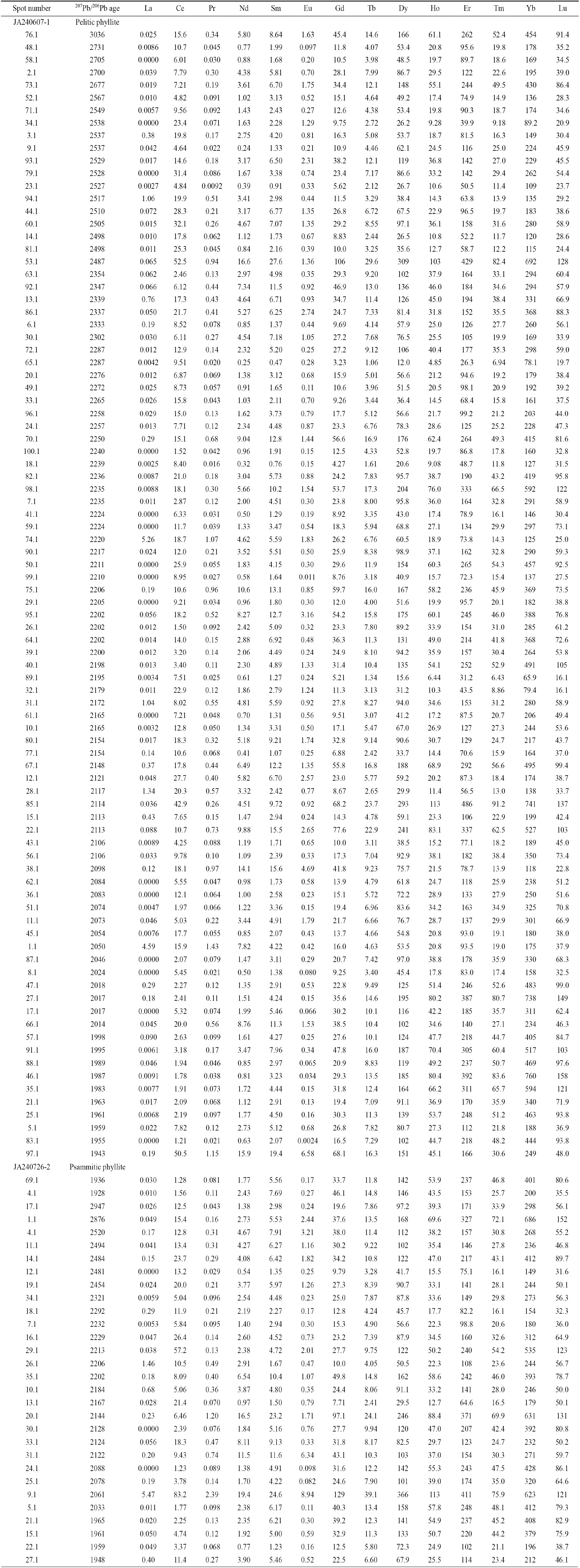
희토류 원소(rare earth elements; REE) 패턴으로 분석된 쇄설성 저어콘의 기원 및 불일치 연령을 갖는 입자들의 화학적 교란 여부를 확인하였다(그림 5; 표 3). C1 콘드라이트로 정규화하였을 때, 모든 연령군에서 일반적으로 음의 Eu 이상치(Eu/Eu* = EuN/√(SmN × GdN); >2.4 Ga: 0.06-0.84, 2.4-2.0 Ga: 0.01-0.87, <2.0 Ga: 0.00-0.55)와 양의 Ce 이상치(Ce/Ce* = CeN/√(LaN × PrN); >2.4 Ga: 6.6-281.7, 2.4-2.0 Ga: 1.5-329.3, <2.0 Ga: 6.40-37.66)가 나타났다(그림 5a-c). 더불어, 경희토류(light rare earth elements, LREE)의 결핍 및 중희토류(heavy rare earth elements, HREE)의 부화(LuN/GdN; >2.4 Ga: 9.7-34.1, 2.4-2.0 Ga: 4.4-59.6, <2.0 Ga: 5.7-45.9)가 관찰되었다(그림 5a-c). 한편 불일치도가 높은 연령의 저어콘 중심부도 크게 다르지 않은 미량원소 패턴을 보이며(Ce/Ce*: 4.0-55.6, Eu/Eu*: 0.03-0.88; LuN/GdN: 3.6-29.0) 저어콘들 중 비교적 약한 HREE 부화를 보이는 1개의 입자(겉보기연령 1983 Ma)를 제외하면 모두 일치 연령 저어콘들과 동일한 화성 기원의 REE 정규화 패턴을 나타냈다(그림 5d).
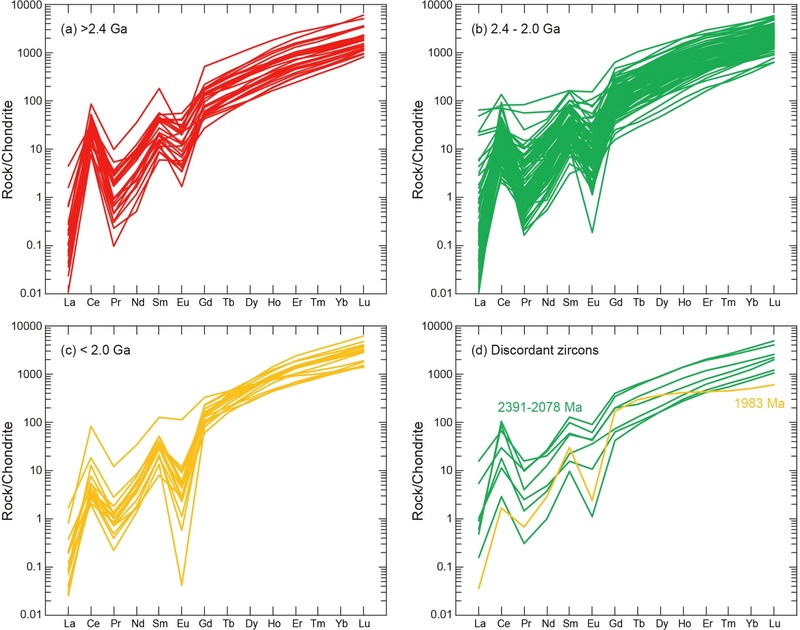
Chondrite-normalized REE patterns of analyzed detrital zircons. Patterns for concordant zircons are categorized by age populations: (a) >2.4 Ga, (b) 2.4-2.0 Ga, and (c) <2.0 Ga. (d) REE patterns of discordant zircons from pelitic phyllite (JA240607-1) and psammitic phyllite (JA240726-2). Normalizing values for Chondrite are from McDonough and Sun (1995).
LA-ICP-MS REE data for zircons from pelitic phyllite (JA240607-1) and psammitic phyllite (JA240726-2), Jinan area.
6. 토 의
진안 지역 이질 천매암(시료 JA240607-1) 및 사질 천매암(시료 JA240726-2)에서 분리된 저어콘의 중심부에는 진동누대구조와 호상구조가 발달하며, Th/U 비 또한 0.1 이상의 높은 값을 보여, 전형적인 화성기원 저어콘의 특성을 보였다(Cox, 2002; Corfu et al., 2003). 저어콘의 미량원소 패턴 또한 연령에 무관하게 음의 Eu 이상치, 양의 Ce 이상치 및 HREE의 부화 특성을 보여 이들이 변질받지 않은 화성기원 저어콘임을 뒷받침한다(그림 5a-c) (Hoskin and Schaltegger, 2003; Rubatto, 2017). 불일치연령을 보이는 저어콘 역시 하나의 입자(1983 Ma)를 제외하고 모두 이러한 화성기원의 미량원소 패턴을 나타내며(그림 5d), 이는 연대 측정의 불일치도를 야기한 납 손실 과정이 변성재결정화 등 격자 내 희토류원소의 이동을 수반하는 심각한 화학적 교란에 기인한 것이 아님을 지시한다. 따라서 저어콘 중심부에서 획득한 가장 젊은 세 연령의 가중평균 연대인 1933 ± 51 Ma (시료 JA240607-1)와 1956 ± 42 Ma (시료 JA240726-2)를 최대퇴적시기로 간주할 수 있을 것으로 판단된다(Dickinson and Gehrels, 2009).
불일치도가 낮은 저어콘 중심부의 207Pb/206Pb 겉보기 연대는 이질 천매암(시료 JA240607-1)에서 1928-3036 Ma, 사질 천매암(시료 JA240726-2)에서 1948-2947 Ma의 연대분포를 보인다. 확률 밀도 다이어그램에서 이질 천매암(시료 JA240607-1)과 사질 천매암(시료 JA240726-2)은 모두 신시생대 말기에서 고원생대 초기(2550-2450 Ma, 14%)의 부수 연대군, 고원생대 시데로스기 말기-라이악스기(2300-2100 Ma, 44%)의 주 연대군, 그리고 고원생대 오로세이라기의 부수 연대군(2050-1950 Ma, 15%)으로 구성되며, 각 연대군 내 강한 연대 피크를 보인다(그림 4c, 4f). 이는 두 시료가 유사한 지각물질의 공급을 받아 형성되었음을 시사하며, 특히 약 2.30-1.80 Ga 구간의 지각물질이 주요 기원지였을 가능성을 지시한다.
이러한 특성은 연구대상 변성퇴적암류와 유사한 자세 또는 산상을 보이는 영암-강진지역 변성사질암, 강진-해남지역 및 영광-장성지역 규암의 연대분포양상과 뚜렷한 차이를 보인다. 전남 일대의 시료들은 약 1.85 Ga의 공통적인 주 피크(1900-1800 Ma, 65%)와 함께 신원생대에서 고생대-전기트라이아스기(약 0.9 Ga 및 511–246 Ma)에 이르는 다수의 젊은 부수 피크를 포함한다(그림 6a) (Ha, 2014; Kim et al., 2015). 더불어 영광-장성 규암은 약 379 Ma (데본기), 강진-해남 규암은 약 265 Ma (페름기), 영암-강진 변성사질암은 약 246 Ma (전기 트라이아스기)의 가장 젊은 쇄설성 저어콘 연령을 바탕으로 고생대 이후 퇴적되었음이 확인되었다(Ha, 2014; Kim et al., 2015). 이러한 연대분포는 옥천대에 분포하는 고생대-전기트라이아스기 퇴적암들에서 흔히 나타난다. 예로써 상부 고생대 태백산분지 퇴적암은 대체로 약 2.5 Ga 및 2.0–1.8 Ga 부근에서 뚜렷한 주 연대 피크를 가지며, 약 510-480 Ma의 퇴적동시성 또는 그와 가까운 시기의 화성활동 연대를 포함하는 경우가 흔하고, 일부 층에서는 중원생대에서 신원생대에 걸친 다양한 연령이 분포함이 알려져 있다(e.g., Kim et al., 2017; Cho, M. et al., 2021; Jang et al., 2024). 한편 옥천대를 따라 분포하는 상부 고생대의 평안누층군 역시 약 2.0–1.8 Ga에 주요 피크가 관찰되고 약 540–240 Ma에 걸친 고생대 및 중생대 트라이아스기의 부수 연대 피크가 흔하게 나타난다(Kim et al., 2017, 2018). 종합해 볼 때, 태백산분지 및 옥천대를 따라 분포하는 고생대 퇴적암들은 지질연대학적 기원지 특성을 서로 상당 부분 공유하고 있으나, 본 연구지역의 변성퇴적암과 이들과의 기원지적 친화성은 확인하기 어렵다.
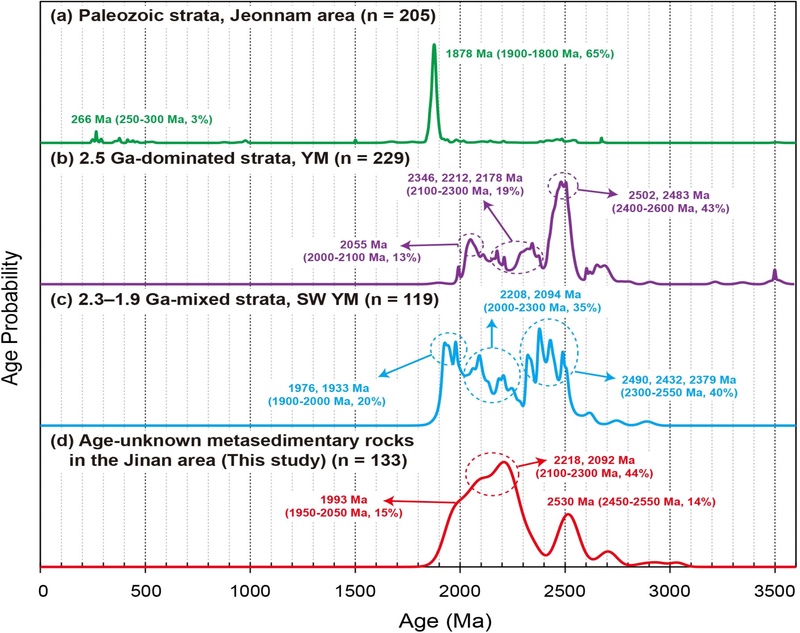
Relative age probability plots for detrital zircon 207Pb/206Pb ages of (a) Paleozoic metasedimentary rocks in the Jeonnam area (Ha, 2014; Kim et al., 2015); (b) 2.5 Ga-dominated age group of the Yeongnam Massif (YM), representing Paleoproterozoic metasedimentary units in the eastern YM and the Gwangju-Jangseong area (Kim, 2010; Lee et al., 2011; Kim et al., 2012, 2014); (c) 2.3–1.9 Ga mixed age group, representing Paleoproterozoic metasedimentary units in the southwestern YM (Lee, B.C. et al., 2014, 2022; Oh et al., 2016; Lee, Y. et al., 2018); (d) Age-unknown metasedimentary rocks in the Jinan area (this study).
현재까지 태백산분지 이외 지역의 고생대 퇴적암에 대한 지질연대학적 자료는 현재 충분히 확보되었다고 보기 어려우며, 최근 한반도 육괴 내에서도 고생대 퇴적작용의 기록이 보고되는 등(e.g., Kim and Yi, 2015; Kim, 2019; Kwak et al., 2025) 이들의 지리적 분포에 근거한 층서 대비는 불확실성을 내포한다. 연구지역의 변성퇴적암은 인근 암층서 단위와의 관계가 명확히 규명되지 않은 상태이므로 쇄설성 저어콘 연대 자료만으로 퇴적 시기를 추정하거나 그 층서적 의의를 정확히 해석하기는 어렵다. 다만 천매암-편암상을 보이는 외견상의 유사성과 지층의 자세 등으로 층서적으로 연관되어 있을 것으로 추정되어 온 전남 지역의 고생대층과 지질연대학적 특성을 공유하지는 않는 것으로 판단된다(Kee et al., 2019). 이와 같은 차이는 시공간적 퇴적물 기원지의 차이를 함께 반영하는 바, 최근 고생대층으로 함께 분대된 옥천대 남서부 시대미상 변성퇴적암류와 연구지역의 변성퇴적암과의 층서적 상관관계에 대한 면밀한 검토의 필요성을 시사한다.
인접 고생대 지층들과의 기원지적 연관성이 배제됨에 따라, 획득한 쇄설성 저어콘 연대 스펙트럼은 연구 지역 변성퇴적암의 잠재적 배후지로서 영남육괴 내 선캄브리아시대 기반암류와의 기원지적 친화성을 평가하는 지시자로 활용될 수 있다. 영남육괴의 고원생대 변성퇴적암류는 쇄설성 저어콘 연대 특성에 따라 크게 두 그룹으로 대별된다. 먼저 영남육괴 동부의 평해층, 원남층 일부, 호산리층, 기성층 및 율리층(Kim, 2010; Lee et al., 2011; Kim et al., 2012, 2014) 등과 영남육괴 서부 광주-장성지역(Lee et al., 2022)의 변성퇴적암류는 약 2.18-1.98 Ga 범위의 최대퇴적연령을 가지고, 신시생대 말-고원생대 초기의 약 2.5 Ga 연대군이 지배적으로 우세하며, 고원생대 라이악스기에 해당하는 2.1-2.0 Ga 연대군과 2.3-2.1 Ga 연대군은 비교적 부수적으로 나타난다(그림 6b). 두 번째로, 영남육괴 남서부(무주-산청-화순-보성 등)에서 보고된 변성퇴적암류에서는 그보다 젊은 약 1.98–1.93 Ga의 최대퇴적연령과 2.0–1.9 Ga 및 2.3–2.0 Ga 구간의 연대군이 높은 비율로 혼재하며, 2.5 Ga 피크의 연령군은 비교적 미약하게 나타난다(그림 6c) (Oh et al., 2016; Lee, B.C. et al., 2017, 2022; Lee, Y. et al., 2018). 영남육괴 동부 및 광주-장성 지역의, ~2.5 Ga 연대가 우세한 변성퇴적암류의 퇴적시기가 1.98 Ga 이전으로 제안된 것을 고려할 때(Lee et al., 2011; Kim et al., 2012, 2014), 이들 영남육괴 남서부의 변성퇴적암은 비교적 후기에 퇴적되었을 것으로 간주할 수 있다(Lee et al., 2022).
연구 대상인 진안의 변성퇴적암은 약 1933 Ma의 최대퇴적연령을 보이며, 오로세이라기의 연령군이 두드러지는 특성은 영남육괴 남서부의 ‘젊은’ 고원생대 퇴적단위와 유사하다. 또한 이러한 특성은 일본 오키-도고섬에서도 보고되는 등, 광역적인 기반암의 분포 가능성을 지시한다(Cho, D.-L. et al., 2021). 그러나 세부적인 기원지 특성에서는 이들과 차이를 보이는데, 연구지역 변성퇴적암에서는 2.5 Ga 연대군(14%)이 부수적으로 나타나는 대신 고원생대 라이악스기(2.3–2.1 Ga) 연대군이 44%로 가장 우세하고, 오로세이라기(2.05–1.95 Ga) 연대군(15%)이 뒤따르는 뚜렷한 특징을 나타낸다(그림 6d). 따라서 퇴적분지로 쇄설물을 공급한 배후지의 구성 비율에 있어서는 다소 독립적이거나 국지적인 기원지 통제를 받았을 가능성이 있다. 다만, 본 연구의 제한된 시료 수와 국지성, 층서적 불확실성 등을 고려할 때 이를 영남육괴 서부의 기반암 특성으로 확장하여 해석하기는 어렵다. 향후 영남육괴 기반암 층서 체계 및 최근 보고되고 있는 고생대 퇴적암류의 분포에 대한 광역적인 재고찰을 바탕으로(e.g., Kim and Yi, 2015; Kim, 2019; Kwak et al., 2025), 진안 지역 변성퇴적암의 지체구조적 위치와 진화사 또한 새롭게 재해석될 여지를 남긴다.
7. 결 언
본 연구는 진안 지역에 분포하는 변성퇴적암류를 대상으로 쇄설성 저어콘 U-Pb 연대측정을 수행하여 퇴적 시기의 상한(최대퇴적연령)과 기원지 특성을 규명하고, 인접 지체구조 단위들과의 층서적 상관관계를 검토하였다. 변성퇴적암의 쇄설성 저어콘으로부터 산출된 최대퇴적연령은 약 1956-1933 Ma이며, 고원생대 라이악스기에 가장 강한 피크를 보인다. 이는 외견상 암상 및 산상이 유사하여 층서적 연관성이 추정되었던 전남 일대의 변성퇴적암류나 옥천대에 분포하는 고생대 퇴적암류가 공통적으로 보이는 최대퇴적연령 및 연대 스펙트럼과도 뚜렷한 차이를 나타내므로, 이들과의 층서적 연관성 또는 기원지적 친화성은 확인되지 않았다. 본 시료의 연대 분포는 영남육괴의 선캄브리아시대 기반암류 중, 상대적으로 젊은 최대퇴적연령(ca. 1.93 Ga)을 갖는 영남육괴 남서부(무주, 산청, 화순-보성 등)의 고원생대 퇴적단위들과 대조해 볼 수 있으나, 세부 기원지 구성 비율에 있어서 차이를 보였다. 본 연구결과는 해당 변성퇴적암이 인접한 고생대 퇴적암류나 영남육괴의 기존 고원생대 기반암 어느 쪽과도 기원지적 특성을 온전히 공유하지 않음을 보여주며, 진안 지역 및 인근의 시대미상 변성퇴적암의 정확한 지체구조적 위치와 층서적 의미를 규명하기 위해서는 향후 영남육괴 기반암 층서 체계 및 고생대 퇴적암류의 분포에 대한 광역적인 재고찰이 후속되어야 한다.
Acknowledgments
이 연구는 진안군 지질명소 가치 발굴 용역과제에 의해 지원받았습니다. 논문을 검토하고 개선 방향을 제시해 주신 지질학회지 편집위원과 두 분의 심사위원께 감사드립니다.
References
- Ahn, K.-S., Kim, Y.J. and Shin, I.H., 1997, Metamorphism of the Meta-Sedimentary Rocks in the Osu-Jinan Area, Cheonrapuk-Do, Korea. Economic and Environmental Geology, 30, 163-174 (in Korean with English abstract).
- Chang, K.H. and Kim, K.T., 1967, Geological Map and Explanatory Text of Gangjin sheet (scale 1:50,000). Geological Survey of Korea, 15 p.
- Cheong, W., Han, G., Kim, T., Aum, H.W. and Kim, Y., 2020, SHRIMP Zircon U-Pb Ages of Basement Rocks in the Danyang National Geopark. Korean Journal of Mineralogy and Petrology, 33, 339-347.
- Cho, D.-L., 2004, Mineral separation and sample preparation methods efficient for subgrain zircon analyses. Journal of the Petrological Society of Korea, 13, 126-132 (in Korean with English abstract).
-
Cho, D.-L., 2014, SHRIMP U-Pb zircon geochronology of the Guryong Group in Odesan area, east Gyeonggi Massif, Korea: A new identification of Late Paleozoic strata and its tectonic implication. Journal of the Petrological Society of Korea, 23, 197-208 (in Korean with English abstract).
[https://doi.org/10.7854/JPSK.2014.23.3.197]

-
Cho, D.-L., Lee, B.C. and Oh, C.W., 2020, Petrogenesis of paleoproterozoic (2.02–1.96 Ga) metagranitoids in the southwestern Yeongnam Massif, Korean Peninsula and their significance for the tectonic history of northeast Asia: Insights from zircon U–Pb–Hf isotope and whole-rock geochemical compositions. Precambrian Research, 340, 105631.
[https://doi.org/10.1016/j.precamres.2020.105631]
-
Cho, D.-L., Takahashi, Y., Kim, S.W., Yi, K. and Lee, B. C., 2021, Zircon U-Pb-Hf and geochemical analyses of paragneiss and granitic gneiss from Oki-Dogo Island, Southwest Japan and its tectonic implications. Lithos, 396, 106217.
[https://doi.org/10.1016/j.lithos.2021.106217]
-
Cho, M., Cheong, W., Ernst, W.G., Kim, Y. and Yi, K., 2021, U-Pb detrital zircon ages of Cambrian–Ordovician sandstones from the Taebaeksan Basin, Korea: Provenance variability in platform shelf sequences and paleogeographic implications. GSA Bulletin, 133, 488-504.
[https://doi.org/10.1130/B35521.1]
- Cho, M., Kim, T., Yang, S.Y. and Yi, K., 2017, Paleoproterozoic to Triassic crustal evolution of the Gyeonggi Massif, Korea: tectonic correlation with the North China craton. In: Law, R.D., Thigpen, J.R., Merschat, A.J. and Stowell, H.H. (Eds.), Linkages and Feedbacks in Orogenic Systems. Geological Society of America Memoir, 213, 165-197.
-
Cho, M., Na, J. and Yi, K., 2010, SHRIMP U-Pb ages of detrital zircons in metasandstones of the Taean Formation, western Gyeonggi massif, Korea: Tectonic implications. Geosciences Journal, 14, 99-109.
[https://doi.org/10.1007/s12303-010-0011-7]
-
Choi, S.J., Kim, D.-Y., Cho, D.-L. and Kim, Y.-B., 2015, Detrital zircon U-Pb Ages of the Metapelite on the Southwestern Part of the Ogcheon Belt and Its Stratigraphical Implication. Journal of the Petrological Society of Korea, 24, 1-9 (in Korean with English abstract).
[https://doi.org/10.7854/JPSK.2015.24.1.55]
- Choi, Y.K. and Yoon, H.D., 1968, Geological Map and Explanatory Text of Jangheung sheet (scale 1:50,000). Geological Survey of Korea, 18 p.
-
Corfu, F., Hanchar, J.M., Hoskin, P.W.O. and Kinny, P., 2003, Atlas of Zircon Textures. Reviews in Mineralogy and Geochemistry, 53, 469-500.
[https://doi.org/10.2113/0530469]
- Cox, R.A., 2002, Morphological, chemical and geochronological techniques for characterizing detrital zircons. In: Lentz, D.R. (ed.), Geochemistry of Sediments and Sedimentary Rocks: Evolutionary Considerations to Mineral Deposit-Forming Environments. Geological Association of Canada GeoText Series 4, Geological Association of Canada, Newfoundland, 105-120.
-
Dickinson, W.R. and Gehrels, G.E., 2009, Use of U–Pb ages of detrital zircons to infer maximum depositional ages of strata: a test against a Colorado Plateau Mesozoic database. Earth and Planetary Science Letters, 288, 115-125.
[https://doi.org/10.1016/j.epsl.2009.09.013]
- Ha, Y.J., 2014, SHRIMP U-Pb age distribution of the zircons from the Precambrian basement and overlying meta-sedimentary rocks distributed in Homan Shear Zone and their geologic implications. M.S. thesis, Pukyong National University, Busan, 77 p.
-
Hoskin, P.W. and Schaltegger, U., 2003, The composition of zircon and igneous and metamorphic petrogenesis. Reviews in Mineralogy and Geochemistry, 53, 27-62.
[https://doi.org/10.2113/0530027]
-
Hu, Z., Zhang, W., Liu, Y., Gao, S., Li, M., Zong, K., Che, H. and Hu, S., 2015, “Wave” signal-smoothing and mercury-removing device for laser ablation quadrupole and multiple collector ICPMS analysis: application to lead isotope analysis. Analytical Chemistry, 87, 1152-1157.
[https://doi.org/10.1021/ac503749k]
-
Hu, Z., Li, X. H., Luo, T., Zhang, W., Crowley, J., Li, Q., Ling, X., Yang, C., Li, Y., Feng, L., Xia, X., Zhang, S.B., Wang, Z., Guo, J., Xu, L., Lin, J., Liu, X., Bao, Z., Liu, Y., Zong, K., Chen, W. and Hu, S., 2021, Tanz zircon megacrysts: A new zircon reference material for the microbeam determination of U–Pb ages and Zr–O isotopes. Journal of Analytical Atomic Spectrometry, 36, 2715-2734.
[https://doi.org/10.1039/D1JA00311A]
-
Jackson, S.E., Pearson, N.J., Griffin, W.L. and Belousova, E.A., 2004, The application of laser ablation-inductively coupled plasma-mass spectrometry to in situ U–Pb zircon geochronology. Chemical Geology, 211, 47-69.
[https://doi.org/10.1016/j.chemgeo.2004.06.017]
-
Jang, Y., Kim, S.W., Samuel, V.O., Kwon, S., Park, S.-I., Santosh, M. and Yi, K., 2024, Paleozoic tectonic evolution of the proto-Korean Peninsula along the East Asian continental margin from detrital zircon U-Pb geochronology and Hf isotope geochemistry. Geoscience Frontiers, 15, 101700.
[https://doi.org/10.1016/j.gsf.2023.101700]
-
Jeong, J.W., Nakano, N., Adachi, T. and Kawaguchi, K., 2025, Detrital zircon chronology of the Guryong Group, the eastern part of the Gyeonggi Massif, Korea: Implication for the Late Paleozoic pre-collisional evolution in the Korean Peninsula. Lithos, 496, 107972.
[https://doi.org/10.1016/j.lithos.2025.107972]
-
Kang, M.S., Oh, C.W., Lee, B.C. and Lee, B.Y., 2023, The tectonic evolution from the Archean to Triassic in the north central Gyeonggi Massif (Hongcheon-Chuncheon areas) in the Korean Peninsula and its application to the tectonic evolution of the North China Craton. Earth-Science Reviews, 247, 104605.
[https://doi.org/10.1016/j.earscirev.2023.104605]
- Kee, W.-S., Kim, S.W., Hong, P.S., Lee, B.C., Cho, D.-L., Byun, U.H., Ko, K., Kwon, C.W., Kim, H.C., Jang, Y., Song, K.-Y., Koh, H.J. and Lee, H.J., 2019, 1:1,000,000 Geological Map of Korea. Korea Institute of Geoscience and Mineral Resources.
- Kee, W.-S., Lim, S.B., Kim, H., Kim, B.C., Hwang, S.K., Song, K.-Y. and Kihm, Y.H., 2008, Geological Report of the Yeoncheon Sheet (1:50,000). Korea Institute of Geoscience and Mineral Resources, Daejeon, 83 p (in Korean with English abstracts).
-
Kim, C.B., 1990, Petrochemical and geochronological study on the igneous rocks of the Jangsu area. Journal of the Geological Society of Korea, 26, 553-563 (in Korean with English abstracts).
[https://doi.org/10.14770/jgsk.1990.26.6.553]
-
Kim, D.Y., Choi, S.J. and Yi, K., 2015, SHRIMP U-Pb Zircon Ages of the Metasandstone in the Yeongam-Gangjin Area. Economic and Environmental Geology, 48, 287-299 (in Korean with English abstract).
[https://doi.org/10.9719/EEG.2015.48.4.287]
- Kim, H.S., 2019, Reassessment of the Pyeongan Supergroup: Metamorphism and Deformation of the Songrim Orogeny. Economic and Environmental Geology, 52, 367-379 (in Korean with English abstract).
-
Kim, H.S. and Yi, K., 2015, Multiple metamorphic episodes recorded in the Paleozoic Pyeongan Supergroup on the northeastern margin of the Yeongnam massif, South Korea: Implications for the Songrim (Indosinian) orogeny. Journal of Asian Earth Sciences, 113, 883-896.
[https://doi.org/10.1016/j.jseaes.2015.09.012]
- Kim, J., Cho, M. and Kim, H.S., 1994, Metamorphism of the Hongjesa granite and the adjacent metasedimentary rocks (Magmatism and metamorphism of the Proterozoic in the northeastern part of Korea). The Journal of the Petrological Society of Korea, 3, 94-108.
- Kim, K.B., Choi, W., Hwang, J.H. and Kim, J.H., 1984, Geological Report of the Osu Sheet (1:50,000). Korea Institute of Energy and Resources (in Korean with English abstract).
-
Kim, M.G. and Lee, Y.I., 2017, The stratigraphy and correlation of the upper Paleozoic Pyeongan Supergroup of southern Korean Peninsula-A review. Journal of the Geological Society of Korea, 53, 321-338 (in Korean with English abstract).
[https://doi.org/10.14770/jgsk.2017.53.2.321]
-
Kim, M.G. and Lee, Y.I., 2018, The Pyeongan Supergroup (upper Paleozoic–Lower Triassic) in the Okcheon Belt, Korea: A review of stratigraphy and detrital zircon provenance and its implications for the tectonic setting of the eastern Sino-Korean Block. Earth-Science Reviews, 185, 1170-1186.
[https://doi.org/10.1016/j.earscirev.2018.09.006]
-
Kim, M.J., Park, J.W., Lee, T.H., Song, Y.-S. and Park, K.-H., 2016, LA-MC-ICPMS U-Pb ages of the detrital zircons from the Baengnyeong Group: Implications of the dominance of the Mesoproterozoic zircons. Economic and Environmental Geology, 49, 433-444 (in Korean with English abstract).
[https://doi.org/10.9719/EEG.2016.49.6.433]
-
Kim, N., Cheong, C.S., Park, K.-H., Kim, J. and Song, Y.-S., 2012, Crustal evolution of northeastern Yeongnam Massif, Korea, revealed by SHRIMP U–Pb zircon geochronology and geochemistry. Gondwana Research, 21, 865-875.
[https://doi.org/10.1016/j.gr.2011.10.003]
-
Kim, N., Cheong, C.S., Yi, K., Song, Y.-S., Park, K.-H., Geng, J.Z. and Li, H.K., 2014, Zircon U-Pb geochronological and Hf isotopic constraints on the Precambrian crustal evolution of the north-eastern Yeongnam Massif, Korea. Precambrian Research, 242, 1-21.
[https://doi.org/10.1016/j.precamres.2013.12.008]
- Kim, N., Song, Y.-S., Park, K.-H. and Lee, H.S., 2009, SHRIMP U-Pb Zircon Ages of the Granite Gneisses from the Pyeonghae Area of the northeastern Yeongnam Massif (Sobaeksan Massif). The Journal of the Petrological Society of Korea, 18, 31-47 (in Korean with English abstract).
- Kim, N.H., 2010, Petrology, geochemisty and geochronology study of the Precambrian basement rocks in the northeastern Yeongnam Massif, South Korea: their tectonic implications. Ph.D, thesis, Pukyong National University, Busan, 237 p.
-
Kim, S.W., Cho, D.-L., Lee, S.B., Kwon, S., Park, S.I., Santosh, M. and Kee, W.-S., 2018, Mesoproterozoic magmatic suites from the central-western Korean Peninsula: Imprints of Columbia disruption in East Asia. Precambrian Research, 306, 155-173.
[https://doi.org/10.1016/j.precamres.2017.12.038]
-
Kim, S.W., Park, S.-I., Jang, Y., Kwon, S., Kim, S.J. and Santosh, M., 2017, Tracking Paleozoic evolution of the South Korean Peninsula from detrital zircon records: Implications for the tectonic history of East Asia. Gondwana Research, 50, 195-215.
[https://doi.org/10.1016/j.gr.2017.05.009]
- Kim, Y.B., Chun, H.Y., Lim, S.-B., Choi, H.I., Lee, C.B. and Kim, B.C., 2001, Plant Fossils and Stratigraphy of Metasedimentary Rocks of Southeastern Part of Haenam. Journal of the Paleontological Society of Korea, 17, 35-52 (in Korean with English abstract).
- Kinosaki, Y., 1929, Haenam sheet (1:50,000). Geological Survey of Chosun.
-
Kwak, Y., Lee, S.-E., Choi, T. and Park, S.-I., 2025, Late Paleozoic detrital zircon ages from metasedimentary rocks of the Wonnam Formation in northeastern Yeongnam Massif. Journal of the Geological Society of Korea, 61, 423-435 (in Korean with English abstract).
[https://doi.org/10.14770/jgsk.2025.019]
-
Lee, B.C., Kim, M.G. and Cho, D.-L., 2022, Zircon U-Pb ages from Paleoproterozoic migmatites in the western part of Yeongnam Massif: implication for the depositional ages of sedimentary protoliths. Journal of the Geological Society of Korea, 58, 51-66 (in Korean with English abstract).
[https://doi.org/10.14770/jgsk.2022.58.1.51]
-
Lee, B.C., Kim, S.W., Lee, B.Y., Oh, C.W., Cho, D.-L. and Kee, W.-S., 2024, Middle Paleozoic metamorphic and sedimentary events in the central Korean Peninsula and their geological implications. Geoscience Frontiers, 15, 101840.
[https://doi.org/10.1016/j.gsf.2024.101840]
-
Lee, B.C., Oh, C.W., Cho, D.-L. and Yi, K., 2019, Paleoproterozoic (2.0–1.97 Ga) subduction-related magmatism on the north–central margin of the Yeongnam Massif, Korean Peninsula and its tectonic implications for reconstruction of the Columbia supercontinent. Gondwana Research, 72, 34-53.
[https://doi.org/10.1016/j.gr.2019.02.002]
-
Lee, B.C., Oh, C.W., Yengkhom, K.S. and Yi, K., 2014, Paleoproterozoic magmatic and metamorphic events in the Hongcheon area, southern margin of the Northern Gyeonggi Massif in the Korean Peninsula and their links to the Paleoproterozoic orogeny in the North China Craton. Precambrian Research, 248, 17-38.
[https://doi.org/10.1016/j.precamres.2014.04.003]
-
Lee, B.C., Park, J.H., Oh, C.W. and Yi, K., 2017, Metamorphic and magmatic evolution of the Paleoproterozoic gneisses in the Sancheong area, Yeongnam Massif, South Korea and their implications to the tectonics in the Northeast Asia. Precambrian Research, 298, 439-461.
[https://doi.org/10.1016/j.precamres.2017.06.001]
-
Lee, B.Y., Oh, C.W. and Lee, B.C., 2023, The Neoproterozoic continental extension tectonic event in the Chuncheon area of the northern Gyeonggi massif in the Korean Peninsula and its implication for the tectonic correlation between the Korean Peninsula and China. Lithos, 456, 107297.
[https://doi.org/10.1016/j.lithos.2023.107297]
-
Lee S.H., Oh, C.W. and Park, J.W., 2020, The age and geochemistry of the mid-cretaceous volcanic rocks in the Jinan Basin: Implications for the mid-cretaceous tectonic environments of the Korean Peninsula and Northeast Asia. Lithos, 358, 105383.
[https://doi.org/10.1016/j.lithos.2020.105383]
-
Lee, S.R. and Cho, K.O., 2012, Precambrian crustal evolution of the Korean Peninsula. The Journal of the Petrological Society of Korea, 21, 89-112 (in Korean with English abstract).
[https://doi.org/10.7854/JPSK.2012.21.2.089]
-
Lee, S.R., Cho, M., Yi, K. and Stern, R.A., 2000, Early Proterozoic granulites in central Korea: tectonic correlation with Chinese cratons. The Journal of Geology, 108, 729-738.
[https://doi.org/10.1086/317951]
-
Lee, Y. and Cho, M., 2020, Fluid-present partial melting of Paleoproterozoic Okbang amphibolite in the Yeongnam Massif, Korea. Lithosphere, 2020, 8854615.
[https://doi.org/10.2113/2020/8854615]
-
Lee, Y., Cho, M., Cheong, W. and Yi, K., 2018, Prolonged high-temperature, low-pressure metamorphism associated with∼1.86 Ga Sancheong–Hadong anorthosite in the Yeongnam Massif, Korea: Paleoproterozoic hot orogenesis in the North China Craton. Precambrian Research, 307, 175-200.
[https://doi.org/10.1016/j.precamres.2018.01.018]
-
Lee, Y.I., Choi, T. and Orihashi, Y., 2011, LA-ICP-MS zircon U-Pb ages of the Precambrian Yuli Group. Journal of the Geological Society of Korea, 47, 81-87 (in Korean with English abstract).
[https://doi.org/10.14770/jgsk.2011.47.1.81]
- Lee, Y.Y., 1992, Stratigraphy, depositional environments and evolution of the cretaceous Chinan basin. Ph.D thesis, Seoul National University, Seoul, 287 p.
-
Lim S.-B., Chun, H.Y., Kim, Y.B., Kim, B.C. and Cho, D.-L., 2005, Geologic ages, stratigraphy and geological structures of the metasedimentary strata in Bibong∼Yeonmu area, NW Okcheon belt, Korea. Journal of the Geological Society of Korea, 41, 335-368 (in Korean with English abstract).
[https://doi.org/10.14770/jgsk.2005.41.3.335]
-
Lim, S.-B., Chun, H.Y., Kim, Y.B., Kim B.C. and Song, K.-Y., 2006, Stratigraphy and geological ages of the metasedimentary strata in Jinsan∼Boksu area, Chungcheongnam-do, NW Okcheon belt. Journal of the Geological Society of Korea, 42, 149-174 (in Korean with English abstract).
[https://doi.org/10.14770/jgsk.2006.42.2.149]
-
Lim, S.-B., Chun, H.Y., Kim, Y.B., Lee, S.R. and Kee, W.-S., 2007, Geological ages and stratigraphy of the metasedimentary strata in Hoenam∼Miwon area, NW Okcheon belt. Journal of the Geological Society of Korea, 43, 125-150 (in Korean with English abstract).
[https://doi.org/10.14770/jgsk.2007.43.2.125]
- Ludwig, K.R., 2012, User's manual for Isoplot 3.75: A geochronological toolkit for Microsoft Excel. Berkeley Geochronology Center Special Publication, 5, 75.
-
McDonough, W.F. and Sun, S.S., 1995, The composition of the Earth. Chemical Geology, 120, 223-253.
[https://doi.org/10.1016/0009-2541(94)00140-4]
- Oh, C.W., Jeon, E.Y., Park, B.Y., Ahn, K.-S. and Lee, J.H., 2000, Metamorphic evolution of granitic and porphyroblastic gneisses in the Seungju-Suncheon area, the southwestern part of the Sobacksan Massif. Journal of the Petrological Society of Korea, 9, 121-141.
-
Oh, C.W., Lee, B.C., Lee, S.H., Kim, M.D., Lee, B.Y. and Choi, S.H., 2016, The tectonic evolution and important geoheritages in the Jinan and Muju area, Jeollabuk-do. Journal of the Geological Society of Korea, 52, 709-738 (in Korean with English abstract).
[https://doi.org/10.14770/jgsk.2016.52.5.709]
-
Oh, C.W., Lee, B.C., Yi, S.B. and Ryu, H.I., 2019, Correlation of Paleoproterozoic igneous and metamorphic events of the Korean Peninsula and China; Its implication to the tectonics of Northeast Asia. Precambrian Research, 326, 344-362.
[https://doi.org/10.1016/j.precamres.2018.03.010]
- Park, K.-H., Song, Y.-S., Park, M.E., Lee, S.G. and Ryu, H.J., 2000, Petrological, Geochemical and Geochronological Studies of Precambrian Basement in Northeast Asia Region: 1. Age of the Metamorphism of Jirisan Area. Journal of the Petrological Society of Korea, 10, 95-105 (in Korean with English abstract).
-
Rubatto, D., 2017, Zircon: The metamorphic mineral. Reviews in Mineralogy and Geochemistry, 83, 261-295.
[https://doi.org/10.2138/rmg.2017.83.9]
- Shimamura, S., 1924, Geological Atlas of Chosen (Korea: 1:50,000). Chinan and Cheonju sheets. Geological Survey of Korea, No. 5
-
Sláma, J., Košler, J., Condon, D.J., Crowley, J.L., Gerdes, A., Hanchar, J.M., Horstwood, M.S.A., Morris, G.A., Nasdala, L., Norberg, N., Schaltegger, U., Schoene, B., Tubrett, M.N. and Whitehouse, M.J., 2008, Plešovice zircon-a new natural reference material for U–Pb and Hf isotopic microanalysis. Chemical Geology, 249, 1-35.
[https://doi.org/10.1016/j.chemgeo.2007.11.005]
-
Yi, K., Cheong, C.S., Kim, J., Kim, N., Jeong, Y.J. and Cho, M., 2012, Late Paleozoic to Early Mesozoic arc-related magmatism in southeastern Korea: SHRIMP zircon geochronology and geochemistry. Lithos, 153, 129-141.
[https://doi.org/10.1016/j.lithos.2012.02.007]