
계룡산단층의 실체와 구조·지형학적 특성

초록
이 단보는 세종 및 공주 일대에 북북동-남남서에서 남-북 방향으로 발달하는 계룡산단층의 실체를 보고하고, 구조 및 지형학적 특성을 제시한다. 계룡산단층은 기존 1:5만 도폭 연구와 일부 보고서에서 지형 지시자 및 암상 이격에 근거해 존재가 추정되어 왔으나, 단층대를 직접 제시하는 야외 증거는 제한적이다. 이번 연구에서 확인된 계룡산단층은 북쪽의 세종시 전의면에서 남쪽의 공주시 의당면 및 금흥동 일대까지 최소 20 km 이상 연장되며, 공주 시내를 관통하여 남쪽으로 추가 연장될 가능성도 있다. 단층의 전반적 주향은 북부에서는 N10~20°E, 남쪽으로 갈수록 남-북 방향으로 변화하며, 야외에서 확인되는 단층의 경사는 거의 수직이다. 이 단층은 선캄브리아시대 변성암과 백악기 퇴적암·화산암류를 약 1~1.5 km 변위로 우향 절단한다. 퇴적암을 모암으로 하는 금흥지점의 단층핵은 약 2.5 m 폭으로 주로 자색 엽리상 단층비지와 일부 단층각력으로 구성된다. 반면 변성암을 모암으로 하는 덕학지점과 양곡지점의 단층핵은 수 m에서 수십 m 폭으로 발달하며, 주로 담청색 단층각력이 우세하나 부분적으로 망상의 단층 비지대 및 폭 2 cm 이내의 좁은 단층비지띠(주미끌림대, principal slip zone)가 확인된다. 각 지점에서 관찰되는 다양한 단층암의 산상(단층각력대, 수십 cm 폭의 엽리상 및 망상 단층비지대, 수 cm 폭의 주미끌림대), 여러 운동감각 지시자, 그리고 최대 수십 m폭에 이르는 단층핵의 규모는 이 단층이 변화하는 지구조 환경(응력장) 하에서 다양한 거동의 단층운동이 반복적으로 누적되며 비교적 성숙한(mature) 단층대로 진화해 왔음을 지시한다. 한편, 단층대를 따라 발달하는 좁은 폭의 단층곡(fault valley), 선형적인 분포의 단층안부(fault saddle) 등의 지형 요소는 이 단층의 일부 구간이 최근 지질시대 동안 재활성되었을 가능성을 제기한다. 다만, 이러한 특징들은 기반암 단층대가 구조적 약대로 작용하며 차별침식을 받아 형성된 지형일 가능성도 있으므로, 우리나라 지진지질학적 환경에서는 해당 지형 요소만으로 제4기 단층운동을 직접적으로 입증하기에는 한계가 있다. 그럼에도 불구하고, 양곡지점에서 관찰되는 연질퇴적변형구조는 계룡산단층대 일대에서 최근 지질시대 동안 중규모 이상의 강한 지진동이 발생하였을 가능성을 지지한다.
Abstract
This short note presents the direct field evidence of the Gyeryongsan Fault, a N-S to NNE-SSW-striking fault developed in the Sejong-Gongju area, central Korea, and summarizes its key structural and geomorphic characteristics. The fault has previously been inferred from 1:50,000 geological maps and several reports based on geomorphic indicators and discontinuities in lithological distribution, however, direct field evidence of the fault zone remains limited. The fault extends for at least ~20 km from Jeonui-myeon, Sejong City, in the north to Uidang-myeon and Geumheung-dong, Gongju City, in the south, and may further extend southward across the Gongju urban area. Its overall strike changes progressively from N10~20°E in the northern part to nearly N-S toward the south. The fault surface observed in the field is steeply dipping to nearly vertical. The fault dextrally offsets Precambrian metamorphic rocks and Cretaceous sedimentary and volcanic rocks by approximately 1~1.5 km. The width and lithological features of the fault core vary among sites. At the Geumheung site, the sedimentary rock-derived fault core is ~2.5 m wide and consists mainly of purple, foliated fault gouge with minor fault breccia. In contrast, at the Deokhak and Yanggok sites, hosted by Precambrian metamorphic rocks, the fault core is several meters to several tens of meters wide and is dominated by light bluish fault breccia, locally accompanied by anastomosing gouge zones and < 2 cm-wide principal slip zones. The coexistence of diverse fault rock assemblages (fault breccia zones, decimeter-wide foliated and/or anastomosing fault gouge zones, and centimeter-wide principal slip zones), multiple kinematic indicators, and the large width of the fault core suggest that the fault evolved into a relatively mature fault zone through repeated accumulation of fault slip with variable behavior under changing tectonic stress regimes. Meanwhile, narrow fault valleys and fault saddle arrays developed along the fault zone imply possible reactivation of the Gyeryongsan Fault during the recent geological past. However, these geomorphic features alone cannot be regarded as definitive evidence for Quaternary faulting, because they may also result from differential erosion along a bedrock fault zone under the Korean tectonic and climatic setting. Nevertheless, the soft-sediment deformation structures observed at the Yanggok site support the occurrence of moderate-to-strong seismic shaking in the Gyeryongsan Fault zone during recent geological time.
Keywords:
Gyeryongsan Fault, fault core, principal slip zone, soft-sediment deformation structure키워드:
계룡산단층, 단층핵, 주미끌림대, 연질퇴적변형구조1. 서 언
한반도의 중생대 이후 지각변형은 대체로 북북동-남남서 및 서북서-동남동 방향의 구조적 이방성에 의해 규제되어 왔다(Cheon, 2018). 특히 북북동-남남서 방향으로 발달하는 양산단층계와 공주단층계, 그리고 소위 광주단층계 및 추가령단층계로 통용되는 북북동-남남서 방향 단층의 군집들은 일부 연성전단운동을 포함하여 지판운동의 변화에 따른 다중 취성전단운동(multi-stage brittle deformation)을 경험한 것으로 알려져 있다(그림 1; e.g., Kim, J.H. et al., 1994; Chung et al., 2014; Ha et al., 2016; Kim and Lee, 2016, 2017, 2022; Cheon et al., 2019, 2020a; Kim, C.-M. et al., 2022b). 다학제적 연구가 지속적으로 수행되어 온 양산단층계의 경우에는, 백악기 동안의 좌수향 운동과 고진기(Paleogene) 동안의 우수향 운동을 포함하는 다중 변형 진화사가 비교적 잘 정립되어 있다(e.g., Hwang et al., 2007a, 2007b; Ha et al., 2016; Cheon et al., 2017, 2019, 2020a; Kim, C.-M. et al., 2022b; Smeraglia et al., 2026). 또한 양산단층계의 일부 구간에서 보고되는 제4기 지진지표파열의 흔적(e.g., Kyung, 2003; Ryoo and Cheon, 2019; Cheon et al., 2020b, 2023; Kim, N. et al., 2020; Song et al., 2020; Kim and Seong, 2021; Ko et al., 2022; Ha et al., 2022, 2025; Kim, T. et al., 2023, 2024), 2016년에 양산단층대의 지하 부차단층(subsidiary fault)에서 발생한 경주지진(Mw 5.5, ML 5.8; Kim, K.-H. et al., 2016; Kim, Y. et al., 2016, 2017), 그리고 최근 밀양단층을 따라 관찰되는 미소지진 군집 현상(e.g., Liu et al., 2024)은 오랜 지질시대 동안 진화해 온 단층대(fault zone; 주단층과 부차단층들의 집합체)가 현재 응력장 하에서 지진성 미끌림으로 재활성하는 주요 지진원(seismogenic source)임을 강력하게 지시한다.
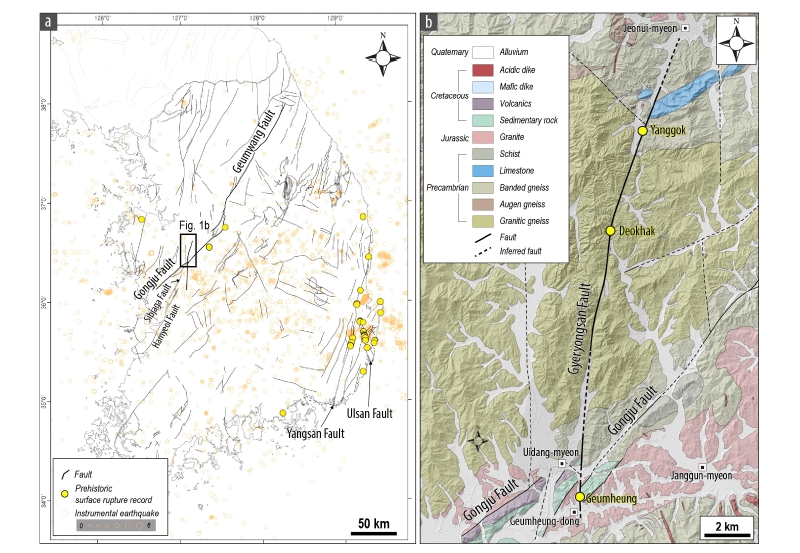
(a) Map showing the distribution of faults, paleoearthquake ruptures, and instrumental earthquakes in South Korea. (b) Geological map of the study area showing the distribution of the rocks and faults.
한편, 한반도 중부의 공주단층계 역시 북북동-남남서 내지 북동-남서 방향의 성숙한(mature) 단층계로, 강원도 인제에서부터 전라북도 부안에 이르는 구간에 금왕단층, 공주단층, 십자가단층, 함열단층 등으로 구성된다(그림 1; e.g., Kee et al., 2019). 이들 단층은 쥐라기 우수향 연성전단변형, 백악기 당겨열림분지(pull-apart basin) 형성과 연계된 좌수향 주향이동운동, 그리고 고진기 우수향 주향이동운동 등 복수 단계의 변형사를 기록한 것으로 알려져 있다(e.g., Bae and Lee, 2014; Kim and Lee, 2016, 2017, 2022). 최근 연구들은 공주단층계를 구성하고 있는 단층들의 일부 구간에도 제4기 지진지표파열의 존재를 보고하고 있으며(Kim, T. et al., 2022; Lee et al., 2023; Kim, C.-M. et al., 2024; Kim, D.-E. et al., 2024; Park et al., 2025), 이는 중부 지역의 주요 단층들 또한 현재 응력 환경에서 잠재적 지진원으로 역할을 할 가능성을 의미한다.
이와 관련하여 중부 지역에서 주목해야 할 또 다른 구조는 세종과 공주 일대에서 북동-남서 방향의 공주단층을 1~1.5 km의 우수향 변위로 절단하는 N0~20°E 방향의 단층이다(그림 1). 1:5만 광정도폭(Kang and Lim, 1974)과 공주도폭(Kim et al., 1976)에서는 세종시 전의면, 공주시 의당면 및 금흥동 일대에 발달하는 남-북 내지 북북동-남남서 방향의 침식곡과 삼각말단면 등의 지형적 특징을 근거로, 이 단층의 연장을 약 20 km로 추정하였다. 다만 당시 조사에서는 단층의 직접적인 노두 증거를 확인하지는 못하였다. 이후 Choi et al. (2012)의 「활성단층지도 및 지진위험 지도제작」 조사 사업 보고서에서는 이 추정 단층에 대해 “계룡산단층”이라는 명칭을 처음 사용하였으나, 단층물질을 포함하는 단층대를 직접 제시하지 못하였다. 최근 Gihm et al. (2025)는 굴착조사를 통해 계룡산단층 양곡지점의 단층핵을 보고하고, 해당 지점의 단층 특성과 연질퇴적변형구조를 제시하였다. 그럼에도 불구하고, 계룡산단층의 연장과 내부변형구조를 포함한 단층대의 전반적인 실체를 종합적으로 제시한 연구는 아직 이루어지지 않았으며, 그 정의와 지질학적 의미 역시 충분히 검증되지 못한 상태이다.
이 연구는 세종과 공주 일대에서 확인된 계룡산단층대의 구조적·지형학적 변형 양상을 체계적으로 제시하는 것을 목적으로 한다. 이를 위해 (1) 선형구조를 따라 발달하는 구조지형학적 특징을 정리하고, (2) 1개 굴착단면과 2개 공사장 절개지에서 확인된 단층의 내부변형 특성을 지점별로 기술한다. 이러한 자료를 바탕으로 토의에서는 계룡산단층의 정의를 정립하고, 현재의 수준에서 제시할 수 있는 이 구조의 장기 진화와 현재 응력환경에서 지진원으로서의 의의에 대해 논의한다.
2. 연구 지역
연구 지역은 북쪽의 세종시 전의면에서 남쪽의 공주시 의당면 및 금흥동 일대에 이르는 구간이다. 세종시 전의면과 공주시 의당면 대부분의 영역은 선캄브리아시대 변성암이 광범위하게 분포하며, 주로 화강암질 편마암과 편암으로 구성된다. 반면, 공주시 의당면 남부 및 금흥동 일대에는 쥐라기 화강암과 함께 백악기 퇴적암 및 안산암질 화산암류가 분포한다. 백악기 퇴적암은 역암, 자색 내지 회백색 사암, 미사암, 그리고 셰일 등으로 구성된다.
1:5만 광정도폭(Kang and Lim, 1974)에서는 북동-남서 방향으로 대상 분포를 보이는 선캄브리아시대 석회암층이 양곡 인근에서 북북동-남남서 방향 단층에 의해 우향으로 약 1 km 절단되어 있음을 보고하였으며(그림 1), 이번 연구에서는 이 단층을 계룡산단층으로 기술한다. 또한 1:5만 공주도폭(Kim et al., 1976)에서도 백악기 공주분지의 분지충전물을 금흥 인근에서 우향으로 1~1.5 km 이격시킨 남-북 방향의 선형구조를 근거로 계룡산단층의 존재를 추정하였다(그림 1).
연구 지역 남부에서 계룡산단층에 의해 절단된 북동-남서 방향의 공주단층은 백악기 공주분지의 북서쪽 경계를 이루는 단층이며, 공주분지의 남동쪽 경계를 이루는 북동-남서 방향 단층 또한 공주단층계를 구성하는 단층에 해당한다. 최근 Kim, D.-E. et al. (2024)은 계룡산단층의 동편에 위치한 공주단층을 따라 발달하는 선상지 지형면 낙차 및 경사변곡점 분석을 통해, 이를 ‘침식이 진행된 단층애(degraded fault scarp)’로 해석하였다. 또한 해당 단층선상의 송학지점에서 수행된 굴착조사를 통해 약 94 ka 전의 퇴적층을 절단하고 있는 지진지표파열 흔적을 확인하였다.
3. 구조지형 특성
연구 지역의 지형적 특성을 분석하기 위해 국토지리정보원에서 제공하는 1:5,000 수치지형도와 고해상도 항공 LiDAR (Light Detection and Ranging) 기반 수치표고모델(DEM)을 활용하였다. 분석에는 수목 제거가 적용된 0.5m 해상도의 DTM (Digital Terrain Model)을 사용하였으며, 음영기복도(hillshade) 등의 지형 해석 기법을 적용하여 미세 지형 요소의 형태와 공간적 연속성을 검토하였다. 이러한 고해상도 자료는 기존에 일반적으로 활용되는 5 m 해상도의 DEM에 비해 미세한 지형 요소를 보다 효과적으로 식별할 수 있다.
선형구조 분석 결과, 단층대를 따라 남-북 내지 북북동-남남서 방향의 선형구조 7개가 식별된다(그림 2a). 이들 선형구조는 1~3.8 km의 길이를 가지며, 단층곡(fault valley), 삼각말단면(triangular facet), 단층안부(fault saddle), 능선절단 등의 단층 관련 지형(fault-related landforms)이 동반된다. 충남 공주시 의당면 덕학리 북쪽에 분포하는 선형구조는 능선 절단 양상을 통해 식별된다(그림 2b). 서편의 산봉우리에서 동편으로 연장되는 산능선들이 선형구조에 의해 절단되면서, 좁은 곡부, 산사면 또는 낮은 구릉지로 전이되는 형태가 관찰된다(그림 2b). 이러한 능선 절단 양상은 공주시 의당면 청룡리 남쪽에서도 유사하게 나타난다(그림 2c). 금흥지점을 둘러싼 양측의 두 구릉지는 선형구조를 중심으로 각각의 능선들이 연장되지 못한 채 어긋난 양상을 보인다. 한편 공주시 의당면 덕학리에서는 단층안부가 연속적으로 배열된 선형구조가 확인된다(그림 2d). 이 단층안부들은 산록부에 발달한 단층와지(kerncol)와 그 동쪽에 분포하는 단층구릉(kernbut)으로 구성되며, 이러한 배열은 비교적 일관되게 나타난다. 이는 지형단면에서도 잘 나타나며, 선형구조는 단층와지와 단층구릉이 접하는 부분에 위치한다(그림 2e). 이와 같은 구조지형들은 계룡산단층의 제4기 지표 변형이 발생했을 가능성을 보여준다. 그러나 굴절하천, 변위하천, 압축능선, 단층애, 변위된 지형면 등과 같이 직접적인 변위를 지시하는 지형 요소들은 확인되지 않는다. 또한, 관찰된 지형들이 제4기 이전의 단층운동에 의해 형성된 기반암 내 구조적 약대를 따라 장기간 차별침식을 받아 형성되었을 가능성도 배제할 수 없다. 따라서 이러한 지형 분석 결과만으로는 연구 지역 내 최근 지진지표파열 여부를 단정하기 어렵다. 이에 최근 지표 변형의 존재여부를 검증하기 위해 상세 야외조사와 굴착조사를 수행하였다.
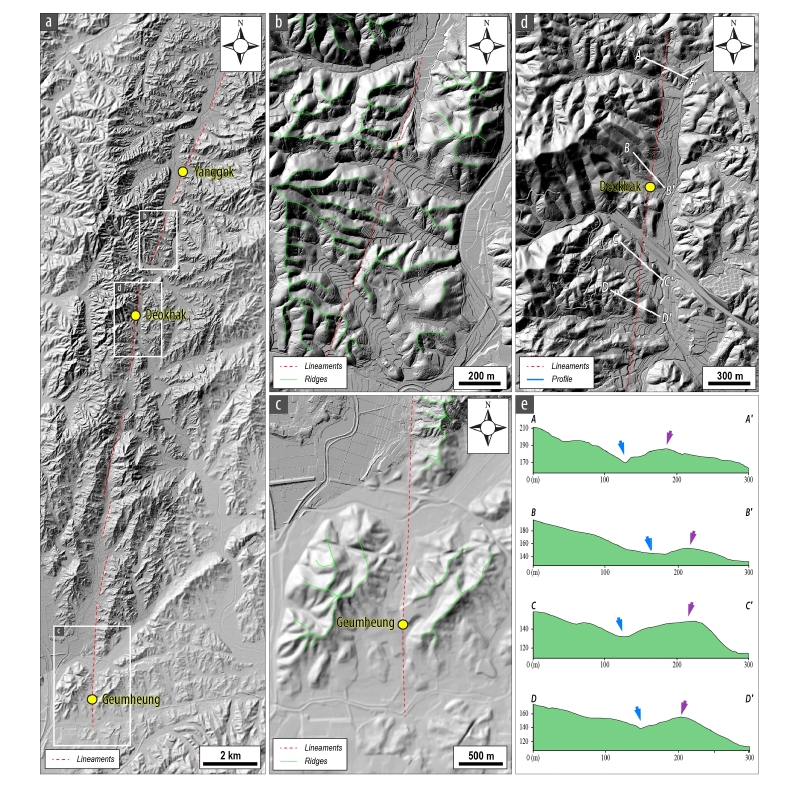
(a) Map showing the results of lineament analysis in the study area. (b, c) Enlarged views highlighting lineaments cutting across mountain ridges (green lines). (d) Distribution of fault saddles forming a linear array along the lineaments. White lines indicate the locations of topographic profiles. (e) Topographic profiles across the fault saddles shown in (d). Blue and purple arrows mark the locations of the kerncol and kernbut, respectively.
4. 지점별 내부변형 특성
1계룡산단층은 구조지형학적 선형성과 지시자들이 비교적 뚜렷하게 나타남에도 불구하고, 야외에서 단층노두를 직접 확인하기는 쉽지 않다. 이러한 관찰상의 제약으로 인해 선행 연구들은 주로 선형구조를 포함한 지형적 근거에 기반하여 단층을 추정하는 수준에 머물렀다. 이번 연구에서는 공사장 절개지에서 새롭게 노출된 1개 지점(금흥지점)과 굴착조사를 통해 확인된 2개 지점(덕학지점, 양곡지점)에서 관찰되는 단층핵의 내부변형 특성을 지점별로 기술한다. 굴착조사는 계룡산단층의 실체를 확인하고 전반적인 변형 양상을 규명하기 위한 목적뿐만 아니라, 이 단층을 따라 발생하였을 가능성이 있는 제4기 지진지표파열 및 이에 수반된 변형을 탐지하기 위한 목적으로 수행되었다. 굴착지점의 선정은 앞서 기술한 지형 분석 결과를 토대로 결정하였다. 지점별 기술은 연구 지역 남부에 위치한 지점부터 순차적으로 제시한다.
4.1. 금흥지점
충남 공주시 금흥동에 위치한 금흥지점(N36° 29' 19.61", E127° 8' 53.05")은 공사 과정에서 일시적으로 노출된 사면으로, 계룡산단층의 단층핵을 관찰할 수 있는 노두이다(그림 3). 이 지점에서 확인되는 약 2.5 m 폭의 단층핵은 서편에서부터 약 10 cm 폭의 담녹색 단층비지대, 약 1.5 m 폭의 엽리상 자색 단층비지대, 약 1 m 폭의 단층각력대로 구성된다(그림 3a). 전반적으로 N15~20°E/85°SE 자세를 가지는 단층핵은 서편의 쥐라기 화강암과 동편의 백악기 역암을 경계하는 데, 특히 쥐라기 화강암과 담녹색 단층비지대의 경계부는 비교적 날카로운 특징을 보인다(그림 3b). 이 경계면과 함께 자색 단층비지대 내의 엽리면에서 확인되는 단층조선들은 대체로 주향이동감각(선주각(rake) ~0°)이 우세하게 확인되지만, 좌수향 또는 우수향 감각을 지시할 만한 증거는 명확하지 않다(그림 3c, 3d). 동편의 역암층은 대체로 자색의 기질(matrix)에 변성암에서 기원한 아각형에서 아원형의 거력 및 왕자갈로 구성되며, 이는 백악기공주분지의 충전물에 해당한다(그림 3e, 3f). 주변 공주분지 충전물의 상당 부분이 자색 이암 내지 미사암으로 이루어져 있음을 고려할 때, 금흥지점에서 관찰되는 엽리상 자색 단층비지는 이러한 세립질 퇴적물이 반복적인 전단운동에 의해 화강암과 역암층 사이로 유입 및 연장되어 스미어링(smearing)된 결과로 해석된다. 한편, 단층핵을 기준으로 양측에 위치하는 단층손상대는 서로 다른 암상과 함께 확연하게 비대칭적인 변형 양상을 보이는 것이 특징적이다(그림 3a). 우선, 노출된 화강암 내에는 일부 전단단열 이외에는 강한 변형의 흔적이 확인되지 않는다. 반면, 백악기 역암층 내에는 전반적으로 열수변질 흔적과 함께 상당한 부차단층 또는 전단단열이 관찰되며, 이들의 방향성은 북북동-남남서, 북동-남서, 서북서-동남동이 주를 이룬다. 일부 북북동-남남서 방향의 소규모 단층들은 좌수향 변위를 보이며(그림 3e), 이는 지질도 규모에서 확인되는 우수향 변위와는 반대된다.
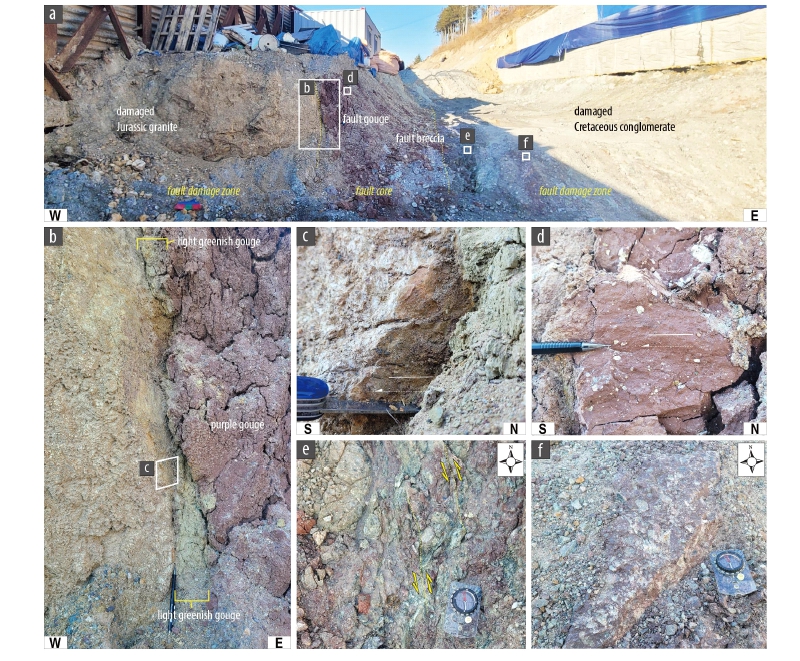
Photographs of the fault zone at Geumheung site. (a) Fault core separating the western granitic damage zone and the eastern sedimentary damage zone. (b) Sharp contact between the light greenish fault gouge and the western damage zone. (c), (d) Strike-slip striations observed on the main slip surface and foliated surface, respectively. (e) Sinistral offsets along N-S-striking minor faults within the damage zone. (f) Cretaceous conglomerate exposed in the eastern damage zone.
4.2. 덕학지점
공주시 덕학리에 위치한 덕학지점(N36° 35' 46.18", E127° 9' 48.78")은 서북서-동남동 방향의 길이 약 30 m, 깊이 약 4 m의 굴착단면에서 확인된 계룡산단층 단층핵 지점이다(그림 4). 굴착단면의 하부에는 약 1 m 두께로 기반암이 노출되며, 이는 선캄브리아시대 변성암으로 구성된다. 이 기반암을 절단하는 단층핵은 굴착단면에서 확인된 범위 내에서만 폭이 약 30 m에 이른다. 다만 부지 협상 여건상 단층핵의 서편 경계가 노출되지 않았으므로, 실제 단층핵의 폭은 이보다 더 넓을 것으로 추정된다. 단층핵은 전반적으로 담청색을 띠며, 대체로 단층각력이 우세하게 분포한다(그림 4). 그러나 단층각력 사이의 일부 구간에서는 엽리상의 단층비지대가 수 cm에서 수십 cm 폭으로 관찰되며, 이들은 서로 연결되는 망상 기하(anastomosing geometry)를 보인다(그림 4a). 또한 이들 단층암을 날카롭게 절단하는 < 2cm 폭의 단층비지띠가 여러 매 확인된다(그림 4b, 4c). 한편, 전단엽리면 또는 전단활면에서 확인되는 조선은 대체로 주향이동성분(선주각 <5°)이 우세한 운동감각을 나타낸다. 기반암 상부를 피복하는 약 3 m 두께의 퇴적층은 총 4개의 퇴적단위로 구분되나, 이차적인 변형 양상은 확인되지 않는다.
Photographs of northern face exposing the fault zone at Deokhak site. (a) Exposed fault zone characterized by fault breccia and several fault gouge layers with an anastomosing geometry. (b), (c) Narrow gouge layers (<2 cm thick) with sharp boundaries.
4.3. 양곡지점
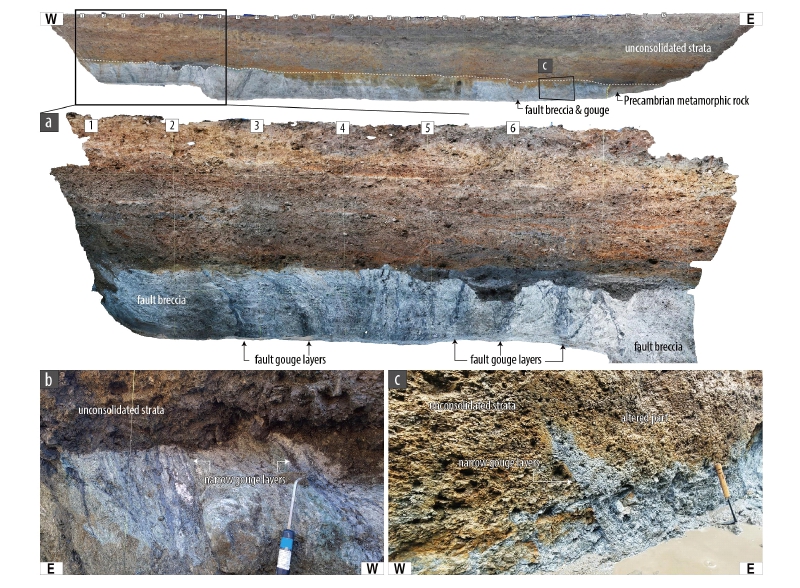
세종시 전의면 양곡리에 위치한 양곡지점(N36° 38' 11.25", E127° 10' 47.32")은 동-서 방향의 길이 약 30 m, 깊이 약 3.5 m의 굴착단면에서 계룡산단층 단층핵이 노출된 지점으로(그림 5), Gihm et al. (2025)에 의해 처음 보고되었다. 굴착단면 하부에는 약 1 m 내외의 두께로 선캄브리아시대 변성암이 노출되며, 이 기반암을 절단하는 약 2.5 m 폭의 단층핵이 발달한다(그림 5a, 5b, 5c). 단층핵과 기반암은 약 3 m두께의 제4기 퇴적층에 의해 피복되어 있다. N30°E/80°NW자세를 가지는 단층핵은 담청색의 단층비지 및 단층각력으로 구성되며, 단층핵 전반에 미약한 엽리구조가 확인되며 서편에서 동편으로 갈수록 해당 엽리구조를 인지하기 어려운 경향을 보인다(그림 5b, 5c). 일부 영역에서 확인되는 S-C 조직은 우수향 운동감각을 지시한다. 또한, 단층핵의 서편 경계부뿐만 아니라 내부에도 <2 cm 폭의 보다 세립질로 구성된 단층비지띠가 관찰된다(그림 5b, 5c). 단층을 피복하는 미고결 하성퇴적층은 입도, 층서 기하, 중첩 양상에 따라 세 개의 퇴적단위(상위로부터 퇴적단위 1, 2, 3)으로 구분된다(그림 5a)(Gihm et al., 2025). 퇴적단위 1은 불량한 분급의 모래-점토 혼합(모래질 점토)층으로, 퇴적단위 2는 불량한 분급의 적갈색 모래 및 잔자갈층으로, 퇴적단위 3은 각력 또는 아각력질의 잔자갈-왕자갈층으로 구성된다. 주목할 점은 퇴적단위 1과 2의 경계부에서 전반적으로 확인되는 침강퇴적물(down-sagging sediment)이다(그림 5d, 5e). Gihm et al. (2025)은 밀도가 작은 세립질의 상부 퇴적물이 상대적으로 밀도가 큰 조립의 하부 퇴적단위로 침투하면서 형성된 이러한 연속적이면서 불규칙한 경계면 변형을 하중에 의한 것이 아닌 강한 지진동에 따른 공극수압 상승에 의해 형성된 연질퇴적변형구조로 해석하였다. 본 연구에서는 해당 연질퇴적변형구조의 기원에 대한 독립적인 재해석을 수행하지 않았으며, Gihm et al. (2025)의 해석을 인용하여 논의를 전개한다.
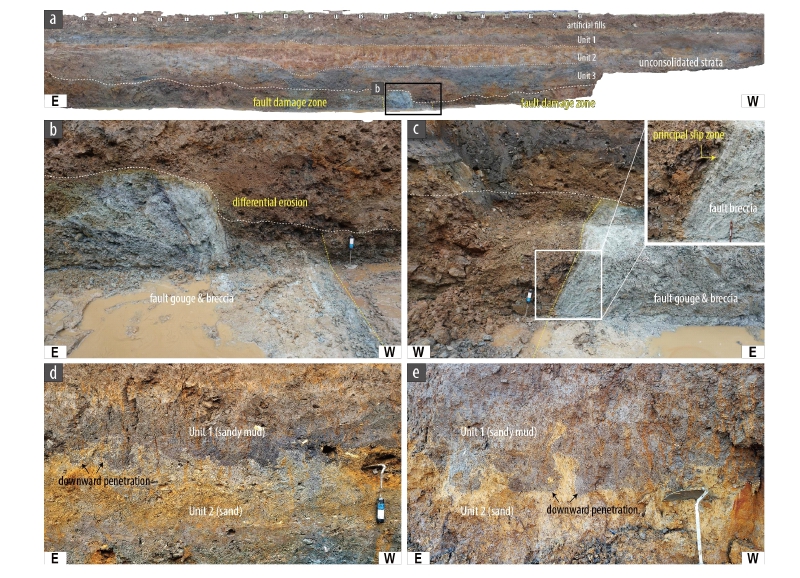
Photographs of the fault zone and soft-sediment deformation structures at Yanggok site. (a) South face at Yanggok trench. (b), (c) Fault core exposed on southern and northern faces, respectively. The inset of (c) shows the principal slip zone developed along the boundary between the fault core and the western damage zone. (d), (e) Downward penetration of overlying sandy mud into underlying sand, forming a series of down-sagging sediments.
5. 계룡산단층의 정의와 단층진화 및 지진원 측면에서의 의의
이번 연구에서는 세종시 전의면에서 공주시 의당면 및 금흥동 일대에 이르는 구간에서 N0~20°E 방향으로 발달하는 고각 단층을 ‘계룡산단층’으로 정의한다. 계룡산단층의 전반적인 주향은 북부에서 N10~20°E 방향으로 발달하다가 남쪽으로 연장되면서 남-북 방향으로 점진적으로 변화하는 경향을 보인다. 기존 1:5만 도폭 연구와 함께 이번연구에서 새롭게 제시한 단층자취 및 구조지형학적 특징들을 종합하면, 이 단층은 최소 20 km 이상 연장되며 1 km 이상의 우수향 변위를 기록하는 것으로 해석된다. 또한 현재까지 확인된 단층대의 규모와 공주시 의당면과 금흥동 일대에서 탐지되는 1 km 이상의 우수향 변위를 고려할 때, 단층의 자취가 공주 시내를 관통하여 남쪽으로 연장될 가능성도 제기된다. 이 단층은 선캄브리아시대 변성암과 백악기 퇴적암 및 화산암을 절단하며, 단층핵의 폭은 지점별로 수 m에서 수십 m로 차이를 보인다. 백악기 퇴적암을 모암으로 하는 금흥지점의 단층핵은 엽리상 자색 단층비지대와 단층각력대가 발달하는 것이 특징적이다. 반면 선캄브리아시대 변성암을 모암으로 하는 덕학지점 및 양곡지점 단층핵의 경우에는 대체로 담청색의 단층각력이 우세하며, 일부 구간에서 엽리구조가 부분적으로 관찰된다. 특히 이들 단층각력을 폭 2 cm 이내의 좁은 단층비지띠가 절단하는 양상이 명확하게 관찰된다. 단층암의 산상만으로 지진성과 비지진성 전단운동을 단정하기에는 여전히 논쟁의 여지가 존재하지만(e.g., Fagereng and Toy, 2011), 야외 관찰과 실내 실험을 결합한 여러 단층물질 연구에서는 비교적 두께를 갖고 분산된 형태의 엽리상, 점토질 단층물질을 속도강화 거동(velocity-strengthening behavior) 또는 비지진성의 느린 변형(aseismic creep)과 연계하여 설명하기도 한다(e.g., Faulkner et al., 2003; Collettini et al., 2009, 2011; Smeraglia et al., 2017; Kim, C.-M. et al., 2022b; Woo et al., 2024; Woo and Han, 2026). 반면, 보다 세립질로 구성된 좁고 날카로운 띠 형태의 구조는 지진성 미끌림이 집중되었던 구간(즉, 주미끌림대, principal slip zone)으로 해석하는 경우가 많다(e.g., Sibson, 2003; Smith et al., 2011; Kim, C.-M. et al., 2020, 2022b; Gu et al., 2021; Lee et al., 2023; Woo et al., 2023). 이러한 관점에서 계룡산단층 단층핵 내에서 관찰되는 엽리상 단층비지대와 좁고 날카로운 형태의 단층비지띠의 공존은 다양한 거동 양상을 갖는 미끌림들이 장기간에 걸쳐 반복적으로 누적되었을 가능성을 의미한다. 한편, 단층활면 및 전단엽리면에서 확인되는 단층조선, 단층손상대 내부의 전단단열 또는 소규모 단층의 변위를 통해, 이 단층이 우수향 운동뿐만 아니라 좌수향 운동 또한 경험하였음을 알 수 있다. 일반적으로 단층대의 성숙도(maturity)는 장기간에 걸친 반복적인 전단운동과 밀접하게 관련되며, 단층물질과 단층대 규모 모두에서 높은 변형(high-strain)의 누적을 반영한다(e.g., Manighetti et al., 2007; Gu et al., 2021; Kim, C.-M. et al., 2022b). 단층물질 규모에서는 강한 전단변형에 수반된 입자크기 감소(grain-size reduction)로 기질의 비율이 증가하고, 층상규산염 광물로 구성된 단층비지대가 망상 기하를 이루며 발달함이 특징적이다(e.g., Rutter et al., 2001). 단층대 규모에서는 단층의 길이, 변위량, 운동 지속 기간, 변위율, 그리고 단층핵과 손상대의 발달 정도 등이 성숙도를 규제하는 주요 요소로 제시된다(e.g., Manighetti et al., 2007). 계룡산단층에서 확인되는 최대 수십 m 폭의 단층핵, 엽리상 및 망상 단층비지대와 좁은 주미끌림대의 공존, 그리고 다중 운동감각이 기록된 구조적 특징에 근거할 때, 이 단층대는 비교적 성숙한 단층대로 해석된다. 즉, 이 단층은 최소 두 차례 이상의 지구조 환경(응력장) 변화 동안 지진성 및 비지진성 미끌림이 반복적으로 누적되면서 현재의 성숙도에 이른 단층으로 평가할 수 있다. 또한 이 단층이 1 km 이상의 변위로 백악기 공주분지를 우향 절단한 특징에 근거할 때, 가장 우세했던 운동인 우수향 주향이동감각의 변형은 백악기말 이후에 발생했을 가능성이 높다.
계룡산단층을 따라 확인되는 단층곡, 단층안부, 능선 절단 양상 등의 여러 구조지형을 고려하면, 이 단층대를 따라 제4기 지진지표파열의 발생 가능성을 제기할 수 있다. 하지만 이번 연구에서 제4기 미고결 지층을 절단하는 단층파열의 직접적인 증거를 확인하지는 못하였다. 그럼에도 불구하고 양곡지점의 미고결 퇴적층에서 관찰되는 연질퇴적변형은 최근 지질시대에 발생한 중규모 이상의 지진과 연관되었을 가능성을 지지한다(Gihm et al., 2025). 단, 이 지점에서 기반암 내 단층대가 상부의 미고결 지층으로는 연장되지 않는 점을 고려할 때, 해당 퇴적변형구조가 최근 지질시대(아마도 제4기) 단층운동에 수반된 결과라면, (1) 단층핵을 따라 발생한 지진파열이 지표까지 도달하지 못했거나, 또는 (2) 주단층이 아닌 부차단층의 지진성 운동에 의해 형성되었을 가능성을 배제할 수 없다. 이렇듯, 양곡지점의 미고결 지층 내 변형 양상은 복수의 시나리오로 해석될 수 있으나, 전반적으로는 계룡산단층대를 따라 최근 지질시대의 단층운동 발생 가능성을 지지한다.
우리나라에 분포하는 상당수의 단층들은 오랜 지질시대동안 변화하는 지구조 환경에 따라 진화하면서, 하나의 면으로 표현되는 단일한 단층이 아니라 주단층과 그 주변 손상대 내의 부차단층들로 구성된 ‘단층대’의 형태로 남겨져 있다. 이러한 단층대에서는 주단층뿐만 아니라 부차단층 역시 현재의 응력환경 하에서 개별적인 지진원으로서 역할을 할 수 있으며(Kim, C.-M. et al., 2022a), 경우에 따라서는 인접한 단층의 재활성을 유발하는 방아쇠(trigger) 역할을 수행할 수도 있다. 가까운 미래에 사회적·경제적 피해를 초래할 수 있는 잠재적 지진원을 이해하기 위해서는 고(古)지진학적 접근을 통해 과거 지진지표파열의 재발 이력(recurrence)을 규명하는 것이 기본적으로 요구되며, 이러한 연구는 전 국토 단위에서 수행 중이다. 더 나아가 우리나라에 발달하는 단층(대)의 전반적인 분포, 연장, 기하, 내부구조를 포함한 제반 특성을 종합적으로 이해함으로써, 기존에 형성된 이들 구조 요소들이 현재 응력환경 하에서 어떠한 인자(parameter)에 규제되어 어떠한 메커니즘으로 재활성(reactivation)되는지를 평가하는 근원적인 접근 또한 우리나라의 잠재적 지진원을 이해함에 있어 필수적이다.
Acknowledgments
이 단보는 행정안전부 지진위험분석 및 관리기술개발사업(2022-MOIS62-001; 한반도 단층구조선의 조사 및 평가기술 개발(2단계))과 한국지질자원연구원 기본사업(GP2025-013; 판내부 중대형지진 재발모델 기반 한반도 잠재지진특성 평가 연구)의 지원을 받아 수행된 연구 결과이다. 심사과정에서 건설적 조언을 주신 두 분의 익명 심사위원과 편집위원 및 편집위원장에게 감사드립니다.
References
-
Bae, H. and Lee, H., 2014, Space-time patterns of fault activity of the Keumwang Fault developed in the Jincheon-Eumseong-gun, Chungcheongbuk-do. Journal of the Geological Society of Korea, 50, 735-752 (in Korean with English abstract).
[https://doi.org/10.14770/jgsk.2014.50.6.735]

- Cheon, Y., 2018, Tectonic Evolution of the Cretaceous Gyeongsang Basin Focused on the Jinju, Daegu, and Uiseong Blocks. Ph.D. thesis, Pusan National University, 172 p (in Korean with English abstract).
-
Cheon, Y., Cho, H., Ha, S., Kang, H.-C., Kim, J.-S. and Son, M., 2019, Tectonically controlled multiple stages of deformation along the Yangsan Fault Zone, SE Korea, since Late Cretaceous. Journal of Asian Earth Sciences, 170, 188-207.
[https://doi.org/10.1016/j.jseaes.2018.11.003]
-
Cheon, Y., Choi, J.-H., Kim, N., Lee, H., Choi, I., Bae, H., Rockwell, T., Lee, S.R., Ryoo, C.-R., Choi, H. and Lee, T.-H., 2020b, Late Quaternary transpressional earthquakes on a long-lived intraplate fault: A case study of the Southern Yangsan Fault, SE Korea. Quaternary International, 553, 132-143.
[https://doi.org/10.1016/j.quaint.2020.07.025]
-
Cheon, Y., Ha, S., Lee, S., Cho, H. and Son, M., 2017, Deformation features and history of the Yangsan Fault Zone in the Eonyang-Gyeongju area, SE Korea. Journal of the Geological Society of Korea, 53, 95-114 (in Korean with English abstract).
[https://doi.org/10.14770/jgsk.2017.53.1.95]
-
Cheon, Y., Ha, S., Lee, S. and Son, M., 2020a, Tectonic evolution of the Cretaceous Gyeongsang Back-arc Basin, SE Korea: Transition from sinistral transtension to strike-slip kinematics. Gondwana Research, 83, 16-35.
[https://doi.org/10.1016/j.gr.2020.01.012]
-
Cheon, Y., Kim, C.-M., Choi, J.-H., Ha, S., Lee, S., Kim, T., Kang, H.-C. and Son, M., 2023, Near-surface termination of upward-propagating strike-slip ruptures on the Yangsan Fault, Korea. Scientific Report, 13, 9869.
[https://doi.org/10.1038/s41598-023-37055-7]
- Choi, S.J., Jeon, J.S., Song, K.Y., Kim, H., Kim, Y.H., Choi, B.Y., Chwae, U., Han, J., Ryoo, C.R., Sun, C.G., Jun, M.S., Kim, G.Y., Kim, Y.B., Lee, H.J., Shin, J.S., Lee, Y.S., Kee, W.S., Lee, H.K., Song, Y., Kim, Y.S., Kang, T.S., Hong, D.G. and Kim, S.G., 2012, Active fault map and seismic hazard map, KIGAM, NEMA-N- 2009-24, p. 620 (in Korean).
-
Chung, D., Song, Y., Park, C., Kang, I.-M., Choi, S.-J. and Khulganakhuu, C., 2014, Reactivated timings of some major faults in the Chugaryeong Fault Zone since the Cretaceous period. Economic and Environmental Geology, 47, 29-38 (in Korean with English abstract).
[https://doi.org/10.9719/EEG.2014.47.1.29]
-
Collettini, C., Niemeijer, A., Viti, C. and Marone, C., 2009, Fault zone fabric and fault weakness. Nature, 462, 907-910.
[https://doi.org/10.1038/nature08585]
-
Collettini, C., Niemeijer, A., Viti, C., Smith, S.A.F. and Marone, C., 2011, Fault structure, frictional properties and mixed-mode fault slip behavior. Earth and Planetary Science Letters, 311, 316-327.
[https://doi.org/10.1016/j.epsl.2011.09.020]
-
Fagereng, Å. and Toy, V., 2011, Geology of the earthquake source: an introduction. From: Fagereng, Å., Toy, V.G., and Rowland, J.V. (eds) Geology of the Earthquake Source: A Volume in Honour of Rick Sibson. Geological Society, London, Special Publications, 359, 1-16.
[https://doi.org/10.1144/SP359.1]
-
Faulkner, D.R., Lewis, A.C. and Rutter, E.H., 2003, On the internal structure and mechanics of large strike-slip fault zones: field observations of the Carboneras fault in southeastern Spain. Tectonophysics, 367, 235-251.
[https://doi.org/10.1016/S0040-1951(03)00134-3]
-
Gihm, Y.S., Cheon, Y. and Ko, K., 2025, Fine-grained sediments down-sagging into coarse-grained substrate: A new category of soft-sediment deformation structures and their paleoseismological implications. Sedimentary Geology, 486, 106936.
[https://doi.org/10.1016/j.sedgeo.2025.106936]
-
Gu, D., Han, R. and Woo, S., 2021, Geological records of coseismic shear localization along the Yangsan Fault, Korea. Journal of Geophysical Research: Solid Earth, 126, e2020JB021393.
[https://doi.org/10.1029/2020JB021393]
-
Ha, S., Cheon, Y., Kang, H.-C., Kim, J.-S., Lee, S.-K. and Son, M., 2016, Geometry and kinematics of the subsidiary faults of the Ilgwang fault, SE Korea. Journal of the Geological Society of Korea, 52, 31-50 (in Korean with English abstract).
[https://doi.org/10.14770/jgsk.2016.52.1.31]
-
Ha, S., Kang, H.-C., Lee, S., Seong, Y.B., Choi, J.-H., Kim, S.-J. and Son, M., 2025, Quaternary surface ruptures of the inherited mature Yangsan Fault: implications for intraplate earthquakes in southeastern Korea. Solid Earth, 16, 197-231.
[https://doi.org/10.5194/se-16-197-2025]
-
Ha, S., Son, M. and Seong, Y.B., 2022, Active fault trace identification using a LiDAR high-resolution DEM: a case study of the central Yangsan Fault, Korea. Remote Sensing, 14, 4838.
[https://doi.org/10.3390/rs14194838]
-
Hwang, B.H., Lee, J.D., Yang, K. and McWilliams, M., 2007a, Cenozoic strike-slip displacement along the Yangsan fault, southeast Korean Peninsula. International Geology Review, 49, 768-775.
[https://doi.org/10.2747/0020-6814.49.8.768]
-
Hwang, B.H., McWilliams, M., Son, M. and Yang, K., 2007b, Tectonic implication of A-type granites across the Yangsan fault, Gigye and Gyeongju areas, southeast Korean Peninsula. International Geology Review, 49, 1094-1102.
[https://doi.org/10.2747/0020-6814.49.12.1094]
- Kang, P.C. and Lim, J.H., 1974, Explanatory text of the geological map of Gwangjeong (1:50,000). Geological & Mineral Institute of Korea, 13 p.
- Kee, W.-S., Kim, S.W., Kim, H., Hong, P., Kwon, C.W., Lee, H.-J., Cho, D.-L., Koh, H.J., Song, K.-Y., Byun, U.H., Jang, Y. and Lee, B.C., 2019, Geologic Map of Korea (1:1,000,000). Korea Institute of Geoscience and Mineral Resources (KIGAM).
-
Kim, C.-M., Cheon, Y., Han, R., Jeong, G.Y. and Jeong, J.O., 2022a, Fault reactivation with rapid slip along subsidiary faults in the Yangsan Fault zone, SE Korea. Geosciences Journal, 26, 167-181.
[https://doi.org/10.1007/s12303-021-0027-1]
-
Kim, C.-M., Cheon, Y., Lee, T.-H., Choi, J.-H., Ha, S. and Jeong, J.O., 2022b, Long-term weakening processes and short-term seismic slip behavior of an intraplate mature fault zone: A case study of the Yangsan Fault, SE Korea. Journal of Geophysical Research: Solid Earth, 127, e2021JB023154
[https://doi.org/10.1029/2021JB023154]
-
Kim, C.-M., Ha, S. and Son, M., 2020, Evidence of coseismic slip recorded by Quaternary fault materials and microstructures, Naengsuri, Pohang. Journal of the Geological Society of Korea, 56, 175-192 (in Korean with English abstract).
[https://doi.org/10.14770/jgsk.2020.56.2.175]
-
Kim, C.-M., Lee, T.-H., Choi, J.-H., Lee, H. and Kim, D.-E., 2024, Multi-scale analysis and paleoseismic investigations along the Geumwang Fault: an example of integrated approach in paleoseismology in slow tectonic region. Geosciences Journal, 28, 565-582.
[https://doi.org/10.1007/s12303-024-0029-x]
-
Kim, D.-E., Kim, C.-M., Choi, H.-W. and Lee, H., 2024, New evidence of late Quaternary earthquake surface rupturing along the Gongju Fault, central Korea. Geosciences Journal, 28, 583-593.
[https://doi.org/10.1007/s12303-024-0018-0]
- Kim, D.-E. and Seong, Y.B., 2021, Cumulative slip rate of the southern Yangsan Fault from geomorphic indicator and numerical dating. Journal of the Korean Geographical Society, 56, 201-213 (in Korean with English abstract).
-
Kim, J.H., Lee, J.Y. and Kee, W.S., 1994, Structural evolution of the Cretaceous Puyeo Basin, Korea. Journal of the Geological Society of Korea, 30, 182-192 (in Korean with English abstract).
[https://doi.org/10.14770/jgsk.1994.30.2.182]
-
Kim, K.-H., Kang, T.-S., Rhie, J., Kim, Y., Park, Y., Kang, S.Y., Han, M., Kim, J., Park, J., Kim, M., Kong, C., Hea, D., Lee, H., Park, E., Park, H., Lee, S.-J., Cho, S., Woo, J.-U., Lee, S.-H. and Kim, J., 2016, The 12 September 2016 Gyeongju earthquakes: 2. Temporary seismic network for monitoring aftershocks. Geosciences Journal, 20, 753-757.
[https://doi.org/10.1007/s12303-016-0034-9]
-
Kim, M. and Lee, H., 2016, Internal structure and movement history of the Keumwang Fault. The Journal of Petrological Society of Korea, 25, 211-230 (in Korean with English abstract).
[https://doi.org/10.7854/JPSK.2016.25.3.211]
-
Kim, M. and Lee, H., 2017, Quaternary activity patterns of the Keumwang Fault in the Wonju-si area. Journal of the Geological Society of Korea, 53, 79-94 (in Korean with English abstract).
[https://doi.org/10.14770/jgsk.2017.53.1.79]
-
Kim, M. and Lee, H., 2022, Structural characteristics and space-time pattern of Quaternary fault activity of the Keumwang fault zone in the Inje-gun area, Gangwon-do. Journal of the Geological Society of Korea, 58, 393-410 (in Korean with English abstract).
[https://doi.org/10.14770/jgsk.2022.58.4.393]
-
Kim, N., Choi, J.-H., Park, S.-I., Lee, T.-H. and Choi, Y., 2020, Cumulative offset analysis of the Central-Southern Yangsan Fault based on topography of Quaternary fluvial terrace. Journal of the Geological Society of Korea, 53, 135-154 (in Korean with English abstract).
[https://doi.org/10.14770/jgsk.2020.56.2.135]
- Kim, S.W., Woo, H. and Woo, Y.K., 1976, Explanatory text of the geological map of Gongju sheet. Korea Research Institute of Geoscience and Mineral Resources, 29 p.
-
Kim, T., Choi, J.-H., Cheon, Y., Lee, T.-H., Kim, N., Lee, H., Kim, C.-M., Choi, Y., Bae, H., Kim, Y.-S., Ryoo, C.-R. and Klinger, Y., 2023, Correlation of paleoearthquake records at multiple sites along the southern Yangsan Fault, Korea: Insights into rupture scenarios of intraplate strike-slip earthquakes. Tectonophysics, 854, 229817.
[https://doi.org/10.1016/j.tecto.2023.229817]
-
Kim, T., Choi, J.-H., Lee, H., Bae, H., Choi, Y., Lee, T.-H., Cheon, Y., Kim, C.-M., Kim, D.-E. and Ryoo, C.-R., 2022, First detection of stratigraphic records of paleoearthquakes in Chungbuk Region, Korea. Journal of the Geological Society of Korea, 58, 411-425 (in Korean with English abstract).
[https://doi.org/10.14770/jgsk.2022.58.4.411]
-
Kim, T., Lee, H., Kim, D.-E., Choi, J.-H., Choi, Y., Han, M. and Kim, Y.-S., 2024, Determination of the long-term slip rate of a fault in a slowly deforming region based on a reconstruction of the landform and provenance. Geomorphology, 461, 109286.
[https://doi.org/10.1016/j.geomorph.2024.109286]
-
Kim, Y., He, Z., Ni, S., Lim, H. and Park, S.-C., 2017, Earthquake Source Mechanism and Rupture Directivity of the 12 September 2016 Mw 5.5 Gyeongju, South Korea, Earthquake. Bulletin of the Seismological Society of America, 107, 2525-2531.
[https://doi.org/10.1785/0120170004]
-
Kim, Y., Rhie, J., Kang, T.-S., Kim, K.-H., Kim, M. and Lee, S.-J., 2016, The 12 September 2016 Gyeongju earthquakes: 1. Observation and remaining questions. Geosciences Journal, 20, 747-752.
[https://doi.org/10.1007/s12303-016-0033-x]
-
Ko, K., Choi, S.-J., Lee, T.-H., Gihm, Y.S., Kim, C.-M., Kim, K. and Cheon, Y., 2022, A multidisciplinary approach to characterization of the mature northern Yangsan fault in Korea and its active faulting. Marine Geophysical Research, 43, 21.
[https://doi.org/10.1007/s11001-022-09486-w]
-
Kyung, J.B., 2003, Paleoseismology of the Yangsan Fault, south-eastern part of the Korean Peninsula. Annals of Geophysics, 46, 983-996.
[https://doi.org/10.4401/ag-3465]
-
Lee, H., Cheon, Y., Kim, C.-M. and Han, R., 2023, Seismic slip zone characteristics in near-surface unconsolidated sediments: Low-angle reverse paleo-rupture in Central Korea. Journal of Structural Geology, 177, 105003.
[https://doi.org/10.1016/j.jsg.2023.105003]
-
Liu, L., Peng, F., Kang, S.Y., Lee, Y.-C. and Kim, K.-H., 2024, Integrated passive and active seismic profiling for detection of buried faults: a case study at the north end of the Miryang Fault in the Geoncheon Valley, southeastern Korean Peninsula. Geosciences Journal, 28, 659-669.
[https://doi.org/10.1007/s12303-024-0019-z]
-
Manighetti, I., Campillo, M., Bouley, S. and Cotton, F., 2007, Earthquake scaling, fault segmentation, and structural maturity. Earth and Planetary Science Letters, 253, 429-438.
[https://doi.org/10.1016/j.epsl.2006.11.004]
-
Park, S., Cheon, Y., Kim, T. and Choi, J.-H., 2025, Applicability of electrical resistivity surveys for tracing and characterizing active faults: a case study in the Northern Gongju Fault Zone, Korea. Episodes, 48, 295-305.
[https://doi.org/10.18814/epiiugs/2024/024028]
-
Rutter, E.H., Holdsworth, R.E. and Knipe, R.J., 2001, The nature and tectonic significance of fault-zone weakening: An introduction. In Holdsworth, R.E., Strachan, R.A., Magloughlin, J.F., and Knipe, R.J., (Eds.), The nature and tectonic significance of fault-zone weakening. Geological Society, London, Special Publications, 186, 1-11.
[https://doi.org/10.1144/GSL.SP.2001.186.01.01]
- Ryoo, C.-R. and Cheon, Y., 2019, Characteristics of the main fault zone developed along Yangsan fault: on the outcrop of Cheonjeon-ri, Dudong-myeon, Ulju-gun, Ulsan, Korea. The Journal of the Petrological Society of Korea, 28, 347-357 (in Korean with English abstract).
-
Sibson, R.H., 2003, Thickness of the Seismic Slip Zone. Bulletin of the Seismological Society of America, 93, 1169-1178.
[https://doi.org/10.1785/0120020061]
-
Smeraglia, L., Bettucci, A., Billi, A., Carminati, E., Cavallo, A., Di Toro, G., Natali, M., Passeri, D., Rossi, M. and Spagnuolo, E., 2017, Microstructural evidence for seismic and aseismic slips along clay-bearing, carbonate faults. Journal of Geophysical Research: Solid Earth, 122, 3895-3915.
[https://doi.org/10.1002/2017JB014042]
-
Smeraglia, L., Cheon, Y., Kim, C.-M., Billi, A., Boschi, C., Baneschi, I., Bernasconi, S.M., Fiorini, A. and Carminati, E., 2026, From seal to pathway: carbonate veins reveal fluid flow in the clayrich strike-slip Yangsan Fault, South Korea. Earth and Planetary Science Letters, 676, 119807.
[https://doi.org/10.1016/j.epsl.2025.119807]
-
Smith, S.A.F., Billi, A., Toro, G.D. and Spiess, R., 2011, Principal slip zones in limestone: Microstructural characterization and implications for the seismic cycle (Tre Monti Fault, Central Apennines, Italy). Pure and Applied Geophysics, 168, 2365-2393.
[https://doi.org/10.1007/s00024-011-0267-5]
-
Song, Y., Ha, S., Lee, S., Kang, H.-C., Choi, J.-H. and Son, M., 2020, Quaternary structural characteristics and paleoseismic interpretation of the Yangsan Fault at Dangu-ri, Gyeongju-si, SE Korea, through trench survey. Journal of the Geological Society of Korea, 56, 155-173 (in Korean with English abstract).
[https://doi.org/10.14770/jgsk.2020.56.2.155]
-
Woo, S. and Han, R., 2026, Water-induced shear localization and slip mode partitioning in montmorillonite gouge. Journal of Structural Geology, 203, 105590.
[https://doi.org/10.1016/j.jsg.2025.105590]
-
Woo, S., Han, R. and Lee, H., 2024, Fault rock structure-related stiffness contrast explains earthquakes in creeping faults. Geology, 52, 700-705.
[https://doi.org/10.1130/G52122.1]
-
Woo, S., Han, R. and Oohashi, K., 2023, Principal slip zone in kaolinite gouge: A seismic slip indicator?. Journal of Structural Geology, 175, 104940.
[https://doi.org/10.1016/j.jsg.2023.104940]