
심해퇴적물 내 희토류원소의 분포와 연구 현황

Copyright ⓒ The Geological Society of Korea 2025
초록
희토류 원소와 이트륨(REY)은 산업에 필수적인 자원으로, 타 대양에 비해 태평양 심해퇴적물에서 상대적 고농도로 부존함이 확인됨에 따라 대체 자원으로서 주목받고 있다. 본 논평은 태평양을 포함한 주요 해양에서 REY 분포 특성과 배태광물(host phase), 농집 기작 및 형성 시기에 관한 연구를 종합하여 REY의 분포 및 거동에 대해 지화학적인 이해를 돕고자 하였다. 심해퇴적물에서 REY는 특정 깊이의 층준에서만 고농도로 산출되며 그 깊이는 해역간, 해역 내에서 서로 다르게 나타난다. 이는 서로 다른 해양환경 하에서 특정 지질 시대에 집중된 농집 사건의 존재를 시사한다. REY 농집에 있어서 생물기원 인회석이 주요 배태광물로 작용하며, 철-망가니즈 산화물(Fe-Mn oxides)은 이차적 공급원으로 기능한다. REY 농집은 심층해류 강화 등의 고해양학적 조건과 밀접한 관련이 있으나 REY 고함유층의 연대 및 분포는 낮은 퇴적률, 해저지형의 복잡성 등의 환경 조건으로 인해 분석 및 고환경적 해석에 한계점이 존재한다. 본 논평은 이러한 제한 사항을 검토하고, 향후 정밀한 연대 모델과 복수의 코어에 기반한 통합 연구의 필요성을 제안함으로써 REY 농집 사건의 고해양학적 의의를 도출하고 향후 함REY 심해퇴적물의 효율적 탐사에 기여하고자 한다.
Abstract
Rare earth elements and yttrium (REY) are critical resources for advanced industries and have recently attracted attention as alternative sources due to their high concentrations in Pacific deep-sea sediments. This review summarizes recent studies on the spatial distribution, host minerals, enrichment mechanisms and depositional timing of REY in major oceanic regions, with a particular focus on the Pacific, in order to improve the geochemical understanding of their occurrence and behavior. In deep-sea sediments, REY is often highly concentrated within specific stratigraphic horizons, indicating episodic enrichment events associated with specific geological time periods. Biogenic apatite has been identified as the primary host phase, with Fe-Mn oxides acting as secondary sources or carriers. REY enrichment is considered to be strongly associated with paleoceanographic conditions such as enhanced bottom currents. However, interpretation of the chronology and spatial distribution of REY-rich layers remains challenging due to low sedimentation rates and complex seafloor bathymetry. This review highlights these limitations in current understanding and emphasizes the need for multi-proxy age models and integrated multi-core geochemical analyses to better understand the paleoceanographic significance of REY enrichment events and to enhance future deep seabed resources exploration.
Keywords:
rare earth elements and yttrium (REY), deep-sea sediment, biogenic apatite, REY-rich mud, paleoceanography키워드:
희토류, 심해퇴적물, 생물기원 인회석, 고희토류 점토, 고해양1. 서 론
희토류 원소(rare earth elements; REE)는 란탄족(lanthanides)에 속하는 15개의 원소(La, Ce, Pr, Nd, Pm, Sm, Eu, Gd, Tb, Dy, Ho, Er, Tm, Yb, Lu)를 가리키며, 유사한 거동으로 동일한 광상에서 함께 발견되는 이트륨(Y)을 포함하여 REY (Rare earth elements and Yttrium)로 흔히 통칭한다. 이들은 독특한 광학적, 전자기적 특성으로 인해 전자산업부터 방위산업까지 첨단산업 전반에 걸쳐 사용되며, 특히 최근의 에너지 전환 추세에 따라 수요가 급증하고 있다. 이러한 산업적 수요에도 불구하고 REY의 공급은 세계적으로 중국 남부의 이온흡착형 광상에 절대적으로 의존하고 있어(e.g., Mancheri, 2015), 주요 수입국들은 대체 공급처를 모색해 왔다.
이러한 노력의 일환으로 Kato et al. (2011) 가 태평양 심해퇴적물 내 REY 고함유 점토(REY-rich mud)의 존재를 보고하였으며, 특히 일본의 미나미토리시마(南鳥島; Minamitorishima) 배타적경제수역(Exclusive Economic Zone; EEZ)에서 REY의 총 함량(ΣREY)이 최대 7,000 ppm에 이르는 REY 고함유 퇴적층이 발견되었다(Fujinaga et al., 2016; Iijima et al., 2016). 이들의 품위는 육상의 이온흡착형 광상(ion-adsorption type deposits)과 비견되어 REY 고함유 점토(REY-rich mud; ΣREY>400 ppm)로 명명되었다. 주로 중국 남부에 분포하고 있는 육상의 이온흡착형 광상은 타 육상광상(최대 10% 이상)에 비해 품위가 대체로 낮으나, 최근 영구자석 사용 증가에 따라 자원 수요가 높아진 중(重)희토류(Heavy REE; HREE, Eu-Lu) 함량이 높아 경제적 가치는 비교적 높게 평가되어 왔다(Pak et al., 2019). REY 고함유 점토의 총 REY 함량(ΣREY=500-2,000 ppm)은 이온흡착형 광상과 비슷하며, 총 중희토류 농도가 약 두 배(ΣHREE=70-430 ppm)에 달하여(Bao and Zhao, 2008; Kato et al., 2011), 퇴적광상으로서의 잠재성이 높게 평가되었다. 그러나 이들 REY 고함유 점토의 부존 깊이나 공간적 분포는 대체로 불균질하며, 이는 향후 자원평가에 어려움으로 작용할 가능성이 높다. 따라서 향후 REY 고함유 점토의 효과적인 자원탐사와 평가를 위해서는 이들의 형성 연대, 부존 기작에 대한 고해양학적 이해가 선행되어야 한다.
이에 본 논평에서는 기존 연구를 통해 보고된 대양저 퇴적물 내 REY 분포 양상을 정리하고, 현재까지 제안된 REY의 농집기작과 환경, 그리고 이들이 지니는 고해양학적 의의에 대해 논하였다. 이를 통해 심해퇴적물 내 REY의 물리/화학적 부존특성에 대한 이해를 도모하는 한편, 현재까지의 연구의 한계를 파악하고 향후 연구 방향을 모색하고자 한다.
2. 해역별 심해퇴적물 내 고농도 REY 분포 양상
Kato et al. (2011)는 태평양 심해퇴적물 내 ΣREY 함량을 보고하고, 남태평양 동부와 중앙태평양 북부 일부 해역에서 특히 높은 함량을 보임을 지적하였다. 이후 Fujinaga et al. (2016), Iijima et al. (2016) 등이 북서태평양의 미나미토리시마 EEZ에서 REY 함량이 5,000 ppm을 상회하는 REY 고함유 점토층의 존재를 보고한 이후, 다양한 해역에서 심해퇴적물 내 REY 함량이나 분포특성 등에 대한 연구가 이루어졌다. 이들 연구에서는 기존 Kato et al. (2011)가 사용한 REY 고함유 점토(REY-rich mud; ΣREY>400 ppm) 중 특히 높은 함량을 보이는 퇴적물에 대해 고농도(highly REY-rich mud; ΣREY>2,000 ppm), 초고농도(extremely REY-rich mud; ΣREY>5,000 ppm) 등의 용어를 제안하였다. 이와 같은 고농도 REY의 부존은 특정 층준에서 최대치를 나타내는 양상을 보이고, 그 분포 깊이는 지역마다 크게 다르게 나타났다. 분석대상 코어에서 보고된 REY의 최대농도는 그 분포 깊이가 상이하더라도 해당 해역 퇴적물의 자원잠재성을 대변한다 간주할 수 있어 코어별 최대 ΣREY 위주로 문헌을 검토하였다.
2.1. 북서태평양
북서태평양 지역에서 초기에는 고농도의 REY 함량이 보고되지 않았었으나, 2013년 이후 일본 미나미토리시마 EEZ 내에서 매우 높은 농도(최대 ΣREY=6,799 ppm)의 REY 고함유 퇴적층이 보고되었다(Kon et al., 2014; Fujinaga et al., 2016; Iijima et al., 2016). 이후에도 최대 4,000 ppm 이상의 ΣREY 함량이 지속적으로 보고되었고(Tanaka et al., 2020a), 미나미토리시마 EEZ 주변의 동마리아나분지(East Mariana Basin), 피가페타 분지(Pigafetta Basin) 및 주변의 해산지대를 중심으로 7,500 ppm에 이르는 ΣREY 함량이 보고되는 등(Mimura et al., 2019; Tanaka et al., 2020b; Bi et al., 2021; Wang et al., 2021), 현재까지 가장 활발한 연구가 이루어지고 있는 해역이다(그림 1).
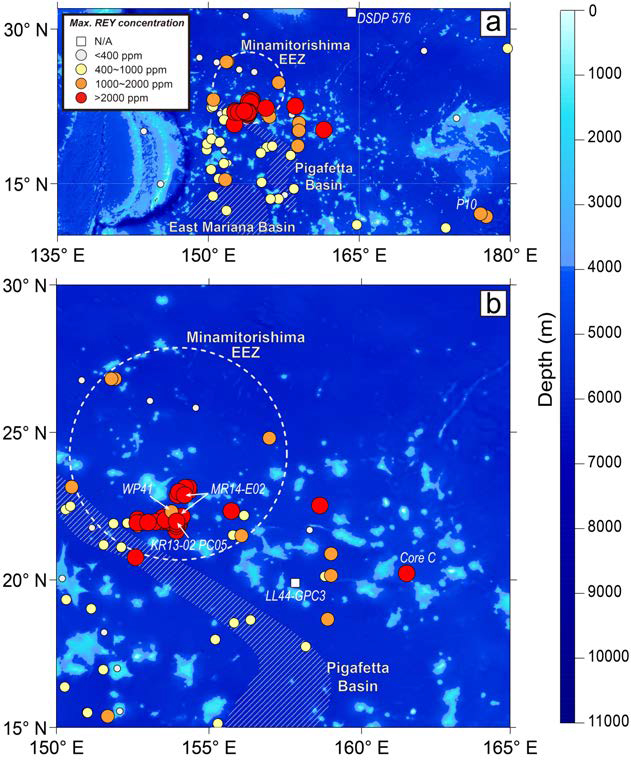
Spatial distribution of maximum REY concentrations (ΣREY; in ppm) in deep-sea sediments in Northwestern Pacific (a), and a zoomed-in view around the Minamitorishima EEZ from the same region (b). The color-coded circles represent different concentration ranges: gray (<400 ppm), yellow (400–1000 ppm), orange (1000–2000 ppm), and red (>2000 ppm). White squares indicate sites where REY data are not available (N/A) yet cited in text.
북서태평양 해역 내 REY 고함유 점토(ΣREY>400 ppm)가 보고된 지역의 퇴적물 코어 내 수직적 REY 변화를 살펴보면, 대체로 표층으로부터 2-13 m 깊이의 층준에서 급격한 REY의 부화가 관찰되며(1st REY peak), 상하부 각각의 층준(Unit Ⅱ, Ⅲ)에서 나타나는 지화학적 특성도 대체로 유사하다(그림 2) (Tanaka et al., 2020a). 이러한 REY 피크가 북서태평양 해저분지 내에서 동시기에 형성되었을 가능성에 착안, 미나미토리시마 EEZ 내 및 인근 해역에 한해 적용될 수 있는 화학층서가 제안된 바 있다(Tanaka et al., 2020a, 2020b).
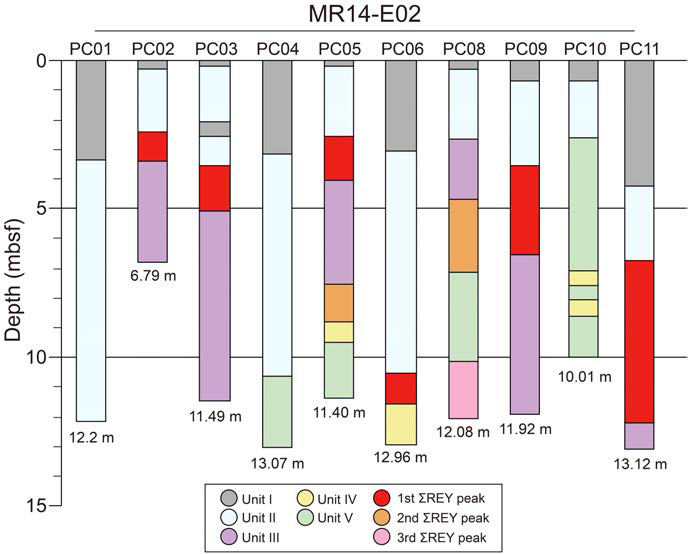
Chemostratigraphic correlation in MR14-E02 cores from the Northwestern Pacific (adopted from Tanaka et al., 2020a). REY peak: ΣREY (ppm) > 2000, Unit I: Ba (ppm) > Co (ppm) + 330 (ppm) and ΣREY (ppm) < 400, Unit II: TiO2 (wt.%) > 0.7 and ΣREY (ppm) > 400, Unit III: Fe2O3* (wt.%)/TiO2 (wt.%) >11 and ΣREY (ppm) > 400, Unit IV: P2O5 (wt.%)/ΣREY (ppm) > 0.0018 and ΣREY (ppm) > 400, Unit V: the remaining samples.
2.2. 동태평양, 중앙 북태평양, 남태평양
동태평양, 중앙 북태평양, 남태평양 해역은 REY 고함유 점토층이 최초로 보고된 해역으로, 특히 동태평양 해팽(East Pacific Rise)에 가까운 해역에서 최대 ΣREY가 약 1,500 ppm 이상의 농도로 나타나 이들의 농집에 열수가 기여했다는 해석이 제안되었다(Kato et al., 2011; Seo et al., 2014). 그러나 상대적으로 수심이 얕고 퇴적률이 높은 일부 해역을 제외하면, 동태평양 해팽의 영향이 작은 중앙 북태평양 해역의 천부 퇴적층에서도 REY 고함유 점토가 흔히 나타난다(Kato et al., 2011; Tanaka et al., 2023; 그림 3).
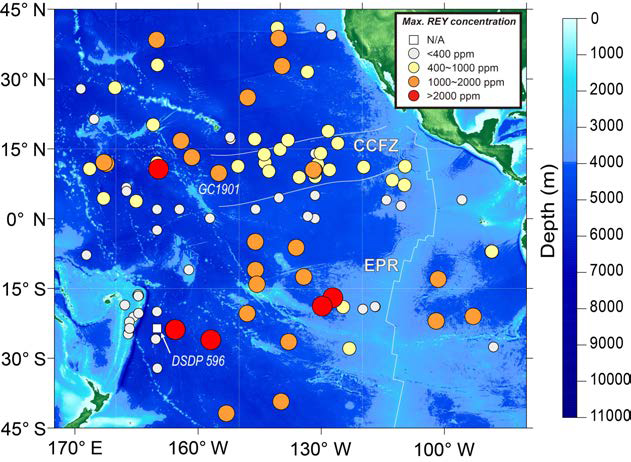
Spatial distribution of maximum REY concentrations (ppm) in deep-sea sediments in Central and Eastern Pacific. The color coding follows the classification used in Figure 1.
남태평양에서는 크게 통가 해구와 동태평양 해팽 사이의 심해저 분지에서 최대 4,662 ppm에 이르는 REY 고함유 점토의 분포가 보고되었다(e.g., Kato et al., 2011; Dunlea et al., 2015; Yasukawa et al., 2016; Zhou et al., 2020, 2021; Ohta et al., 2021; Tanaka et al., 2023). 남태평양은 북서태평양에 비해 보고된 ΣREY의 극댓값은 낮으나, 약 2 m 이내 깊이의 천부 지층의 ΣREY가 높은 지역들이 많다는 점에서 주목할 만하다.
2.3. 인도양 및 대서양
인도양 및 대서양은 평균적으로 태평양에 비해 퇴적물 내 REY 함량이 낮게 나타난다. 인도양은 대체로 400 ppm 이하의 낮은 최대 ΣREY를 나타내나 퇴적물 희석의 영향이 비교적 작은 남동인도양에서 상대적으로 높은 희토류 함량이 나타난다(그림 4). 중앙인도양분지(Mid-Indian Basin)에서 최대 1,737 ppm의 REY 고함유 점토가 보고되었으며(Zhang et al., 2017, 2023; Yu et al., 2021). 동인도양 와튼 분지(Wharton Basin) 에서도 약 1,100 ppm의 최대 ΣREY를 나타내는 지역이 발견되었다(Pattan et al., 1995; Yasukawa et al., 2014). 대체적인 인도양의 희토류 함량에 비해 높은 함량의 희토류가 산출되는 곳은 상대적으로 수심이 깊은 해저분지 내부에 위치한다.
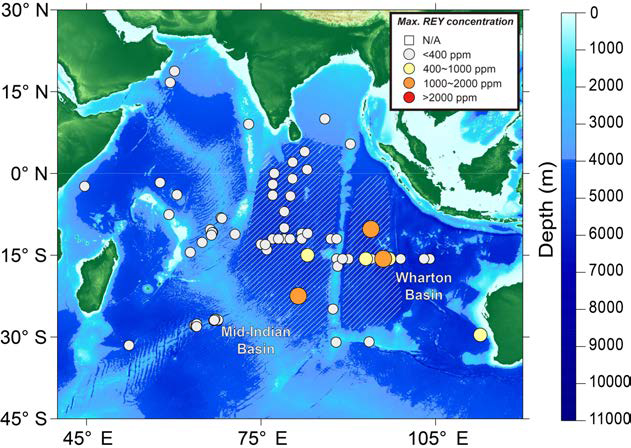
Spatial distribution of maximum REY concentrations (ppm) in deep-sea sediments in Indian Ocean. The color coding follows the classification used in Figure 1.
대서양은 전체적으로 희토류 함량이 400 ppm 이하이며 보고된 데이터의 수도 태평양, 인도양에 비해 현저히 적다(그림 5). 북대서양에서는 ΣREY 400 ppm 이상의 퇴적물의 존재가 보고되지 않았으나, 현재까지의 데이터가 표층퇴적물에 한정되어 하부의 희토류 함량은 알려지지 않았다. 남대서양에서는 최대 1,392 ppm의 희토류 함량이 보고되었다(Zhang et al., 2017).
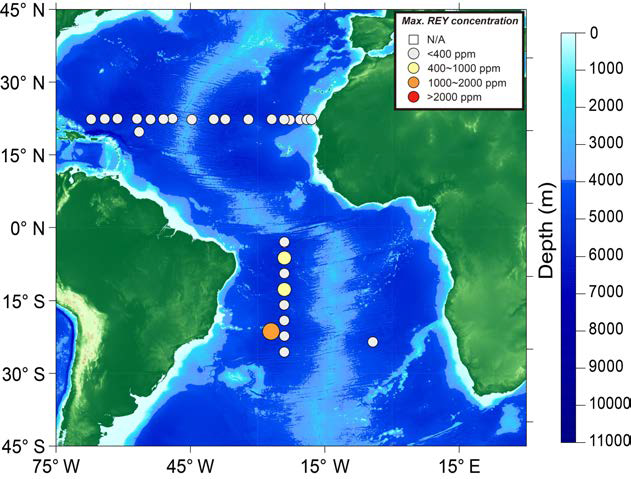
Spatial distribution of maximum REY concentrations (ppm) in deep-sea sediments in Atlantic Ocean. The color coding follows the classification used in Figure 1. CCFZ: Clarion-Clipperton fracture zone; EPR: East Pacific Rise.
2.4. 해역별 REY 분포 특성의 시사점
퇴적물 내 REY의 공간적 분포 특성을 종합하면, 대륙 기원 물질의 유입, 높은 생산성에 기인한 탄산염 및 생물 기원 규질 퇴적물 공급, 낮은 수심으로 인한 탄산염의 양호한 보존 등으로 인한 희석 효과로 전반적인 퇴적률이 높은 해역에서 REY의 함량이 낮게 나타난다. 이에 따라 전 해양에서 대륙 주변부는 퇴적물 내 REY 함량이 낮은 양상을 보이며, 특히 인도양 및 대서양은 일부 분지중심부를 제외하고는 대륙 기원 퇴적물의 유입량과 탄산염포화도가 높아 대체로 태평양에 비해 REY 함량이 낮다(그림 4, 5; Yu et al., 2021). 또한, 동태평양의 멕시코 남서부는 주변에 대해 상대적으로 ΣREY가 낮은 것을 볼 수 있고(그림 3), 이는 멕시코 연안에서 강하구 퇴적물 유입의 영향으로 보인다(Romero-Rodriguez et al., 2020). 남태평양 퇴적물은 다른 해역, 특히 태평양 역 내에서도 전반적으로 높은 ΣREY를 나타내는데, 남태평양이 북태평양에 비해 대륙 기원 쇄설물의 유입이 낮기 때문으로 판단된다(Yasukawa et al., 2016; Tanaka et al., 2023). 다만 신생대 동안 태평양판의 이동으로 인한 대륙과의 거리 감소, 신생대의 장기적 한랭화 및 건조화에 따른 풍성입자의 유입량 증가는 표층 및 천부퇴적층의 ΣREY의 감소를 야기하였을 것으로 보인다(Yasukawa et al., 2016; Ohta et al., 2021; Tanaka et al., 2023).
쇄설성 퇴적물의 유입이 제한적인 해역에서는 생물 기원 퇴적물의 생산 및 보존이 주된 희석 요인으로 작용한다. 주변 심해저분지에 비해 비교적 낮은 ΣREY를 나타내는 동태평양 적도 해역(그림 3)은 생물 생산성이 높아 생물 기원 퇴적물, 특히 탄산염 및 규질 연니의 공급이 활발하며 이들의 빠른 매몰로 퇴적 후 보존 역시 주변 심해저분지에 비해 양호하다. 이처럼 수심 및 표층생산성의 영향, 주변 대륙으로부터의 쇄설성 퇴적물 유입은 해역별 REY 분포특성을 좌우하는 일차적 조절인자이며, 이외에도 인근의 열수활동, 심층해류, 생물기원 인산염의 공급량 등이 해역별 REY 분포에 영향을 미칠 것으로 예상할 수 있다.
3. 부존 특성과 REY 농집 기작
원양성 심해퇴적물은 주로 대륙으로부터 유입되는 쇄설성 퇴적물, 표층 또는 중층해양으로부터 생산되는 생물 기원 연니, 수층 및 저서에서 형성되는 자생(authigenic) 광물로 구성된다. 이들 중 각 성분의 함량이 ΣREY와의 양의 상관관계를 나타내 REY의 주 배태상으로 제안되었던 광물은 필립사이트(phillipsite)(Piper, 1974; Kato et al., 2011), 철-망가니즈 산화물(Fe-Mn oxides) 등의 자생광물(Kato et al., 2011; Seo et al., 2014), 생물 골격 파편의 속성작용 산물인 생물기원 인회석(biogenic calcium phosphate; bioapatite or BCP) 등이다(Fujinaga et al., 2016; Iijima et al., 2016; Wang et al., 2016; Tanaka et al., 2020a).
여러 선행 연구들은 퇴적물 내 P2O5함량과 ΣREY간의 뚜렷한 양의 상관관계, 탄산염/인산염, 철-망가니즈 산화물, 자철석 등 다양한 광물상의 개별적 용해를 통한 순차적 침출실험 등을 통해 심해퇴적물 내 REY의 70% 이상이 생물기원 인회석에 포함되어 있음을 밝혔다(Kon et al., 2014; Fujinaga et al., 2016; Iijima et al., 2016; Tanaka et al., 2020a; Kim et al., 2022; 그림 6). 생물기원 인회석은 주로 어류의 치아 및 골격의 파편이 퇴적 후 재결정된 산물로, 재결정 과정에서 REY가 농집된다고 알려져 있다(Liao et al., 2019). 이들은 철-망가니즈 산화물에 비해 약 13배, 필립사이트, 석영 등 기타 광물에 대해 약 200배의 희토류 축적 잠재력을 보인다(Kon et al., 2014). 특히 어류 치아는 법랑질(enamel), 상아질(dentin), 치수(pulp)로 구성되며 치수를 통해 유입된 희토류는 상아질에 농집되고 다른 부위보다 치밀한 구조의 법랑질은 희토류의 치아 외부 유출을 막으며 치아가 보존되는 데에 중요한 역할을 한다(그림 7; Liao et al., 2019; Huang et al., 2023).
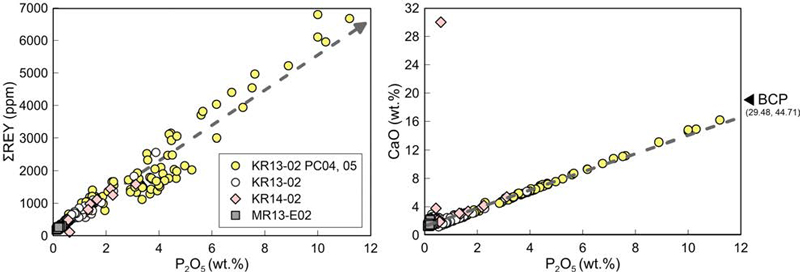
P2O5 versus total REY (left) and CaO of sediment core samples (right) in the Minamitorishima EEZ. P2O5 and ΣREY show positive correlation (R = 0.98). Linear regression line between CaO and P2O5: CaO=1.28×P2O5+1.24, Stoichiometric ratio of BCP: 1.52 (Kon et al., 2014). KR13-02 PC04, 05: Iijima et al. (2016); KR13-02, KR14-02, MR13-E02: Fujinaga et al. (2016).
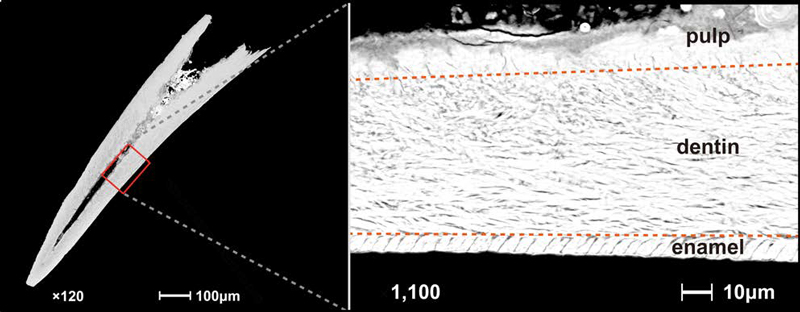
SEM images of bioapatite fossil recovered from Northwestern Pacific deep-sea sediments (688 cm depth in WP21GPC04 core, unpublished).
철-망가니즈 산화물은 미소단괴, 비정질 철산화-수산화물 등의 형태로 존재하며 특히 Clarion-Clipperton fracture zone (CCFZ) 등의 해역에서는 동태평양 해팽의 열수로부터 기원한 REY를 흡착하는 것으로 제안되었다(Kato et al., 2011; Seo et al., 2014). 이들은 REY의 주 배태광물 중 하나이나, 최근의 연구들은 퇴적 후 매몰 과정 중 공극수로 상당량의 REY를 방출하고 생물 기원 인회석으로의 농집을 돕는다고 제안하였다(Kashiwabara et al., 2018; Liao et al., 2019; Kim et al., 2022; Huang et al., 2023). 철-망가니즈 산화물은 환원 용해(reductive dissolution), 광물 변환(mineral transformation), 흡착-탈착 평형(adsorption-desorption equilibrium) 등의 과정을 통해 공극수로 REY를 용출하는 것으로 보인다(Kashiwabara et al., 2018).
필립사이트(phillipsite)는 불석(zeolite)군에 속하는 자생광물의 일종으로, 주로 화산성 물질의 저온 변질산물로서 형성된다(Bonatti, 1963; Petzing and Chester, 1979; Iyer et al., 2018). REY 고함유 층준에 필립사이트가 풍부하게 산출되는 현상은 많은 연구에 의해 보고되었으나(Piper, 1974; Kato et al., 2011; Wang et al., 2016; Liao et al., 2022), 필립사이트에는 REY가 특별히 농집되지 않으므로 주요 배태광물에서는 제외되었다(Dubinin, 2000; Kon et al., 2014; Li, S. et al., 2023). 다만 REY의 농집과 필립사이트의 생성은 특정 사건에 의한 동시기적 결과로 추정되고(Kon et al., 2014; Yasukawa et al., 2014; Ohta et al., 2016), 필립사이트의 형성은 철-망가니즈 산화물의 형성을 도와 결과적으로는 REY의 농집에 긍정적 효과를 나타낼 가능성 역시 제안되었다(Burns and Burns, 1978; Li, S. et al., 2023).
현재까지의 가설을 정리하면, 초기에는 REY가 농집에 기여하는 배태광물로 필립사이트(phillipsite), 생물기원 인회석, 철-망가니즈 산화물 등이 제안되었으나, 최근의 연구들은 인산염, 특히 생물기원 인회석이 REY가 농집되는 일차적인 광물상(primary host phase)이며, 철-망가니즈 산화물은 이차적 광물상(secondary phase) 또는 농집 기작에 참여하는 운반물(carrier)로 간주한다. 해수 및 열수로부터 기원한 REY는 어류 골격의 파편이 재결정되는 과정에서 생물 기원 인회석 내 포함된다. 특히 열수활동이 활발한 지역에서는 Fe2+, Mn2+, Si4+ 등이 철-망가니즈 산화물 및 점토의 형태로 빠르게 산화 및 광물화되며 REY는 이들에 포획된다. 인회석 농도가 높지 않은 지역에서는 철-망가니즈 산화물 역시 주요한 배태광물 중 하나로서 존재한다. 이들 철-망가니즈 산화물은 매몰 후 속성과정 동안 공극수로 용출, 생물기원 인회석의 재결정과정 동안 추가 REY 공급원으로서 작용하여 REY의 고농도 부존을 돕는다(그림 8).
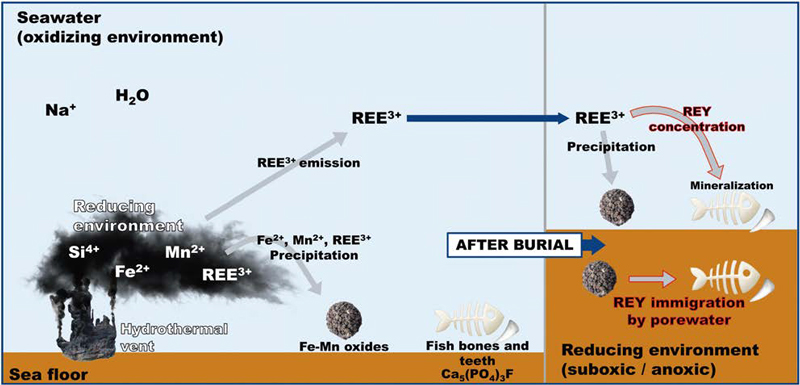
Schematic diagram of REY accumulation mechanism of deep-sea sediments.
4. 태평양 심해퇴적물 내 REY 농집 시기에 대한 가설
상술한 해역별 REY 분포 특성, 주 배태광물과 농집기작을 고려하면, 열수활동과 생물 기원 인회석의 공급, 쇄설성 퇴적물과 석회질 및 규질의 생물 기원 퇴적물의 희석 효과 등이 REY의 농집을 조절하는 가장 중요한 변수로 여겨진다. 흥미롭게도 REY는 심해퇴적물의 일부 층준에서 고농도로 산출되는 경향을 보이며, 이들의 농집사건은 특정한 지질 시대 동안 REY 농집에 우호적인 해양환경이 존재했음을 시사한다. 그러나 해역별 농집사건의 발생 시기는 특정되지 않았으며, 이는 원양성 퇴적물 연대모델 수립의 어려움에서 크게 기인한다. 퇴적물 내 REY의 농집은 쇄설성, 화산쇄설성, 생물 기원 퇴적물 등에 의한 희석이 미미한 해역에서 나타나며, 예로써 초고농도 REY의 농집이 최초로 보고된 북서태평양 해산지대는 쇄설성 퇴적물의 유입이 적고 탄산염 보상심도(carbonate compensation depth; CCD) 이상의 수심이 일반적이며, 약 0.1 cm/kyr 또는 그 이하의 선형퇴적률이 흔히 나타난다. 이러한 특성으로 인해 퇴적기록의 시간적 해상도가 매우 낮으며, 낮은 표층생산성과 생물기원 퇴적물의 불량한 보존, 화산쇄설물의 부재는 심해퇴적물에서 일반적으로 이용되는 생층서적, 화학층서적 기법의 적용을 어렵게 한다. 이러한 퇴적물의 특성으로 인해 REY 농집구간의 형성 시기는 매우 제한적으로 연구되었으며, 그 결과도 연구방법과 해역에 따라 상이하다(Ohta et al., 2020; Bi et al., 2021; Wang, F. et al., 2021; Wang, T. et al., 2023).
Wang, F. et al. (2021)과 Wang, T. et al. (2023)은 동태평양의 CCFZ 및 중앙태평양 연장부에서 위치가 특정되지 않은 퇴적물코어 P10 및 GC1901 내 어류 치아의 개별 Sr 동위원소비(87Sr/86Sr)와 화학층서를 기반으로 REY 고함유 구간의 형성연대를 올리고세-전기마이오세(32-20 Ma)로 제한하였다(그림 1a, 3). 이들이 제안한 연대는 인근의 DSDP Site 163(Van Andel et al., 1973)에서 제안된 생층서적 연대모델과 크게 다르지 않아 신뢰도가 높다고 판단된다.
Bi et al. (2023)은 10Be/9Be 연대측정과 과잉 230Th (excess 230Th), 고지자기 층서를 결합하여 서태평양 Markus-Wake 해산지대의 코어(Core C; 그림 1b)에 나타나는 REY 농집 구간의 연대를 9.5-11.5 Ma로 제한하였다. 이들은 다양한 층서적 방법을 상호보완적으로 사용하였다는 점에서 그 의의가 크다고 할 수 있다. 그러나 이들이 제시한 연대모델은 현재 북서태평양 심해저분지의 평균퇴적률(0.2 cm/kyr) (Moon et al., 2003)을 크게 웃도는 높은 선형퇴적률(0.6-7.5 cm/kyr)을 요구하며, 10Be의 생성률이나 매몰속도가 시대 또는 퇴적환경의 영향을 받는 점,230Th의 반감기가 약 75 kyr로 짧고, 고지자기층서를 활용하기에는 퇴적률이 극심히 낮은 점을 고려할 때 연대를 과소평가했을 가능성이 있다. 다만 해저산의 사면 및 기저부의 퇴적률이 국지적으로 주변 해저분지에 비해 높게 나타났을 가능성 역시 배제할 수 없다(Ohta et al., 2022).
한편 어류 치아의 매몰 후 REY와 함께 우라늄이 축적되는 현상을 이용, 북서태평양 퇴적물코어 WP41의 REY 고함유층준의 어류 치아 인회석의 U-Pb 연대 분석을 통해 해당 해역의 평균퇴적률을 약 0.14 cm/kyr 로 제시하고, 서태평양의 REY 고함유 층준이 마이오세 후기(~6.5 Ma) 이전에 형성되었다고 제안하였다(Li, D. et al., 2023). 해당 연구는 분석 대상 코어의 REY 농도를 제시하거나 농집층준에서 직접적으로 연대를 분석하지 않아 서태평양 전체의 농집시기를 신뢰도 높게 제시한다고 보기 어렵다. 다만 생물 기원 인회석 내 매우 낮은 U 농도와 보통납(common lead)의 오염문제로 인해 시도하기 어려웠던 심해퇴적물의 연대측정 활용 가능성을 제시했다는 데 그 의의가 있다.
Ohta et al. (2020)는 해수의 Os 동위원소비(187Os/188Os) 화학층서, 어류 치아 화석(ichthyolith) 생층서를 기반으로 태평양 내 여러 심해퇴적물 코어(DSDP 576, KR13-02 PC05, LL44-GPC3, GH83-3 P406, DSDP 596; 그림 1, 3)의 퇴적연대 모델을 수립하였다. 이들에 따르면 어류 파편의 축적속도(fish debris accumulation rate; FAR)는 에오세 후기인 약 34.5 Ma에 매우 높게 나타나며, 해당 시기 어류의 번성으로 생물기원 인회석이 농집되었다는 가설을 제안하였다. 그러나 이 연대모델은 REY 농집구간의 선형퇴적률과 FAR을 비현실적으로 높게 평가하는 문제가 있으며, 이후 Usui and Yamazaki (2021)는 인근 지역의 고지자기 자료를 근거로 Os의 퇴적 후 교란 가능성을 제기하고, 실제 REY 농집 사건은 30 Ma 이후까지 지속되었을 것이라고 예상하였다.
5. 서태평양 심층해류 강화 사건의 동시기성에 대한 고찰
최근의 연구들은 생물기원 인회석이 REY의 주요 배태광물이며 이들의 재결정과정에서 REY의 부화가 발생한다는 전제를 공통적으로 받아들이고 있다. 이외의 퇴적물들은 대체로 희석 효과로 인회석의 함량을 낮추며, 빠른 매몰로 충분한 REY의 농집을 저해하는 요소로 평가되었다. REY 농집에 유리한 해양학적 조건으로 제안된 가설들을 종합하면 1) 영양염류의 축적과 이후 용승으로 인한 어류의 번성과 생물기원 인회석 공급량의 극적인 증가(Ohta et al., 2020), 2) 강화된 심층 또는 저층류에 의한 REY 배태광물의 선택적 퇴적(Bi et al., 2023; Li, D. et al., 2023), 3) 운반자인 철-망가니즈 산화물 생성에 필요한 열수활동 및 산화환경 조성(Bi et al., 2023)등으로 정리할 수 있다. 이러한 저서환경의 형성 원인은 대체로 심층해류의 강화로 귀결되는데, 심층해류가 해저산 주변에서의 용승을 촉진하여 생산성을 높이며 비점착성 퇴적물 성분의 침식 또는 재동을 유발하여 퇴적률을 감소시키거나 퇴적중단을 유발할 가능성이 있으므로, REY 고함유층의 형성에 유리한 조건을 조성할 것으로 여겨지기 때문이다.
이와 같은 가정으로부터, 북서태평양에서 수행된 많은 연구들은 REY 농집사건의 발생이 태평양 심층해류의 강화에 기인한다고 제안되었다(Ohta et al., 2020; Wang, F. et al., 2021; Bi et al., 2023, 2024; Li, D. et al., 2023; Wang, T. et al., 2023). 또한 북서태평양 심해퇴적물에서 관찰되는 코어간 화학층서적 유사성은, 일부 코어에서 관찰되는 두 개의 REY 극대 층준이 각각 지역적 심층해류 강화 사건에 기인할 가능성을 시사하였다(Tanaka et al., 2020a, 2020b). 이러한 가능성은 이는 신생대 동안 대양에서의 인산염화 작용이 여러 번의 사건으로서 나타났던 사례와 함께(e.g., Hein et al., 1993; Hyeong et al., 2013; Peng et al., 2024) 동일한 심층해류 강화 사건이 넓은 지역의 REY 농집 사건을 발생시켰으리라는 가설로 확장되기도 하였다(e.g., Bi et al., 2023; Li, D. et al., 2023).
다만 연구 대상 해역별, 또는 해역 내 인접한 코어간에도 농집층준의 깊이, 층서적 분포양상이나 형성 시기간의 불일치가 나타나는 현상은 농집사건의 동시기성에 대한 면밀한 고찰 및 재검토의 필요성을 시사한다. 신생대 동안 발생한 퇴적중단 사건들은 주요 해협 및 해양 수문의 고지리적 변화와 극지방 대륙빙상의 형성 등의 전지구적 규모의 현상과 결부되어 해석되어 왔으나, 장기간의 심층–저층해류의 변화양상 복원은 주요 해협이나 대서양 자오순환 등에 집중적으로 행해져 이외의 해역에 대한 이해는 크게 부족하다. 더불어 개별 코어에서 인지되는 퇴적기록 중단 또는 침식은 지형류로 인한 콘투어라이트 드리프트(contourite drift) 등의 국지적인 현상의 결과로 나타나므로(Dutkiewicz and Müller, 2022), 북서태평양 해산지대 등의 복잡한 해저지형으로부터 특정 해역 내 심층해류의 영향을 파악하기 위해서는 공간적, 시간적으로 상당한 양과 규모의 시료와 데이터를 기반으로 하여야 한다. 또한 국지적 지형류의 영향으로 발생할 수 있는 침식과 재퇴적은 동일한 퇴적기작과 연속퇴적을 가정하는 화학층서의 적용을 어렵게 하며, 퇴적률이 극도로 낮은 REY 농집 해역에서의 유효성을 신중히 검토할 필요가 있다.
6. 결 언
본 논평은 해역별 REY의 분포 양상, 광물 내 농집 기작, 부화의 시기와 해양학적 기작에 대한 연구를 종합적으로 검토하였다. REY의 해역별 분포, 부존 특성 및 농집 기작에 대해서는 최근 이해가 크게 증대되었으나, 북서태평양 심해퇴적물 연구 사례에서와 같이, REY 농집 사건의 시기와 고해양학적 의의에 대해서는 다양한 추가 연구가 필요할 것으로 판단된다. 향후 연구에서는 다수의 인접 코어에 대해 다양한 연대 측정 기법(e.g., U-Pb, Sr isotope, Os isotope 등)을 활용, 연대모델의 공간적인 변이를 기반으로 REY 농집 사건의 동시기성에 대한 전면적 재검토와 상세한 논의가 요구된다. 이를 바탕으로 지역적 해양 순환 변화, 퇴적 기작에 대한 시공간적 변화 양상을 해석하고, 나아가 해역간의 비교를 통해 전 지구적 해양환경 변화와의 연관성을 파악할 필요가 있다. 이러한 연구들은 REY 농집 사건의 고해양학적 의의를 부여하는 한편, REY 자원의 효율적인 탐사 전략 수립에 기여할 수 있을 것으로 기대된다.
Acknowledgments
논문을 검토하고 건설적 의견을 주신 편집위원, 심사위원들께 감사드립니다. 본 연구는 해양수산부 재원으로 해양수산과학기술진흥원의 해양수산 연구인프라 공동활용 지원사업(RS-2023-KS231696), 서태평양 해저산 고코발트 망간각 자원개발 유망광구 선정 사업(RS-2022-KS221644(20220509))의 지원을 받아 수행되었습니다.
References
-
Bao, Z. and Zhao, Z., 2008, Geochemistry of mineralization with exchangeable REY in the weathering crusts of granitic rocks in South China. Ore Geology Reviews, 33, 519-535.
[https://doi.org/10.1016/j.oregeorev.2007.03.005]

-
Bi, D., Shi, X., Huang, M., Shen, F., Yu, M., Zhang, Y., Shi, F. and Liu, J., 2024, Enhanced deep-water circulation facilitated rare earth elements enrichment in pelagic sediments from the northwestern Pacific Ocean. Global and Planetary Change, 242, 104564.
[https://doi.org/10.1016/j.gloplacha.2024.104564]
-
Bi, D., Shi, X., Huang, M., Yu, M., Shen, F., Liu, J., Zhou, T., Chen, T., Shi, F., Wang, X., Qiang, X. and Liu, J., 2023, Dating pelagic sediments from the northwestern Pacific Ocean by integration of Multi-geochronologic approaches. Ore Geology Reviews, 161, 105614.
[https://doi.org/10.1016/j.oregeorev.2023.105614]
-
Bi, D., Shi, X., Huang, M., Yu, M., Zhou, T., Zhang, Y., Zhu, A., Shi, M. and Fang, X., 2021, Geochemical and mineralogical characteristics of deep-sea sediments from the western North Pacific Ocean: Constraints on the enrichment processes of rare earth elements. Ore Geology Reviews, 138, 104318.
[https://doi.org/10.1016/j.oregeorev.2021.104318]
-
Bonatti, E., 1963, Section of geological sciences: Zeolites in Pacific pelagic sediments. Transactions of the New York Academy of Sciences, 25, 938-948.
[https://doi.org/10.1111/j.2164-0947.1963.tb01930.x]
- Burns, V.M. and Burns, R.G., 1978, Authigenic todorokite and phillipsite inside deep-sea manganese nodules. American Mineralogist, 63, 827-831.
-
Dubinin, A.V., 2000, Geochemistry of rare earth elements in oceanic phillipsites. Lithology and Mineral Resources, 35, 101-108.
[https://doi.org/10.1007/BF02782672]
-
Dunlea, A.G., Murray, R.W., Sauvage, J., Pockalny, R.A., Spivack, A.J., Harris, R.N. and D'Hondt, S., 2015, Cobalt-based age models of pelagic clay in the South Pacific Gyre. Geochemistry, Geophysics, Geosystems, 16, 2694-2710.
[https://doi.org/10.1002/2015GC005892]
-
Fujinaga, K., Yasukawa, K., Nakamura, K., Machida, S., Takaya, Y., Ohta, J., Araki, S., Liu, H., Usami, R., Maki, R., Haraguchi, S., Nishio, Y., Usui, Y., Nozaki, T., Yamazaki, T., Ichiyama, Y., Ijiri, A., Inagaki, F., Machiyama, H., Iijima, K., Suzuki, K. and Kato, Y., 2016, Geochemistry of REY-rich mud in the Japanese Exclusive Economic Zone around Minamitorishima Island. Geochemical Journal, 50, 575-590.
[https://doi.org/10.2343/geochemj.2.0432]
-
Hein, R., Yeh, H.-W., Gunn, H., Sliter, V. and Benninger, M., 1993, Two major Cenozoic episodes of phosphogenesis recorded in Equatorial Pacific seamount deposits. Paleoceanography, 8, 293–311.
[https://doi.org/10.1029/93PA00320]
-
Huang, F., Fu, Y., Li, D., Peng, J., He, W., Li, S., Sun, X. and He, G., 2023, Early diagenetic REE migration from Fe-Mn nodules to fish teeth in deep sea sediments. Ore Geology Reviews, 160, 105581.
[https://doi.org/10.1016/j.oregeorev.2023.105581]
-
Hyeong, K., Kim, J., Yoo, C.M., Moon, J.W. and Seo, I., 2013, Cenozoic history of phosphogenesis recorded in the ferromanganese crusts of central and western Pacific seamounts: Implications for deepwater circulation and phosphorus budgets. Palaeogeography, Palaeoclimatology, Palaeoecolgy, 392, 293-301.
[https://doi.org/10.1016/j.palaeo.2013.09.012]
-
Iijima, K., Yasukawa, K., Fujinaga, K., Nakamura, K., Machida, S., Takaya, Y., Ohta, J., Haraguchi, S., Nishio, Y., Usui, Y., Nozaki, T., Yamazaki, T., Ichiyama, Y., Ijiri, A., Inagaki, F., Machiyama, H., Suzuki, K. and Kato, Y., 2016, Discovery of extremely REY-rich mud in the western North Pacific Ocean. Geochemical Journal, 50, 557-573.
[https://doi.org/10.2343/geochemj.2.0431]
- Iyer, S.D., Pinto, S.M. and Sardar, A.A., 2018, Characteristics and genesis of phillipsite grains in a sediment core from the Central Indian Ocean Basin. Indian Journal of Geo-Marine Sciences, 47, 1121-1131.
-
Kashiwabara, T., Toda, R., Nakamura, K., Yasukawa, K., Fujinaga, K., Kubo, S., Nozaki, T., Takahashi, Y., Suzuki, K. and Kato, Y., 2018, Synchrotron X-ray spectroscopic perspective on the formation mechanism of REY-rich muds in the Pacific Ocean. Geochimica et Cosmochimica Acta, 240, 274-292.
[https://doi.org/10.1016/j.gca.2018.08.013]
-
Kato, Y., Fujinaga, K., Nakamura, K., Takaya, Y., Kitamura, K., Ohta, J., Toda, R., Nakashima, T. and Iwamori, H., 2011, Deep-sea mud in the Pacific Ocean as a potential resource for rare-earth elements. Nature Geoscience, 4, 535-539.
[https://doi.org/10.1038/ngeo1185]
-
Kim, M.G., Hyeong, K. and Yoo, C.M., 2022, Distribution of Rare Earth Elements and Yttrium in Sediments From the Clarion-Clipperton Fracture Zone, Northeastern Pacific Ocean. Geochemistry, Geophysics, Geosystems, 23, e2022GC010454.
[https://doi.org/10.1029/2022GC010454]
-
Kon, Y., Hoshino, M., Sanematsu, K., Morita, S., Tsunematsu, M., Okamoto, N., Yano, N., Tanaka, M. and Takagi, T., 2014, Geochemical Characteristics of Apatite in Heavy REE-rich Deep-Sea Mud from Minami-Torishima Area, Southeastern Japan. Resource Geology, 64, 47-57.
[https://doi.org/10.1111/rge.12026]
-
Li, D., Peng, J., Chew, D., Liang, Y., Hollings, P., Fu, Y., Dong, Y. and Sun, X., 2023, Dating rare earth element enrichment in deep-sea sediments using U-Pb geochronology of bioapatite. Geology, 51, 428-433.
[https://doi.org/10.1130/G50938.1]
-
Li, S., Fu, Y., Li, D., Huang, F., Sun, X. and He, G., 2023, Phillipsite in pelagic REY-rich sediments and ferromanganese nodules from the Western Pacific: Geochemical characteristics and implications for REY enrichments. Ore Geology Reviews, 161, 105631.
[https://doi.org/10.1016/j.oregeorev.2023.105631]
-
Liao, J., Chen, J., Sun, X., Wu, Z., Deng, Y., Shi, X., Wang, Y., Chen, Y. and Koschinsky, A., 2022, Quantifying the controlling mineral phases of rare-earth elements in deep-sea pelagic sediments. Chemical Geology, 595, 120792.
[https://doi.org/10.1016/j.chemgeo.2022.120792]
-
Liao, J., Sun, X., Li, D., Sa, R., Lu, Y., Lin, Z., Xu, L., Zhan, R., Pan, Y. and Xu, H., 2019, New insights into nanostructure and geochemistry of bioapatite in REE-rich deep-sea sediments: LA-ICP-MS, TEM, and Z-contrast imaging studies. Chemical Geology, 512, 58-68.
[https://doi.org/10.1016/j.chemgeo.2019.02.039]
-
Mancheri, N.A., 2015, World trade in rare earths, Chinese export restrictions, and implications. Resources Policy, 46, 262-271.
[https://doi.org/10.1016/j.resourpol.2015.10.009]
-
Mimura, K., Nakamura, K., Yasukawa, K., Machida, S., Ohta, J., Fujinaga, K. and Kato, Y., 2019, Significant impacts of pelagic clay on average chemical composition of subducting sediments: New insights from discovery of extremely rare-earth elements and yttrium-rich mud at Ocean Drilling Program Site 1149 in the western North Pacific Ocean. Journal of Asian Earth Sciences, 186, 104059.
[https://doi.org/10.1016/j.jseaes.2019.104059]
-
Moon, D.-S., Hong, G.-H., Kim, Y.I., Baskaran, M., Chung, C.S., Kim, S.H., Lee, H.-J., Lee, S.-H. and Povinec, P.P., 2003, Accumulation of anthropogenic and natural radionuclides in bottom sediments of the Northwest Pacific Ocean. Deep Sea Research Part II: Topical Studies in Oceanography, 50, 2649-2673.
[https://doi.org/10.1016/S0967-0645(03)00140-1]
-
Ohta, J., Yasukawa, K., Machida, S., Fujinaga, K., Nakamura, K., Takaya, Y., Iijima, K., Suzuki, K. and Kato, Y., 2016, Geological factors responsible for REY-rich mud in the western North Pacific Ocean: Implications from mineralogy and grain size distributions. Geochemical Journal, 50, 591-603.
[https://doi.org/10.2343/geochemj.2.0435]
-
Ohta, J., Yasukawa, K., Nakamura, K., Fujinaga, K., Iijima, K. and Kato, Y., 2021, Geological features and resource potential of deep-sea mud highly enriched in rare-earth elements in the Central Pacific Basin and the Penrhyn Basin. Ore Geology Reviews, 139, 104440.
[https://doi.org/10.1016/j.oregeorev.2021.104440]
-
Ohta, J., Yasukawa, K., Nozaki, T., Takaya, Y., Mimura, K., Fujinaga, K., Nakamura, K., Usui, Y., Kimura, J.-I., Chang, Q. and Kato, Y., 2020, Fish proliferation and rare-earth deposition by topographically induced upwelling at the late Eocene cooling event. Scientific Reports, 10, 9896.
[https://doi.org/10.1038/s41598-020-66835-8]
-
Ota, Y., Suzumura, M., Tsukasaki, A., Suzuki, A., Seike, K. and Minatoya, J., 2022, Sediment accumulation rates and particle mixing at northwestern Pacific seamounts. Journal of Marine Systems, 229, 103719.
[https://doi.org/10.1016/j.jmarsys.2022.103719]
-
Pak, S.J., Seo, I., Lee, K.Y. and Hyeong, K., 2019, Rare earth elements and other critical metals in deep seabed mineral deposits: Composition and implications for resource potential. Minerals, 9, 3.
[https://doi.org/10.3390/min9010003]
-
Pattan, J.N., Rao, C.M., Higgs, N.C., Colley, S. and Parthiban, G., 1995, Distribution of major, trace and rare-earth elements in surface sediments of the Wharton Basin, Indian Ocean. Chemical Geology, 121, 201-215.
[https://doi.org/10.1016/0009-2541(94)00112-L]
-
Peng, J., Li, D., Poulton, S.W., O’Sullivan, G.J., Chew, D., Fu, Y. and Sun, X., 2024, Episodic intensification of marine phosphorus burial over the last 80 million years. Nature Communications, 15, 7446.
[https://doi.org/10.1038/s41467-024-51598-x]
-
Petzing, J. and Chester, B., 1979, Authigenic marine zeolites and their relationship to global volcanism. Marine Geology, 29, 253-271.
[https://doi.org/10.1016/0025-3227(79)90112-9]
-
Piper, D.Z., 1974, Rare earth elements in ferromanganese nodules and other marine phases. Geochimica et Cosmochimica Acta, 38, 1007-1022.
[https://doi.org/10.1016/0016-7037(74)90002-7]
-
Romero-Rodríguez, D.A., Soto-Mardones, L.A., Cepeda-Morales, J., Rivera-Caicedo, J.P. and Inda-Díaz, E.A., 2020, Satellite-derived turbidity in front of small rivers mouths in the Eastern Tropical Pacific coast of Mexico. Advances in Space Research, 66, 2349-2364.
[https://doi.org/10.1016/j.asr.2020.08.007]
-
Seo, I., Pak, S.J., Hyeong, K., Kong, G.-S. and Kim, J., 2014, Composition of Rare Earth Elements in Northeast Pacific Surface Sediments, and their Potential as Rare Earth Elements Resources. Ocean and Polar Research, 36, 383-394 (in Korean with English abstract).
[https://doi.org/10.4217/OPR.2014.36.4.383]
-
Tanaka, E., Mimura, K., Nakamura, K., Ohta, J., Yasukawa, K. and Kato, Y., 2023, Rare-Earth Elements in Deep-Sea Sediments in the South Pacific Gyre: Source Materials and Resource Potentials. Geochemistry, Geophysics, Geosystems, 24, e2022 GC010681.
[https://doi.org/10.1029/2022GC010681]
-
Tanaka, E., Nakamura, K., Yasukawa, K., Mimura, K., Fujinaga, K., Iijima, K., Nozaki, T. and Kato, Y., 2020a, Chemostratigraphy of deep-sea sediments in the western North Pacific Ocean: Implications for genesis of mud highly enriched in rare-earth elements and yttrium. Ore Geology Reviews, 119, 103392.
[https://doi.org/10.1016/j.oregeorev.2020.103392]
-
Tanaka, E., Nakamura, K., Yasukawa, K., Mimura, K., Fujinaga, K., Ohta, J., Iijima, K., Nozaki, T., Machida, S. and Kato, Y., 2020b, Chemostratigraphic correlations of deep-sea sediments in the western north pacific ocean: A new constraint on the distribution of mud highly enriched in rare-earth elements. Minerals, 10, 575.
[https://doi.org/10.3390/min10060575]
-
Usui, Y. and Yamazaki, T., 2021, Magnetostratigraphic evidence for post-depositional distortion of osmium isotopic records in pelagic clay and its implications for mineral flux estimates. Earth, Planets and Space, 73, 2.
[https://doi.org/10.1186/s40623-020-01338-4]
-
Van Andel, T.H. and Bukry, D., 1973, Basement Ages and Basement Depths in the Eastern Equatorial Pacific from Deep Sea Drilling Project Legs 5, 8, 9, and 16. GSA Bulletin, 84, 2361-2370.
[https://doi.org/10.1130/0016-7606(1973)84<2361:BAABDI>2.0.CO;2]
-
Wang, F., He, G., Deng, X., Yang, Y. and Ren, J., 2021, Fish Teeth Sr Isotope Stratigraphy and Nd Isotope Variations: New Insights on REY Enrichments in Deep-Sea Sediments in the Pacific. Journal of Marine Science and Engineering, 9, 1379.
[https://doi.org/10.3390/jmse9121379]
- Wang, F., He, G., Sun, X., Yang, Y. and Zhao, T., 2016, The host of REE+Y elements in deep-sea sediments from the Pacific Ocean. Acta Petrologica Sinica, 32, 2057-2068.
-
Wang, T., Dong, Y., Chu, F., Zhang, W., Li, X., Su, R. and Tian, L., 2023, In situ Strontium isotope stratigraphy of fish teeth in deep-sea sediments from the western Clarion-Clipperton Fracture Zone, eastern Pacific Ocean. Chemical Geology, 636, 121624.
[https://doi.org/10.1016/j.chemgeo.2023.121624]
-
Yasukawa, K., Liu, H., Fujinaga, K., Machida, S., Haraguchi, S., Ishii, T., Nakamura, K. and Kato, Y., 2014, Geochemistry and mineralogy of REY-rich mud in the eastern Indian Ocean. Journal of Asian Earth Sciences, 93, 25-36.
[https://doi.org/10.1016/j.jseaes.2014.07.005]
-
Yasukawa, K., Nakamura, K., Fujinaga, K., Iwamori, H. and Kato, Y., 2016, Tracking the spatiotemporal variations of statistically independent components involving enrichment of rare-earth elements in deep-sea sediments. Scientific Reports, 6, 29603.
[https://doi.org/10.1038/srep29603]
-
Yu, M., Shi, X., Huang, M., Liu, J., Yan, Q., Yang, G., Li, C., Yang, B., Zhou, T., Bi, D., Wang, H. and Bai, Y., 2021, The transfer of rare earth elements during early diagenesis in REY-rich sediments: An example from the Central Indian Ocean Basin. Ore Geology Reviews, 136, 104269.
[https://doi.org/10.1016/j.oregeorev.2021.104269]
-
Zhang, X., Lu, Y., Miao, Y., Huang, M., Zhu, K., Cai, L., Wang, J. and Shi, X., 2023, Radiogenic Nd in bioapatite from rare earth elements rich deep sea sediments from Central Indian Oceanic Basin and its implication in material sources. Ore Geology Reviews, 154, 105295.
[https://doi.org/10.1016/j.oregeorev.2023.105295]
-
Zhang, X., Tao, C., Shi, X., Li, H., Huang, M.U. and Huang, D., 2017, Geochemical characteristics of REY-rich pelagic sediments from the GC02 in central Indian Ocean Basin. Journal of Rare Earths, 35, 1047-1058.
[https://doi.org/10.1016/S1002-0721(17)61012-3]
-
Zhou, T., Shi, X., Huang, M., Yu, M., Bi, D., Ren, X., Liu, J., Zhu, A., Fang, X. and Shi, M., 2021, Genesis of REY-rich deep-sea sediments in the Tiki Basin, eastern South Pacific Ocean: Evidence from geochemistry, mineralogy and isotope systematics. Ore Geology Reviews, 138, 104330.
[https://doi.org/10.1016/j.oregeorev.2021.104330]
-
Zhou, T., Shi, X., Huang, M., Yu, M., Bi, D., Ren, X., Yang, G. and Zhu, A., 2020, The Influence of Hydrothermal Fluids on the REY-Rich Deep-Sea Sediments in the Yupanqui Basin, Eastern South Pacific Ocean: Constraints from Bulk Sediment Geochemistry and Mineralogical Characteristics. Minerals, 10, 1141.
[https://doi.org/10.3390/min10121141]