연질퇴적변형구조의 고지진학적 활용

Copyright ⓒ The Geological Society of Korea 2025
초록
2016 경주지진과 2017 포항지진 이후 지진재해 예방의 필요성이 대두되며 국토 전역에 걸친 활성단층에 대한 조사와 고지진 연구가 이어져 오고 있다. 고지진 연구에는 지표파열을 초래하는 제4기 단층을 포함한 여러 지질구조가 사용되며, 지진에 의해 형성된 연질퇴적변형구조 또한 고지진에 대한 중요한 정보를 제공할 수 있다. 지진성 연질퇴적변형구조는 지진동에 의한 액상화로 인해 미고결 퇴적물의 전단강도가 상실되어 발생하는 변형구조이며 변형을 유발한 지진의 발생시기와 재발주기, 지진의 규모와 진앙의 위치를 간접적으로 지시할 수 있다. 지진성 연질퇴적변형구조는 지표파열에 비해 낮은 규모에서도 형성되며 형성 이후 보존 가능성이 높아 해외에서는 지진 기원 연질퇴적변형구조를 이용한 다수의 연구가 진행되었으나, 국내의 경우 관련 연구가 부족한 상황이다. 이번 연구에서는 지진성 연질퇴적변형구조에 대한 최근 연구동향과 연구방법을 파악하고, 정량적 분석 및 시추 조사가 진행된 이스라엘의 사해분지(Dead Sea Basin)과 스페인의 콘쿠드단층(Concud Fault)의 사례를 분석하여 한반도 고지진 연구에 적용 가능성을 평가하였다. 이러한 연구 방법이 국내 활성단층 조사에 적용된다면 보다 정밀한 고지진 연구와 지진재해 평가에 도움을 줄 것으로 기대된다.
Abstract
Following the 2016 Gyeongju and 2017 Pohang earthquakes, the importance of preventing earthquake disasters became clear, leading to widespread investigations of active faults and paleoearthquake studies throughout South Korea. Paleoseismic research utilizes various geological structures, including surface ruptures, and one such structure is seismically-induced soft-sediment deformation structures (SSDS). These structures are formed when unconsolidated sediments lose their shear strength and undergo deformation due to liquefaction, rendering them susceptible to deformation even under minor stress. SSDS can indirectly indicate the timing, recurrence interval, magnitude, and epicenter of the triggering earthquake. Compared to surface ruptures, SSDS can form under events of lower magnitude events and are more likely to be preserved. However, studies on Quaternary seismic SSDS in Korea remain limited. To explore the potential application of these methodologies to paleoseismic studies in the Korean Peninsula, this study analyzes case studies from the Dead Sea Basin in Israel and the Concud Fault in Spain, where in-depth quantitative analysis and borehole investigations of seismic SSDS have been carried out. The application of these research methods to domestic active fault investigations is expected to enable more precise paleoseismic studies and enhance earthquake hazard assessments in South Korea.
Keywords:
earthquake hazard, paleoearhquake, seismically-induced soft-sediment deformation structures, case study키워드:
지진재해, 고지진, 지진성 연질퇴적변형구조(SSDS), 사례연구1. 서 론
2016 경주지진과 2017 포항지진을 기점으로 지진 및 지진재해에 대한 국민적 관심도가 높아짐과 동시에 지질재해 예방의 필요성이 대두되며 전 국토를 대상으로 고지진(paleoearthquake) 연구가 활발히 수행되고 있다. 과거 지진에 의해 발생한 지표파열(surface rupture)의 기록을 대상으로 주로 연구되었으며, 단층에 의한 급격한 지형변화나 지진동에 의해 형성된 미고결 퇴적물의 변형구조 또한 고지진 정보를 제공해 줄 수 있으므로 이와 관련된 연구가 국내·외 다수의 연구자에 의해 수행되었다(Grant and Sieh, 1994; Fumal et al., 2002; Tuttle et al., 2002; Galli et al., 2008; McCalpin, 2009; Obermeier et al., 2009; Kim et al., 2017, 2020; Lee et al., 2018; Sawai, 2020).
연질퇴적변형구조(soft-sediment deformation structure; SSDS)는 퇴적과정 중 또는 직후의 미고결 퇴적물이 변형된 구조를 의미하며, 변형을 유발한 원인이 지진일 때 이를 지진성(seismically-induced) SSDS라 한다. 지진성 SSDS는 일반적으로 지진동에 의해 발생하는 액상화(liquefaction) 및 이에 수반된 유체화(fluidization)에 의해 발생되며, 미고결 퇴적물의 전단강도가 감소하여 경사면에서의 중력이나 퇴적경계면의 밀도 또는 하중 차이와 같은 매우 작은 힘에 의해서도 변형구조가 형성된다(Owen et al., 2011).
SSDS는 퇴적과정과 동시기에 형성되므로 지진성 SSDS의 경우 변형을 유발한 지진의 발생시기와 재발주기, 규모, 진앙위치를 간접적으로 지시할 수 있다. 또한, 지진성 SSDS는 피해를 유발하나 지표파열을 발생시키지 않는 규모 5 이상의 지진정보를 제공해 줄 수 있으며, 지표 아래에서 형성되는 특성상 지표면에서 발생하는 침식작용의 영향으로부터 상대적으로 자유로워 보존 가능성도 높다(McCalpin et al., 2023). 따라서, 지진성 SSDS에 대한 연구는 퇴적분지의 발달 과정과 관련된 지구조 운동 혹은 지구조 환경과 관련된 지진이력을 이해하는 것은 물론 제4기 활성단층 및 지진재해 평가에도 유용하다. 한반도 제4기 활성단층 조사에서 지진성 SSDS 연구가 병행될 때 더욱 다양한 고지진 정보를 획득할 수 있을 것으로 기대된다(Owen et al., 2011; Ghim and Ko, 2019).
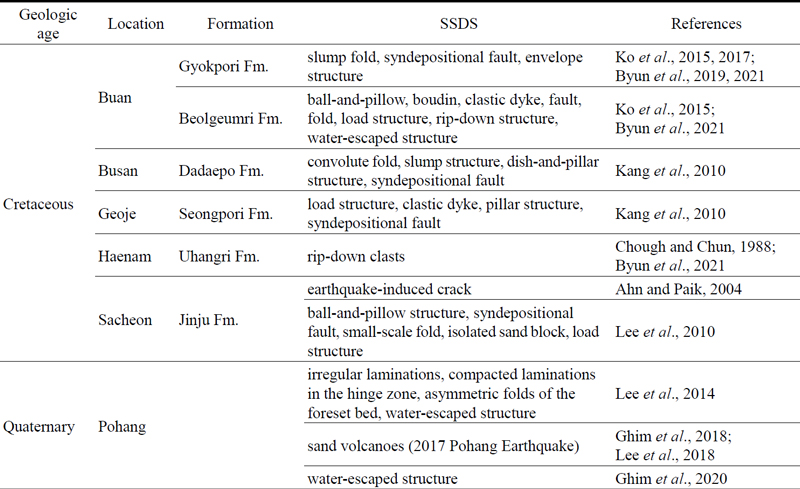
현재까지 국내에서 연구된 지진성 SSDS(표 1) 연구의 대부분은 중생대 백악기의 경상분지와 백악기 소분지에서 이루어졌다. 이에 비해 제4기 지층의 연질퇴적변형구조는 전반적으로 부족한 상황이다. 2017 포항지진 당시 액상화에 의해 발달한 모래화산(sand volcanoes)(Ghim et al., 2018; Lee et al., 2018)과 포항지역에 발달하는 해안단구에서 발달한 말린엽층리(convoluted lamination)와 물빠짐 구조(water-escaped structres)가 연구된 바 있으며(Lee et al., 2014; Ghim et al., 2020), 일부 트렌치 조사에서 지표파열과 함께 보고되기도 하였다(e.g., Cheon et al., 2020; Song et al., 2020; Kim et al., 2022).

List of earthquake-induced soft-sediment deformation structures reported in Korea.
따라서 이번 연구에서는 1) SSDS의 정의와 산상, 변형원인 및 변형과정을 간략하게 정리하고, 2) 지진성 SSDS의 고지진학적 의미와 사례연구를 통해 최근 연구동향과 연구방법을 제시하였다. 이를 통해 지진성 SSDS를 이용한 고지진 연구의 의의와 필요성을 조명하고, 국내에서의 적용 가능성을 평가하고자 한다.
2. 연질퇴적변형구조
SSDS는 지표 근처에서 퇴적과정 중이나 퇴적 직후 미고결 상태의 퇴적물에 발달하는 변형 구조이다(Allen, 1982). 여러 연구에서 SSDS의 분류기준과 용어에 대한 논의가 이어져 왔으며, SSDS는 형태와 크기, 성인에 따라 다양한 명칭을 갖는다. 대표적인 SSDS로는 하중구조(load structures), 물빠짐 구조(water-escaped structures), 말린(엽)층리(convoluted beddings/laminations), 슬럼프 구조(slump structures) 등이 있다(그림 1)(Allen, 1982; Maltman, 1984; Owen, 1987; Rodrı́guez-Pascua et al., 2000; Montenat et al., 2007; Van Loon, 2009; Owen et al., 2011).
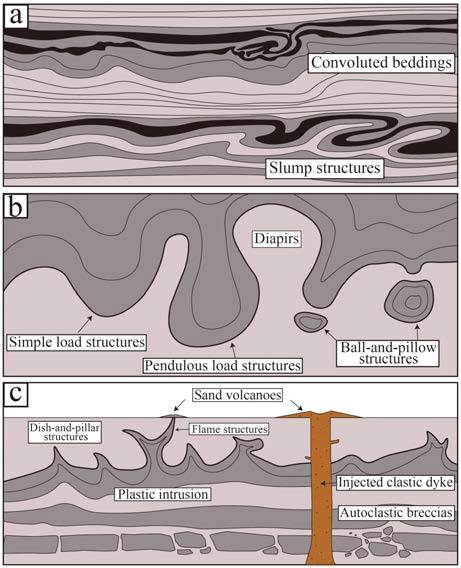
Schematic diagram illustrating examples of earthquake-induced soft-sediment deformation structures. (a) Slump structures where convoluted lamination and recumbent folds are developed. (b) Various load structures, including simple and pendulous load structures, ball-and-pillow structures, and diapirs. (c) Water-escaped structures like dish-and-pillar structures, flame stuctures, and autoclastic breccias. Sand volcanoes, along with an injected clastic dyke and flame stuctrues.
2.1. SSDS의 형성과정과 변형원인
SSDS는 변형원인(trigger), 변형기작(deformation mechanism), 변형동력(driving force)에 의해 형성된다. 변형원인은 지진, 홍수, 쓰나미와 같이 퇴적환경 내외부적으로 발생한 지질학적 사건으로 변형기작을 유발한다. 변형기작은 미고결 퇴적물의 전단강도를 상실시키는 기작으로 액상화와 유체화가 대표적인 변형기작이다. 변형기작이 발생한 퇴적물은 퇴적경계면 상하부의 밀도 차이, 하중 차이 또는 중력과 같은 매우 작은 힘에 의해서도 변형이 발생될 수 있으며, 이와 같이 변형을 일으키는 힘을 변형동력이라고 한다. 즉, 지진 등의 변형원인이 액상화나 유체화 같은 변형기작을 유발시키며, 이와 동시에 변형동력이 작용해 SSDS가 형성된다(Owen, 1987; Obermeier, 2009; Owen et al., 2011; Ghim and Ko, 2019).
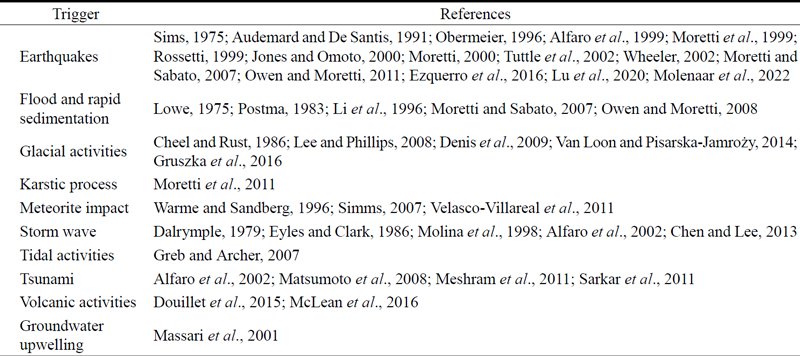
변형원인은 퇴적환경 내에서 발생한 내적원인(endogenic trigger)과 퇴적환경의 퇴적작용과 무관한 외적원인(exogenic trigger)으로 구분할 수 있다(Van Loon, 2009; Owen et al., 2011). 예를 들어 홍수와 조석작용은 퇴적환경 내에서 퇴적과정 중에 발생하는 지질작용으로 내적원인으로 분류할 수 있으며, 지진이나 운석충돌 등은 외적원인으로 분류한다. 그러나 쓰나미처럼 퇴적환경 내외부에 동시에 영향을 미치는 경우도 존재한다. 대표적인 변형원인은 표 2와 같으며 이 외에도 다양한 변형원인이 존재한다(Suter et al., 2011; Shanmugam, 2017).
List of representative triggers responsible for the formation of soft sediment deformation structures.
2.2. 지진성 SSDS
대부분의 변형원인이 급격한 지질학적 사건 및 지질재해와 연관되기 때문에 SSDS를 이용하여 변형원인을 규명하고자 하는 많은 연구가 이루어져 왔다. 특히 지진에 의해 형성된 SSDS, 즉 지진성 SSDS는 퇴적분지의 형성과정과 관련된 지구조 해석과 더불어 고지진 연구에 활용할 수 있어 많은 관심을 받았다.
지진성 SSDS와 유사한 의미로 지진암(seismite)이라는 용어가 제안되기도 하였다. 지진암은 지진동에 의해 변형된 퇴적층을 의미하는 성인적 용어이다(Seilacher, 1964). 이후 원래 의미가 확장되어 지진과 관련된 지질구조를 통칭하는 용어로 사용되기도 하였으나(Montenat et al., 2007) 지나친 의미 확장에 따른 남용과 변형원인 결정의 불확실성이 지적되기도 하였다(Wheeler, 2002; McCalpin, 2009).
지진성 SSDS를 형성하는 대표적인 변형기작에는 액상화와 유체화가 있다. 액상화는 미고결 퇴적물이 액체처럼 거동하는 현상이다. 지진이 발생하면 지층을 따라 전단력이 전파되고, 느슨하게 배열되어 있던 미고결 퇴적물의 입자들이 조밀하게 재배열된다. 이때 공극의 부피가 감소하고, 증가한 공극수압은 퇴적물의 무게와 같거나 커져 퇴적물을 부유시키게 된다. 그 결과 입자 사이 접촉에 의해 유지되던 전단강도가 상실됨에 따라 마치 액체처럼 거동하게 되고, 이를 액상화라 한다. 액상화가 발생한 퇴적물은 변형에 취약한 상태가 되어 작은 힘에도 변형 구조가 발달한다. 유체화는 액상화에 의해 발생한 공극수압을 해소하기 위해 공극수가 미고결 퇴적물과 함께 이동하는 현상으로 기존의 퇴적구조와 조직을 변형시킨다(Ambraseys and Sarma, 1969; Lowe, 1975; Obermeier, 2009; Owen and Moretti, 2011; Ghim and Ko, 2019).
액상화와 유체화는 퇴적물의 물리적 성질에 많은 영향을 받는다. 입도가 조립질 실트에서 세립질 모래 크기 사이에서 잘 일어나며, 상하부에 점토층과 같은 불투수층이 교호할 때 공극수압이 커져 액상화 가능성이 높아진다. 또한 퇴적물의 조성과 연대, 밀도, 입자 모양 등도 영향을 끼치는 것으로 알려져 있다(McCalpin et al., 2023). 이 외에도 지층이 느슨할수록, 지하수위가 높을수록, 이전에 액상화를 경험하지 않았을 경우 액상화가 잘 일어나는 것으로 알려져 있다(Owen and Moretti, 2011; Ghim and Ko, 2019).
야외에서 쉽게 인식 가능한 대표적인 지진성 SSDS는 그림 1과 같다. 퇴적물의 물리적 성질과 지진의 진도 및 진앙지와의 상대적인 거리에 따라 변형기작과 변형동력의 차이가 발생할 수 있으며, 그 결과 동일한 지진에 의해서도 다양한 종류의 SSDS가 형성된다(Molenaar et al., 2024). 이러한 지진성 SSDS는 연성변형구조와 취성변형구조로 구분된다(Montenat et al., 2007; Berra and Felletti, 2011).
연성변형구조에는 말린(엽)층리, 슬럼프 구조, 하중구조, 소성관입(plastic intrusion) 등이 속한다(그림 1a, 1b). 말린(엽)층리(그림 1a)는 여러 매의 층리가 복잡하게 구부러지고 휘어진 형태로, 지진에 의한 전단력, 역밀도구배(reverse density gradient) 등 다양한 변형동력 및 이들의 복합적인 작용에 의해 형성된다. 슬럼프 구조(그림 1a)는 경사면에서 발생한 퇴적물의 사태로 인해 습곡구조가 상,하부의 비변형층 사이에 발달한 것으로, 다른 연성변형구조가 함께 나타나기도 한다(Alsop and Marco, 2011; Owen et al., 2011).
하중구조(그림 1b)는 퇴적경계면 상하부의 밀도 차이 또는 층 상부에 연흔, 사구 등의 층면구조의 발달로 발생하는 하중 차이에 의해 형성된다. 변형 정도에 따라 다양한 형태(simple load casts, pendulous load casts, attached pseudonudules, detached pseudonodules, ball-and-pillow structure)로 나타난다(Owen, 2003). 소성관입(그림 1c)은 유체화에 수반되는 경우가 많으며, 형태에 따라 물빠짐 구조, 접시와 기둥구조(dish-and-pillar structures), 불꽃구조(flame structures) 등으로 불린다. 또한 소성 관입이 상위 지층을 통과하면서 암맥이나 암상의 형태로 발달하거나, 지표까지 도달하여 모래화산을 형성하기도 한다(Berra and Felletti, 2011).
취성변형구조에는 쇄설성 암맥(clastic dyke)과 자가쇄설성 각력암(autoclastic breccias)등이 있다(그림 1c). 쇄설성 암맥은 액상화와 유체화가 일어난 퇴적물이 균열이나 단층을 따라 상부로 이동하며 형성되며, 지표에 모래화산을 형성하기도 한다(Lowe, 1975; Sieh, 1978; Nichols et al., 1994; Obermeier, 2009). 자가쇄설성 각력암은 지진에 의해 파쇄되고 각력화된 파편 사이에 액상화 및 유체화된 퇴적물이 채워지며 형성된다(Berra and Felletti, 2011).
SSDS의 변형원인 결정은 단순한 형태적 특징만이 아니라 퇴적층의 퇴적환경과 퇴적 당시의 지질학적 정보를 종합적으로 고려해 결정한다. 변형기작과 변형동력은 SSDS가 발달하는 퇴적층과 이들 퇴적층의 상, 하부 지층의 물리적 특성 차이로 확인할 수 있으나 변형원인은 직접적인 관찰이 불가능하다. 또한, SSDS의 형태는 변형동력과 변형기작의 함수로서 변형원인이 다르더라도 변형동력과 변형기작이 같으면 동일한 SSDS가 형성될 수 있다(Suter et al., 2011).
일반적으로 퇴적상 분석을 통해 내적원인과 외적원인 여부를 결정한 다음 변형구조의 분석을 통해 잠재적인 변형원인을 하나씩 소거하여 가장 가능성이 큰 변형원인을 검증하는 방식으로 변형원인을 결정한다(그림 2)(Owen et al., 2011; Moretti et al., 2016).
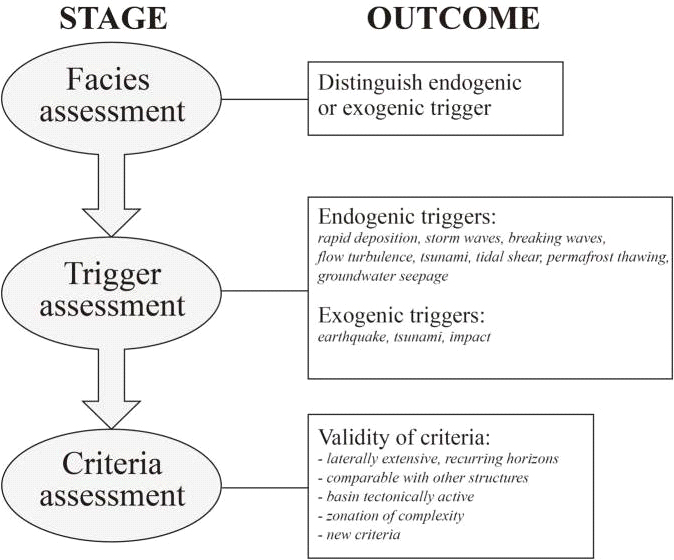
Methodology for determining the trigger for the soft-sediment deformation structures (modified from Owen et al., 2011).
잠재적인 변형원인이 지진인 경우 이를 검증하기 위한 몇 가지 기준이 마련되어 있다. 지진은 진앙을 중심으로 넓은 범위에 영향을 미치며 주기적으로 발생하는 특성이 있으므로, 이를 반영하여 제안된 기준들은 다음과 같다: 1) 변형구조의 넓은 산상과 우수한 측방 연장성, 2) 수직 퇴적단면에서 변형구조의 반복 산출, 3) 지진원 단층으로부터의 측방 산상 변화, 4) 변형구조 형성 당시의 지진활동도(Sims, 1975; Wheeler, 2002; Hilbert-Wolf et al., 2009; Obermeier, 2009; Owen et al., 2011; Ghim and Ko, 2019). 이 밖에도 내부구조의 액상화 흔적 유무, 퇴적물의 입도 조건, 경사면의 부재 등을 기준으로 삼기도 하며 퇴적환경에 따른 별도의 기준이 제안되기도 하였다(Lunina and Gladkov, 2016). 그러나 이러한 기준들에도 예외 사례가 존재하기 때문에 인접지역의 단층 유무와 같은 지질학적 정보를 종합하여 변형원인을 결정해야 한다(Moretti et al., 2014).
3. 지진성 SSDS를 이용한 고지진 연구
고지진학(paleoseismology)은 역사시대 혹은 역사기록 이전에 발생한 선사지진(prehistoric earthquake)에 대한 연구로 지질학적 증거들을 종합해 고지진의 발생 위치, 지진 발생시기 및 재발주기, 규모를 평가한다. 이는 향후 발생할 지진의 재발 주기 및 발생 규모와도 밀접한 관련이 있으므로 제4기 활성단층 연구의 기초자료와 지진재해 평가에 응용될 수 있다.
고지진 연구에 주로 사용되는 지표파열은 인공위성 원격탐사 및 트렌치 조사 등을 통해 단층의 기하와 변위, 활동시기, 지진 규모 등 여러 정보를 얻는다. 규모 5의 지진에서도 지표파열이 발달할 수 있지만, 일반적으로 규모 6 미만의 지진에서는 파열 규모가 작고 불연속적으로 나타나 식별이 매우 어렵다(Bonilla, 1988). 또한 지표에서의 퇴적 및 침식작용에 의해 훼손될 가능성이 높다(McCalpin, 2009). 반면 지진성 SSDS는 형성에 필요한 최소 규모(Mw>5)가 비교적 낮고, 수 km에 걸쳐 형성되므로 더 작은 규모의 고지진도 기록할 수 있다(Galli, 2000; Tuttle et al., 2002). 또한 대부분 지표 아래 전단강도가 약한 미고결 퇴적층에 형성되므로 보존 가능성이 높다(Ghim et al., 2018).
3.1. 고지진 발생 시기 및 재발주기
SSDS는 퇴적 중이나 미고결 상태에 형성되므로 퇴적시기와 SSDS의 형성 시기는 대체로 유사한 경향을 보인다. 따라서 지진성 SSDS를 형성한 고지진의 발생 시기 추정은 일반적인 제4기 퇴적물의 연대측정 방법과 동일한 방법을 이용한다. 주로 방사선탄소 연대측정과 OSL 연대측정(optically stimulated luminescence dating)이 사용되며, 현생 퇴적물의 경우 퇴적률을 이용하여 퇴적시기를 유추하기도 한다(Sims, 1975; Avşar et al., 2014; Ezquerro et al., 2015).
일정한 주기를 가지고 발생하는 지진과 동일하게 지진성 SSDS 역시 수직단면에서 일정 간격을 두고 반복하며 나타나기도 한다. 이상적인 상황에선 각 변형구조의 형성시기와 함께 지진의 재발간격과 평균 재발주기를 구할 수 있으나 지진 발생 당시 지층의 물리적 특성, 지하수면의 위치 등에 따라 실제 재발주기와는 차이가 존재할 수 있다.
정확한 재발주기를 구하기 위한 지진 발생 횟수 파악에는 몇 가지 고려해야 할 점들이 있다. 먼저 기후 조건을 고려해야 한다. 예를 들어 건기와 우기가 반복되는 퇴적환경의 경우 건기의 낮은 지하수면으로 퇴적물이 충분히 포화되지 않은 경우 지진이 발생하더라고 SSDS가 형성하지 않는다. 또한, 한 번의 지진이 여러 층을 동시에 변형시킬 수 있다는 점도 고려해야 한다(Gibert et al., 2011). 예를 들어 유체화로 인해 두 개 이상의 층이 동시에 변형될 경우, 이를 두 번의 지진으로 오인해 지진 발생 횟수를 과대평가할 수 있다. 만약 상부에 침식면이 관찰될 경우에는 변형구조가 형성된 이후 지진의 휴지기가 있었음을 지시하므로, 최소 지진 발생 횟수를 추정하는 데 유용하다(Moretti and Ronchi, 2011; Belzyt et al., 2021).
이처럼 지진성 SSDS를 기반으로 얻어진 재발주기는 실제 발생률(actual incidence)과 차이가 있을 수 있으므로 이를 겉보기 재발주기(apparent recurrence period)라 한다(Allen, 1986; Ezquerro et al., 2015). 실제 발생률과 겉보기 재발주기의 차이를 줄이기 위해서는 야외조사만으로 한계가 있으므로 트렌치 조사와 시추 조사가 병행되어야 한다. 트렌치 조사는 단층의 변위와 기하, 단층운동에 의한 지진 발생 시기를 확인할 수 있고, 시추 조사는 지표 아래의 연속된 퇴적층을 통해 장기간의 지진 기록을 분석하는 데 유용하다. 이러한 방법들이 함께 적용되면 고지진의 실제 재발주기를 더 정확하게 예측할 수 있다(Ghim and Ko, 2019).
3.2. 고지진의 규모와 진도
지진발생 지역의 현장조사와 시뮬레이션 결과에 따르면(Atkinson et al., 1984; Allen, 1986; Ambraseys, 1988; Audemard and De Santis, 1991; Marco and Agnon, 1995; Galli, 2000; Wheeler, 2002), 모래-실트 크기 입자로 구성된 퇴적층의 경우 중규모(Mw>5) 이상의 지진에서 지진기원 SSDS가 형성되는 것으로 알려져 있다. 이와 반대로 역질 퇴적물의 경우 7 이상 규모의 지진에서 발달하는 것으로 보고되었다(Obermeier, 1996). 규모 5 미만의 지진은 지진동 지속시간과 전단력이 액상화가 일어날 만큼 충분하지 못하여 유의미한 변형을 일으키지 못한다. 하지만 퇴적물의 입도 이외에도 포화정도와 응집력, 진앙과의 거리, 지반 특성에 따른 감쇠 또는 증폭 효과에 의해 SSDS 형성에 필요한 최소 규모는 변화할 수 있다(Molenaar et al., 2024).
SSDS를 이용해 고지진의 규모와 진도를 추정하기 위한 다양한 방법이 시도되었으며 그 중 대표적인 접근법은 다음과 같다.
지진성 SSDS의 형태는 지진 규모뿐 아니라 변형동력과 퇴적물의 성질 등 다양한 요인의 영향을 받기 때문에 형태만으로 지진 규모를 추정하는 것은 불가능하다(Rodríguez-Pascua et al., 2000; Moretti and Sabato, 2007). 동일한 암상 및 퇴적환경 내에서는 고지진의 상대적인 규모를 비교할 수 있지만, 퇴적물의 포화도와 고결정도에 따라 형태가 달라질 수 있다(Obermeier, 1996; Berra and Felletti, 2011).
지진의 규모와 액상화 발생 범위는 서로 비례한다. 이는 지진성 SSDS의 공간적 분포범위와 지진의 규모가 서로 관련이 있음을 시사한다. Kuribayashi and Tatsuoka (1975)는 일본에서 발생한 액상화가 수반된 44번의 지진을 분석하여 모래화산 분출 및 건물 침하 등 액상화가 일어난 지점과 지진 규모 간의 관계를 경험식으로 제시하여 지진 규모와 최대 액상화 거리 사이 관계를 나타내었다(그림 3).
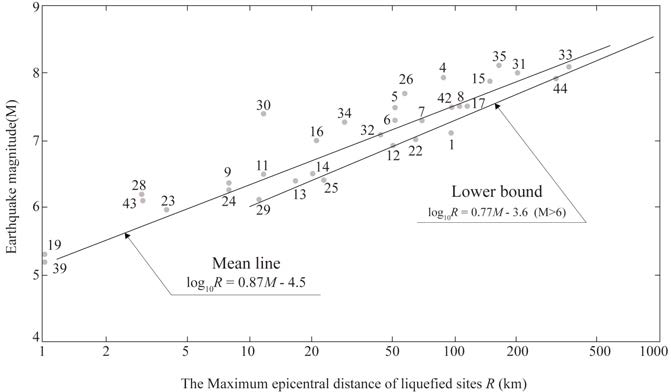
Relationship between the maximum epicentral distance of liquefied sites R and magnitude M (modified from Kuribayashi and Tatsuoka, 1975). Each gray dot with a number represents a specific earthquake event form the original dataset, which encompasses Japanesse earthquakes from 1872 to 1968.
| (1) |
식(1)에서 R은 최대 액상화 거리이며, M은 지진의 규모이다. 이후 여러 연구에서 다양한 지역의 데이터를 추가하고, 지역적 조건을 고려하여 수정된 경험식이 제안되었다(Youd, 1977; Keefer, 1984; Papadopoulos and Lefkopoulos, 1993; Galli, 2000; Castilla and Audemard, 2007; Maurer et al., 2015). 지역마다 지각 구조, 단층 특성, 지진파 전파 경로, 퇴적물의 성질이 다르기 때문에 특정 지역의 경험식이 보편적으로 적용되기에는 한계가 있으며, 각 지역의 지질과 지반 특성을 반영한 경험식 개발이 필요하다.
지진동의 지속시간이 길고, 전단력의 강도가 클수록 SSDS를 포함하는 지층이 두껍게 발달한다는 점을 근거로 변형층의 두께를 이용해 지진의 규모를 추정하는 경험식이 제안되기도 하였다(Hibsch et al., 1997; Rodríguez-Pascua et al., 2003). Mugnier et al. (2011)은 변형층의 두께를 제어하는 요소로 지진의 수평 가속도와 변형률 약화(strain softening), 입도 및 퇴적상의 수직 변화를 제시했다. 지진의 규모와 변형층의 두께 사이의 관계는 지역적 조건에 크게 의존하므로, 앞서 언급한 경험식을 일반화하여 다른 지역에 적용하기에는 한계가 있다. 최근 사해분지(Dead Sea Basin)에서 수행된 연구들은 이러한 지역적 요소를 고려하여 변형층의 두께를 정량적으로 평가하고, 이를 통해 지진의 규모 및 재발주기를 평가하였다(Wetzler et al., 2010; Lu et al., 2020).
3.3. 진앙 위치
지진의 규모에 따라 진앙지로부터 액상화 발생지점의 거리가 증가하는 것은 지진 규모에 따라 지진성 SSDS의 분포가 달라짐을 의미한다. 규모 5-6의 지진은 진앙지 40 km 이내에, 규모 7이상의 지진은 100-120 km까지 액상화를 일으키는 것으로 알려져 있다(Obermeier, 1996; Rossetti, 1999; Galli, 2000; Rodrı́guez-Pascua et al., 2003; Berra and Felletti, 2011; Üner et al., 2019). 또한 지진성 SSDS는 암상이 동일할 경우 진앙지를 중심으로 산상의 측방 변화가 나타난다. 단층 근처에서는 변형층의 두께가 두껍고 복잡한 구조가 발달하는 반면, 멀리 떨어진 곳에선 변형층의 두께가 얇고 단순한 구조가 발달한다(Ringrose, 1989; Guiraud and Plaziat, 1993; Tuttle et al., 2019).
지진성 SSDS의 공간적 분포와 변형정도 분석을 통해 고지진의 진앙을 파악하려는 연구가 계속되어 왔다. 예를 들어 역사지진과 고지진에 의해 형성된 SSDS의 분포를 비교하여 그 중심을 진앙지로 추정하거나(Tuttle, 2001), 변형정도의 양상으로 진앙의 위치를 추정하는 연구가 수행된 바 있으며(Brandes and Winsemann, 2013), SSDS와 주요 단층들 사이의 거리를 비교하여 지진을 일으켰을 가능성이 가장 높은 단층을 해석하기도 하였다(Üner et al., 2019). 또한 입도에 따라 SSDS 액상화가 발생하기 위한 지진동의 세기가 다르므로 변형구조를 입도 별로 분류하여 진앙 범위를 추정하는 방법이 제안되기도 하였다(그림 4)(Rodríguez-Pascua et al., 2010). 이 외에도 지진에 의해 형성된 주입형 쇄설성 암맥의 방향과 지표파열 주향과의 유사성을 이용한 고진앙 위치 추정의 가능성이 제기되기도 했다(Lunina and Gladkov, 2016).
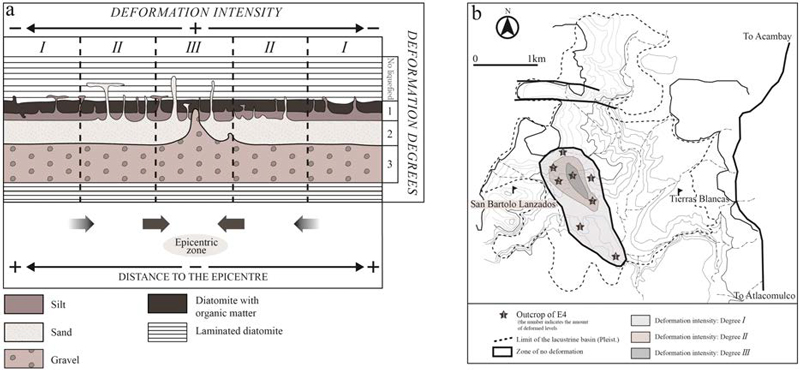
(a) Scheme of liquefaction structures developed in gravel and silt, along with their spatial distribution. The areas of greatest deformation intensity are identified, with the highest intensity corresponding to liquefied gravels and the epicentral area. (b) Distribution map of the spatial gradient for the deformation intensity (paleoseismic isoclines) associated with the paleoearthquake in the Tierras Blancas Basin (modified from Rodríguez-Pascua et al., 2010).
4. 사례연구
4.1. 사해분지(Dead Sea Basin)
사해분지는 제4기 단층 연구와 지진성 SSDS를 이용한 고지진 연구가 성공적으로 수행된 대표적인 지역이다. 제4기에 형성된 SSDS가 광범위하게 분포하고 수직단면에서 뚜렷한 반복성이 나타난다. 건조한 기후로 장기간(~220 ka)의 고지진 기록이 보존되어 있다. 특히 이 지역은 지진성 SSDS의 정량적인 분석을 통해 고지진의 규모와 재발주기 추정 연구가 활발히 이루어진 곳이므로 사례연구를 통해 구체적인 연구방법을 살펴보고자 한다.
사해분지를 구성하는 최대 4 km 두께의 리산층(Lisan Formation)은 우기에 유입된 흑색의 쇄설성 퇴적물과 여름철 증발로 형성된 아라고나이트층이 교호하며 엽층리를 이룬다. 리산층에는 말린엽층리와 슬럼프 구조가 발달하며, 말린엽층리는 형태적 특징과 변형정도를 기준으로 linear waves, asymmetric billows, coherent vortices, breccia로 분류된다(그림 5a, 5b, 5c). Heifetz et al. (2005)은 이들 말린엽층리가 켈빈-헬름홀츠 불안정(Kelvin-Helmholtz instability)에 의해 형성되었다고 해석하였다. 켈빈-헬름홀츠 불안정이란 두 유체 사이에 속도 차이가 있을 때, 그 경계면에서 와류가 발생하는 현상이다. 지진파에서 발생한 전단력이 작용할 때, 하중에 의해 하부로 갈수록 밀도가 증가하는 미고결 퇴적물의 특성상 상·하부층이 같은 방향이지만 서로 다른 속도로 움직이게 된다. 이로 인해 켈빈-헬름홀츠 불안정이 변형동력으로 작용하여 변형구조를 형성할 수 있다. 이러한 해석은 유체역학 모델링을 통해 검증되었으며, 또한 변형구조를 정량적으로 평가하여 변형구조를 형성한 지진의 지반가속도를 추정할 수 있음을 제안하였다(그림 5c).
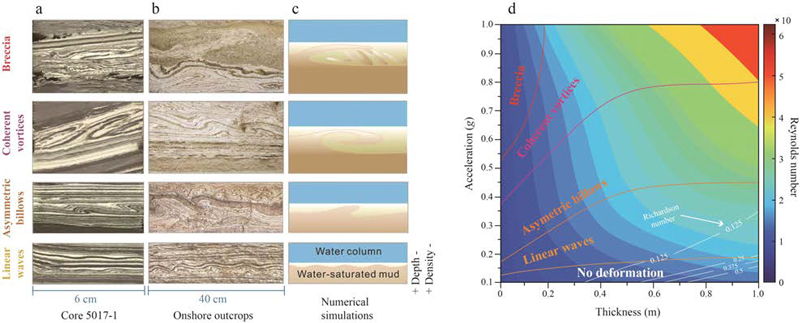
Numerical simulation on in situ folded layer and intraclast breccia structures in the Dead Sea sedimentary sequences. (a) Representative structures observed in Core 5017-1 from the Dead Sea depocenter and their corresponding numerical simulation results. (b) Representative structures observed in onshore outcrops of the Dead Sea Basin. (c) Schematic diagrams derived from simulation snapshots illustrating the formation mechanisms of the four structural types. (d) Quantitative estimation of the minimum accelerations required to initiate each of the four structures at varying thickness. The color scale represent the effective Reynolds number (Re), highlighing zones where inertial forces dominate over viscosity. As Re increases, turbulent Kelvin-Helmholtz deformation becomes more pronounced, progressing from linear waves to breccia. Such deformations typically occurs when Richardson number is ≤ 0.125 (modified from Lu et al., 2020).
Wetzler et al. (2010)은 300개 이상의 변형구조에서 얻어진 변형층의 두께와 길이, 전단력에 의한 지반가속도, 퇴적층의 밀도와 점성도, 수압에 의한 수직 압력을 고려하여 직접적인 수치 모의실험(direct numerical simulation)을 수행하였다. 그 결과 고지진의 최대지반가속도를 추정하였으며, 진앙의 위치와 감쇠효과를 고려하여 이를 지진의 규모로 변환할 수 있음을 제안하였다.
이후 사해의 퇴적중심지에서 얻은 시추 코어(ICDP Core 5017-1, 길이 약 457 m, 최대 연대 220 ka)를 이용해 더 긴 시간 범위의 고지진 연구를 수행하였다. 이를 통해 총 413개의 지진성 SSDS가 식별되었고, Lu et al. (2020)은 Wetzler et al. (2010)의 모델을 개선해 변형층의 두께와 지반 가속도의 상한값을 높여 더 정밀한 분석을 수행하였다. 이를 통해 linear waves, asymmetric billows, coherent vortices, intraclast breccia는 각각 최소 0.13 g, 0.18 g, 0.34 g, 0.50 g의 지반 가속도가 필요하며, 이를 진앙거리와 감쇠효과를 고려하여 지진의 규모로 변환하여 각각 Mw 5.3, 7.0, 7.3, 7.8에 해당함을 제안하였다(그림 5d).
이 연구는 또한 고지진의 재발주기 분석에도 중요한 기여를 했다. 시추 코어의 연대측정 자료를 이용하여 지반가속도 0.13 g와 0.34 g 이상의 지진에 대해 각각 530 ± 40 년과 1500 ± 190 년의 평균 재발주기가 산출되었고, Mw 7.0 이상의 강진의 재발주기는 1400 ± 160 년으로 나타났으며, 특히 지난 40 ka 동안에는 이 주기가 700 ± 110 년으로 더 짧아지는 경향을 보였다. 이와 같은 주기는 기존 연구(Begin et al., 2005; Kagan et al., 2011)에서 제시된 Mw≥7.0 지진의 평균 재발주기인 4600 ± 1500 년과 비교했을 때 유의미하게 짧은 값이다. 이는 사해단층의 복잡한 기하학적 구조와 느린 변위율로 인해 지진 발생이 비주기적으로 이루어졌음을 시사하며, 기존 지진재해 위험이 과소평가 되었을 가능성을 보여준다.
4.2. 콘쿠드단층(Concud Fault)
판 경계 인근 지역은 단층 변위율이 높아 대규모 지진이 짧은 재발주기로 발생하며 고지진 기록이 풍부하다. 반면 판 내부 지역은 낮은 단층 변위율로 인해 대규모 지진의 재발주기가 매우 길기 때문에 노두에 노출된 고지진 기록의 시간 범위가 이를 포함하지 않을 수 있다(Lafuente et al., 2014). 이런 한계를 보완하고자 스페인의 힐로카분지(Jiloca Basin)과 테루엘분지(Teruel Basin)의 경계단층인 콘쿠드단층(Concud Fault)에서 트렌치 조사와 시추코어 조사를 병행하여 서로의 고지진 기록을 비교하였다.
콘쿠드단층은 알프스-히말라야 조산운동의 인장력에 의해 형성되었으며, 전체적으로 북서-남동 방향의 주향과 65-70° SW의 경사를 가진다. 남쪽 말단에서는 북북서-남남동 방향으로의 전환이 일어난다. 단층의 길이는 약 14.2 km이며, 최대 예상 지진 규모는 Mw 6.4-6.8로 추정된다(Lafuente et al., 2014).
트렌치 조사에서는 다섯 곳의 지표파열에서 총 11개의 고지진 기록을 확인하였고, 평균 재발주기는 지난 74 ka 동안 7.1-8.0 ka이다. 시추는 세 지점에서 수행되어 총 35개의 지진성 SSDS와 28개의 비지진성 SSDS를 확인하였다. 시추 코어의 연대 범위는 생층서와 지자기층서를 종합하여 3.6-1.9 Ma로 제한하였다. 시추 코어에서 얻어진 평균 재발주기는 56-108 ka이며, 지진성 SSDS가 군집으로 분포하는 3.207-3.116 Ma 연대 구간에선 4.8-6.1 ka로 나타난다. 트렌치 조사에서 얻어진 평균 재발주기보다 더 짧은 값을 나타내는데 이는 지진성 SSDS가 지표파열에 비해 상대적으로 더 작은 규모의 지진도 기록하며, SSDS가 형성될 수 없던 시기의 환경이 존재했기 때문으로 해석된다(Ezquerro et al., 2015, 2016).
또한 이 지역은 지난 500년 동안의 역사지진과 계기지진을 기반으로 작성된 지진재해도에서 안전한 곳으로 평가받았으나 고지진 연구를 통해 역사지진에 기록되지 않은 중규모 지진의 발생 가능성이 재평가되었다. 이처럼 트렌치 조사와 지진성 SSDS 시추 조사를 병행할 때 더 넓은 시간 범위의 고지진 기록을 획득할 수 있기 때문에 보다 정밀한 지진재해 평가가 가능하다.
5. 토의 및 결론
제4기 지층에 발달한 지진성 SSDS는 고지진의 발생시기와 재발주기, 규모, 발생위치를 간접적으로 제공한다. 지표파열에 비해 상대적으로 낮은 규모이나 피해를 유발할 수 있는 고지진 정보를 얻을 수 있으며, 지표면 아래에 형성되어 보존에 유리하다. 이러한 이점 때문에 해외에서는 지진성 SSDS 연구는 지속적인 관심을 받으며 꾸준히 수행되고 있다. 최근에는 정량적 분석과 컴퓨터 시뮬레이션, 트렌치 조사와 시추 조사를 병행하는 등 다양한 방법이 시도되고 있다.
사례연구에서 다룬 사해분지의 연구는 새로운 변형과정을 제시하고 변형구조를 정량적으로 분석하여 고지진 규모 및 재발주기 추정 모델을 정밀화하여 지진재해 위험 평가에 기여했다는 점에서 의미가 크다. 하지만 사해 지역에 특화된 지질과 지반 특성을 바탕으로 한 연구라는 점에서 이를 국내에 적용하기 위해선 제4기 지층에 대한 기초연구들이 선행되어야 한다.
콘쿠드단층의 연구에서는 시추 코어를 이용할 경우 더 넓은 시간 범위의 고지진 기록을 얻을 수 있고 연속적인 퇴적기록을 확인할 수 있다는 장점을 확인할 수 있었다. 이는 지표 침식이 활발하고, 긴 재발주기를 갖는 우리나라 고지진 연구에도 시추 코어를 이용한 연구방법이 적합할 것을 시사한다. 그러나 시추 코어에서는 제한된 코어 직영에 의해 퇴적층 내의 변형구조를 완전히 파악하기 어렵기 때문에 변형원인 결정에 한계가 있다. 또한 일부 변형구조가 누락되거나 중복되어 고지진의 횟수가 과소 또는 과대평가될 수 있다. 따라서 시추 코어를 활용할 경우 복수의 지점에서 시추 코어를 획득할 필요가 있으며, 정밀한 퇴적상 분석을 수행해야 한다. 또한 노두에서의 산상과 퇴적상, 암상, 변형구조의 분포를 종합적으로 고려하여야 한다(Ezquerro et al., 2015, 2016) 최근에는 X-선 CT 촬영으로 시추코어 내부의 지진성 SSDS를 3차원 영상으로 복원하는 방법이 제안되기도 하였으며(Nakashima and Komatsubara, 2016), 향후 이런 방법을 도입한다면 보다 구체적인 연구가 가능할 것이다.
국내 지진성 SSDS 연구에 해외의 다양한 연구방법이 적용된다면 고지진 연구의 정밀성과 지진재해 평가의 정확성을 높이는 데 도움을 줄 것으로 보인다. 하지만 이러한 연구방법의 적용을 위해서는 호수 퇴적물처럼 안정된 환경에서 연속적으로 퇴적된 퇴적기록체 확보가 필수적이다. 국내에서는 이러한 퇴적체 확보가 어려운 실정이므로 다양한 퇴적 기록체를 활용하는 접근이 필요하다. 제4기 고기후 연구 역시 동일한 어려움을 가지며, 이를 극복하기 위해 지난 20여 년간 국내 연안퇴적물, 범람원, 석호, 저수지, 습지, 고토양을 대상으로 한 연구가 이루어졌다(Park, 2023). 이러한 퇴적체들은 수직 및 측방 연속성은 다소 떨어지지만, 지진성 SSDS가 발달할 수 있으므로(Van Loon, 2009) 고지진 연구에도 활용할 가치가 있다.
또한 기존 고기후 연구 과정에서 얻어진 시추 코어를 검토하여 고지진 기록을 확인할 수 있을 것으로 보이며, 향후 고기후 연구에서 부수적으로 얻어지는 고지진 기록 역시 체계적으로 정리하고 분석하는 통합적 연구 수행을 제안한다. 특히 주요 단층대 인근에서 얻어진 시추 코어는 지진의 영향을 받았을 가능성이 높으므로 고지진 연구에 중요한 자료가 될 수 있다. 이 외에도 토목 및 건설 공사에서 얻어진 시추 코어에서도 지진성 SSDS가 포함되어 있을 가능성이 있으며, 이는 노두 노출과 트렌치 조사가 제한적인 도심지역의 고지진 연구에 기여할 수 있을 것으로 보인다. 국내에서도 지진성 SSDS에 대한 충분한 데이터가 축적된다면 유의미한 연구 결과를 도출할 수 있을 것으로 기대된다.
Acknowledgments
이 논문은 행정안전부 지진 위험분석 및 관리기술 개발사업(2022-MOIS62-001)의 지원을 받아 수행된 연구결과입니다. 본 논문에 대해 건설적인 비평을 주신 두 분의 심사위원과 담당 편집위원께 감사드립니다.
References
- Ahn, K.Y. and Paik, I.S., 2004, Occurrences and genesis of unique cracks in the Cretaceous Jinju Formation, Sacheon city, Gyeongsangnam-do, Korea. Journal of the Geological Society of Korea, 40, 93-102 (in Korea with English abstract).
-
Alfaro, P., Delgado, J., Estévez, A., Molina, J., Moretti, M. and Soria, J., 2002, Liquefaction and fluidization structures in Messinian storm deposits (Bajo Segura Basin, Betic Cordillera, southern Spain). International Journal of Earth Sciences, 91, 505-513.
[https://doi.org/10.1007/s00531-001-0241-z]

-
Alfaro, P., Estévez, A., Moretti, M. and Soria, J.-M., 1999, Sedimentary deformation structures interpreted as seismites in the Quaternary of the Low Segura basin (Eastern Betic Cordillera). Comptes Rendus de l'Académie des Sciences-Series IIA-Earth and Planetary Science, 328, 17-22.
[https://doi.org/10.1016/S1251-8050(99)80082-2]
- Allen, J.R.L., 1982, Sedimentary structures: their character and physical basis. Vol. II, Elsevier, Amsterdam, 663 p.
-
Allen, J.R.L., 1986, Earthquake magnitude-frequency, epicentral distance, and soft-sediment deformation in sedimentary basins. Sedimentary Geology, 46, 67-75.
[https://doi.org/10.1016/0037-0738(86)90006-0]
-
Alsop, G.I. and Marco, S., 2011, Soft-sediment deformation within seismogenic slumps of the Dead Sea Basin. Journal of Structural Geology, 33, 433-457.
[https://doi.org/10.1016/j.jsg.2011.02.003]
-
Ambraseys, N., 1988, Engineering seismology. Earthquake Engineering and Structural Dynamics, 17, 1-105.
[https://doi.org/10.1002/eqe.4290170102]
-
Ambraseys, N. and Sarma, S., 1969, Liquefaction of soils induced by earthquakes. Bulletin of the Seismological Society of America, 59, 651-664.
[https://doi.org/10.1785/BSSA0590020651]
-
Atkinson, G.M., Finn, W.L. and Charlwood, R., 1984, Simple computation of liquefaction probability for seismic hazard applications. Earthquake Spectra, 1, 107-123.
[https://doi.org/10.1193/1.1585259]
-
Audemard, F.A. and De Santis, F., 1991, Survey of liquefaction structures induced by recent moderate earthquakes. Bulletin of the International Association of Engineering Geology, 44, 5-16.
[https://doi.org/10.1007/BF02602705]
-
Avşar, U., Hubert-Ferrari, A., De Batist, M., Lepoint, G., Schmidt, S. and Fagel, N., 2014, Seismically-triggered organic-rich layers in recent sediments from Göllüköy Lake (North Anatolian Fault, Turkey). Quaternary Science Reviews, 103, 67-80.
[https://doi.org/10.1016/j.quascirev.2014.08.020]
-
Begin, Z., Steinberg, D., Ichinose, G. and Marco, S., 2005, A 40,000 year unchanging seismic regime in the Dead Sea rift. Geology, 33, 257-260.
[https://doi.org/10.1130/G21115.1]
-
Belzyt, S., Pisarska-Jamroży, M., Bitinas, A., Woronko, B., Phillips, E.R., Piotrowski, J.A. and Jusienė, A., 2021, Repetitive Late Pleistocene soft-sediment deformation by seismicity-induced liquefaction in north-western Lithuania. Sedimentology, 68, 3033-3056.
[https://doi.org/10.1111/sed.12883]
-
Berra, F. and Felletti, F., 2011, Syndepositional tectonics recorded by soft-sediment deformation and liquefaction structures (continental Lower Permian sediments, Southern Alps, Northern Italy): stratigraphic significance. Sedimentary Geology, 235, 249-263.
[https://doi.org/10.1016/j.sedgeo.2010.08.006]
-
Bonilla, M.G., 1988, Minimum earthquake magnitude associated with coseismic surface faulting. Bulletin of the Association of Engineering Geologists, 25, 17-29.
[https://doi.org/10.2113/gseegeosci.xxv.1.17]
-
Brandes, C. and Winsemann, J., 2013, Soft-sediment deformation structures in NW Germany caused by Late Pleistocene seismicity. International Journal of Earth Sciences, 102, 2255-2274.
[https://doi.org/10.1007/s00531-013-0914-4]
-
Byun, U.H., Van Loon, A.J. and Ko, K., 2021, Lacustrine slope-related soft-sediment deformation structures in the Cretaceous Gyeokpori Formation, Buan area, SW Korea, and volcanism-induced seismic shocks as their possible trigger. Minerals, 11, 721.
[https://doi.org/10.3390/min11070721]
-
Byun, U.H., Van Loon, A.J., Kwon, Y.K. and Ko, K., 2019, A new type of slumping-induced soft-sediment deformation structure. The envelope structure, Geologos, 25, 111-124.
[https://doi.org/10.2478/logos-2019-0011]
-
Castilla, R.A. and Audemard, F.A., 2007, Sand blows as a potential tool for magnitude estimation of pre-instrumental earthquakes. Journal of Seismology, 11, 473-487.
[https://doi.org/10.1007/s10950-007-9065-z]
-
Cheel, R.J. and Rust, B.R., 1986, A sequence of soft-sediment deformation (dewatering) structures in Late Quaternary subaqueous outwash near Ottawa, Canada. Sedimentary Geology, 47, 77-93.
[https://doi.org/10.1016/0037-0738(86)90072-2]
-
Chen, J. and Lee, H.S., 2013, Soft-sediment deformation structures in Cambrian siliciclastic and carbonate storm deposits (Shandong Province, China): Differential liquefaction and fluidization triggered by storm-wave loading. Sedimentary Geology, 288, 81-94.
[https://doi.org/10.1016/j.sedgeo.2013.02.001]
-
Cheon, Y., Choi, J.-H., Kin, N., Lee, H.I., Choi, Y., Bae, H., Rockwell, T.K., Lee, S.R., Ryoo, C.-R., Choi, H. and Lee, T.-H., 2020, Late Quaternary transpressional earthquakes on a long-lived intraplate fault: A case study of the Southern Yangsan Fault, SE Korea. Quaternary International, 553, 132-143.
[https://doi.org/10.1016/j.quaint.2020.07.025]
-
Chough, S.K. and Chun, S.S., 1988, Intrastratal rip-down clasts, Late Cretaceous Uhangri Formation, Southwest Korea. Journal of Sedimentary Research, 58, 530-533.
[https://doi.org/10.1306/212F8DE1-2B24-11D7-8648000102C1865D]
-
Dalrymple, R.W., 1979, Wave-induced liquefaction: a modern example from the Bay of Fundy. Sedimentology, 26, 835-844.
[https://doi.org/10.1111/j.1365-3091.1979.tb00976.x]
-
Denis, M., Buoncristiani, J.-F. and Guiraud, M., 2009, Fluid-pressure controlled soft-bed deformation sequence beneath the surging Breiðamerkurjökull (Iceland, Little Ice Age). Sedimentary Geology, 221, 71-86.
[https://doi.org/10.1016/j.sedgeo.2009.07.013]
-
Douillet, G.A., Taisne, B., Tsang-Hin-Sun, È., Mueller, S.K., Kueppers, U. and Dingwell, D., 2015, Syn-eruptive, soft-sediment deformation of deposits from dilute pyroclastic density current: triggers from granular shear, dynamic pore pressure, ballistic impacts and shock waves. Solid Earth, 6, 553-572.
[https://doi.org/10.5194/se-6-553-2015]
-
Eyles, N. and Clark, B.M., 1986, Significance of hummocky and swaley cross-stratification in late Pleistocene lacustrine sediments of the Ontario basin, Canada. Geology, 14, 679-682.
[https://doi.org/10.1130/0091-7613(1986)14<679:SOHASC>2.0.CO;2]
-
Ezquerro, L., Moretti, M., Liesa, C.L., Luzón, A., Pueyo, E. and Simón, J., 2016, Controls on space-time distribution of soft-sediment deformation structures: applying palaeomagnetic dating to approach the apparent recurrence period of paleoseisms at the Concud Fault (eastern Spain). Sedimentary Geology, 344, 91-111.
[https://doi.org/10.1016/j.sedgeo.2016.06.007]
-
Ezquerro, L., Moretti, M., Liesa, C.L., Luzón, A. and Simón, J., 2015, Seismites from a well core of palustrine deposits as a tool for reconstructing the palaeoseismic history of a fault. Tectonophysics, 655, 91-205.
[https://doi.org/10.1016/j.tecto.2015.05.025]
-
Fumal, T.E., Weldon II, R.J., Biasi, G.P., Dawson, T.E., Seitz, G.G., Frost, W.T. and Schwartz, D.P., 2002, Evidence for large earthquakes on the San Andreas Fault at the Wrightwood, California, paleoseismic site: A.D. 500 to present. Bulletin of the Seismology of America, 92, 2726-2760.
[https://doi.org/10.1785/0120000608]
-
Galli, P., 2000, New empirical relationships between magnitude and distance for liquefaction. Tectonophysics, 324, 169-187.
[https://doi.org/10.1016/S0040-1951(00)00118-9]
-
Galli, P., Galadini, F. and Pantosti, D., 2008, Twenty years of paleoseismology in Italy. Earth-Science Reviews, 88, 89-117.
[https://doi.org/10.1016/j.earscirev.2008.01.001]
-
Gibert, L., Alfaro, P., García-Tortosa, F. and Scott, G., 2011, Superposed deformed beds produced by single earthquakes (Tecopa Basin, California): Insights into paleoseismology. Sedimentary Geology, 235, 148-159.
[https://doi.org/10.1016/j.sedgeo.2010.08.003]
-
Ghim, Y.S., Kim, S.W., Ko, K., Choi, J.-H., Bae, H., Hong, P.S., Lee, Y., Lee, H., Jin, K., Choi, S.-J., Kim, J.C., Choi, M.S. and Lee, S.R., 2018, Paleoseismological implications of liquefaction-induced structures caused by the 2017 Pohang Earthquake. Geoscience Journal, 22, 871-880.
[https://doi.org/10.1007/s12303-018-0051-y]
- Ghim, Y.S. and Ko, K., 2019, Geological significance of liquefaction and soft-sediment deformation structures. Economic Environmental Geology, 52, 471-484 (in Korean with English abstract).
- Ghim, Y.S., Ko, K., Choi, J.-H. and Choi, S.-J., 2020, Large-scale, Miocene mud intrusion into the overlying Pleistocene coastal sediment, Pohang City, SE Korea: deformation mechanism, trigger, and paleo-seismological implication for the 2017 Pohang Earthquakes. Economic and Environmental Geology, 53, 585-596.
-
Grant, L.B. and Sieh, K., 1994, Paleoseismic evidence of clustered earthquakes on the San Andreas fault in the Carrizo Plain, California. Journal of Geophysical Research, 99, 6819-6841.
[https://doi.org/10.1029/94JB00125]
-
Greb, S.F. and Archer, A.W., 2007, Soft-sediment deformation produced by tides in a meizoseismic area, Turnagain Arm, Alaska. Geology, 35, 435-438.
[https://doi.org/10.1130/G23209A.1]
-
Gruszka, B., Fard, A.M. and Van Loon, A.J., 2016, A fluctuating ice front over an esker near Ryssjön (S Sweden) as a cause of a giant load cast. Sedimentary geology, 344, 47-56.
[https://doi.org/10.1016/j.sedgeo.2016.06.018]
-
Guiraud, M. and Plaziat, J.-C., 1993, Seismites in the fluviatile Bima sandstones: identification of paleoseisms and discussion of their magnitudes in a Cretaceous synsedimentary strike-slip basin (Upper Benue, Nigeria). Tectonophysics, 225, 493-522.
[https://doi.org/10.1016/0040-1951(93)90312-8]
-
Ha, S., Lee, S. and Son, M., 2020, Tectonic evolution of the Cretaceous Gyeongsang Back-arc Basin, SE Korea: Transition from sinistral transtension to strike-slip kinematics. Gondwana Resarch, 83, 16-35.
[https://doi.org/10.1016/j.gr.2020.01.012]
-
Heifetz, E., Agnon, A. and Marco, S., 2005, Soft sediment deformation by Kelvin Helmholtz Instability: A case from Dead Sea earthquakes. Earth and Planetary Science Letters, 236, 497-504.
[https://doi.org/10.1016/j.epsl.2005.04.019]
-
Hibsch, C., Alvarado, A., Yepes, H., Perez, V.H. and Sébrier, M., 1997, Holocene liquefaction and soft-sediment deformation in Quito (Ecuador): a paleoseismic history recorded in lacustrine sediments. Journal of Geodynamics, 24, 259-280.
[https://doi.org/10.1016/S0264-3707(97)00010-0]
-
Hilbert-Wolf, H.L., Simpson, E.L., Simpson, W.S., Tindall, S.E. and Wizevich, M.C., 2009, Insights into syndepositional fault movement in a foreland basin; trends in seismites of the Upper Cretaceous, Wahweap Formation, Kaiparowits Basin, Utah, USA. Basin Research, 21, 856-871.
[https://doi.org/10.1111/j.1365-2117.2009.00398.x]
-
Jones, A.P. and Omoto, K., 2000, Towards establishing criteria for identifying tregger mechanisms for soft-sediment deformation: a case study of Late Pleistocene lacustrine sands and clays, Onikobe and Nakayamadaira Basins, northeastern Japan. Sedimentology, 47, 1211-1226.
[https://doi.org/10.1046/j.1365-3091.2000.00355.x]
-
Kagan, E., Stein, M., Agnon, A. and Neumann, F., 2011, Intrabasin paleoearthquake and quiescence correlation of the late Holocene Dead Sea. Journal of Geophysical Research, 116, B04311.
[https://doi.org/10.1029/2010JB007452]
-
Kang, H.-C., Paik, I.S., Lee, H.I., Lee, J.E. and Chun, J.H., 2010, Soft-sediment deformation structures in Cretaceous non-marine deposits of southeastern Gyeongsang Basin, Korea: Occurrences and origin. Island Arc, 19, 628-646.
[https://doi.org/10.1111/j.1440-1738.2010.00738.x]
-
Keefer, D.K., 1984, Landslides caused by earthquakes. Geological Society of America Bulletin, 95, 406-421.
[https://doi.org/10.1130/0016-7606(1984)95<406:LCBE>2.0.CO;2]
-
Kim, T., Choi, J.H., Lee, H., Bae, H., Choi, Y., Lee, T.H., Cheon, Y., Kim, C.M., Kim, D.E. and Ryoo, C.R., 2022, First detection of stratigraphic records of paleoearthquakes in Chungbuk Region, Korea. Journal of the Geological Society of Korea, 58, 411-425 (in Korean and English abstract).
[https://doi.org/10.14770/jgsk.2022.58.4.411]
-
Kim, Y.S., Kim, T.H., Kyung, J.B., Cho, C.S., Choi, J.-H. and Choi, C.U., 2017, Preliminary study on rupture mechanism of the 9.12 Gyeongju Earthquake. Journal of the Geological Society of Korea, 53, 407-422 (in Korean with English abstract).
[https://doi.org/10.14770/jgsk.2017.53.3.407]
-
Kim, Y.S., Son, M., Choi, J.-H., Choi, J.H., Seong, Y.B. and Lee, J., 2020, Processes and challenges for the production of Korean active faults map. Journal of the Geological Society of Korea, 56, 113-134 (in Korean with English abstract).
[https://doi.org/10.14770/jgsk.2020.56.2.113]
-
Ko, K., Kim, S.W., Lee, H.-J., Hwang, I.G., Kim, B.C., Kee, W.-S., Kim, Y.-S. and Gihm, Y.S., 2017, Soft sediment deformation structures in a lacustrine sedimentary succession induced by volcano-tectonic activities: an example from the Cretaceous Beolgeumri Formation, Wido Volcanics, Korea. Sedimentary Geology, 358, 197-209.
[https://doi.org/10.1016/j.sedgeo.2017.07.008]
-
Ko, K., Park, S.-I. and Kwon, C.W., 2015, Soft-sediment deformation structures in the Cretaceous Gyeokpori Formation of the Buan area, Korea: Structural characteristics, reconstruction of paleoslope and triggering mechanism of slump. Journal of the Geological Society of Korea, 51, 545-560 (in Korean with English abstract).
[https://doi.org/10.14770/jgsk.2015.51.6.545]
-
Kuribayashi, E. and Tatsuoka, F., 1975, Brief review of liquefaction during earthquakes in Japan. Soils and Foundations, 15, 81-92.
[https://doi.org/10.3208/sandf1972.15.4_81]
-
Lafuente, P., Arlegui, L.E., Liesa, C.L., Pueyo, Ó. and Simón, J.L., 2014, Spatial and temporal variation of palaeoseismic activity at an intraplate, historically quiescent structure: the Concud fault (Iberian Chain, Spain). Tectonophysics, 632, 167-187.
[https://doi.org/10.1016/j.tecto.2014.06.012]
-
Lee, H.I., Kim, J.C., Ko, K., Ghim, Y.S., Kim, J. and Lee, S.R., 2018, Characteristics of sand volcanoes caused by 2017 Pohang Earthquake-induced liquefaction and their paleoseismological approach. Journal of the Geological Society of Korea, 54, 221-235 (in Korean with English abstract).
[https://doi.org/10.14770/jgsk.2018.54.3.221]
- Lee, H.I., Paik, I.S. and Chun, J.H., 2010, Soft-sediment deformation structures in the Cretaceous Jinju Formation in the Sacheon area, Korea: occurrences and origin. Journal of the Geological Society of Korea, 46, 305-315 (in Korean with English abstract).
-
Lee, H.I., Paik, I.S., Kang, H.-C. and Chun, J.H., 2014, Occurrences and origins of soft-sediment deformation structures in the late Pleistocene marine terrace deposits of the southeastern coast of Korea. Geoscience Journal, 18, 149-165.
[https://doi.org/10.1007/s12303-013-0070-7]
-
Lee, J.R. and Phillips, E.R., 2008, Progressive soft sediment deformation within a subglacial shear zone-a hybrid mosaic-pervasive deformation model for Middle Pleistocene glaciotectonised sediments from eastern England. Quaternary Science Reviews, 27, 1350-1362.
[https://doi.org/10.1016/j.quascirev.2008.03.009]
-
Li, Y., Craven, J., Schweig, E.S. and Obermeier, S.F., 1996, Sand boils induced by the 1993 Mississippi River flood: Could they one day be misinterpreted as earthquake-induced liquefaction?. Geology, 24, 171-174.
[https://doi.org/10.1130/0091-7613(1996)024<0171:SBIBTM>2.3.CO;2]
-
Lowe, D.R., 1975, Water escape structures in coarse-grained sediments. Sedimentology, 22, 157-204.
[https://doi.org/10.1111/j.1365-3091.1975.tb00290.x]
-
Lunina, O.V. and Gladkov, A.S., 2016, Soft-sediment deformation structures induced by strong earthquakes in southern Siberia and their paleoseismic significance. Sedimentary Geology, 344, 5-19.
[https://doi.org/10.1016/j.sedgeo.2016.02.014]
-
Lu, Y., Wetzler, N., Waldmann, N., Agnon, A., Biasi, G.P. and Marco, S., 2020, A 220,000-year-long continuous large earthquake record on a slow-slipping plate boundary. Science Advances, 6, eaba4170.
[https://doi.org/10.1126/sciadv.aba4170]
-
Maltman, A., 1984, On the term “soft-sediment deformation”. Journal of Structural Geology, 6, 589-592.
[https://doi.org/10.1016/0191-8141(84)90069-5]
-
Marco, S. and Agnon, A., 1995, Prehistoric earthquake deformations near Masada, Dead Sea graben. Geology, 23, 695-698.
[https://doi.org/10.1130/0091-7613(1995)023<0695:PEDNMD>2.3.CO;2]
-
Massari, F., Ghibaudo, G., D'alessandro, A. and Davaud, E., 2001, Water-upwelling pipes and soft-sediment-deformation structures in lower Pleistocene calcarenites (Salento, southern Italy). Geological Society of America Bulletin, 113, 545-560.
[https://doi.org/10.1130/0016-7606(2001)113<0545:WUPASS>2.0.CO;2]
-
Matsumoto, D., Naruse, H., Fujino, S., Surphawajruksakul, A., Jarupongsakul, T., Sakakura, N. and Murayama, M., 2008, Truncated flame structures within a deposit of the Indian Ocean Tsunami: evidence of syn-sedimentary deformation. Sedimentology, 55, 1559-1570.
[https://doi.org/10.1111/j.1365-3091.2008.00957.x]
-
Maurer, B., Green, R., Quigley, M. and Bastin, S., 2015, Development of magnitude-bound relations for paleoliquefaction analyses: New Zealand case study. Engineering Geology, 197, 253-266.
[https://doi.org/10.1016/j.enggeo.2015.08.023]
-
McCalpin, J.P., 2009, Application of paleoseismic data to seismic hazard assessment and neotectonic research. International Geophysics, 95, 1-106.
[https://doi.org/10.1016/S0074-6142(09)95009-4]
-
McCalpin, J., Ferrario, F., Figueiredo, P., Livio, F., Grützner, C., PisarskaJamroży, M., Quigley, M., Reicherter, K., Rockwell, T., Stepancikova, P. and Tábořík, P., 2023, New developments in onshore paleoseismic methods, and their impact on Quaternary tectonic studies. Quaternary International, 664, 59-76.
[https://doi.org/10.1016/j.quaint.2023.03.008]
-
McLean, C.E., Brown, D.J. and Rawcliffe, H.J., 2016, Extensive soft-sediment deformation and peperite formation at the base of a rhyolite lava: Owyhee Mountains, SW Idaho, USA. Bulletin of Volcanology, 78, 1-17.
[https://doi.org/10.1007/s00445-016-1035-2]
-
Meshram, D., Sangode, S., Gujar, A., Ambre, N., Dhongle, D. and Porate, S., 2011, Occurrence of soft sediment deformation at Dive Agar beach, west coast of India: possible record of the Indian Ocean tsunami (2004). Natural Hazards, 57, 385-393.
[https://doi.org/10.1007/s11069-010-9619-1]
-
Molenaar, A., Van Daele, M., Huang, J.J.S., Strasser, M., De Batist, M., Pino, M., Urrutia, R. and Moernaut, J., 2022, Disentangling factors controlling earthquake-triggered soft-sediment deformation in lakes. Sedimentary Geology, 438, 106200.
[https://doi.org/10.1016/j.sedgeo.2022.106200]
-
Molenaar, A., Wils, K., Van Daele, M., Daxer, C., Dubois, N., Grießer, A., Oswald, P., Ramisch, A., Strasser, M. and Moernaut, J., 2024, Shaken and stirred: A comparative study of earthquake-triggered soft-sediment deformation structures in lake sediments. Geochemistry, Geophysics, Geosystems, 25, e2023GC011402.
[https://doi.org/10.1029/2023GC011402]
-
Molina, J., Alfaro, P., Moretti, M. and Soria, J., 1998, Soft-sediment deformation structures induced by cyclic stress of storm waves in tempestites (Miocene, Guadalquivir Basin, Spain). Terra Nova, 10, 145-150.
[https://doi.org/10.1046/j.1365-3121.1998.00183.x]
-
Montenat, C., Barrier, P. and Hibsch, C., 2007, Seismites: an attempt at critical analysis and classification. Sedimentary Geology, 196, 5-30.
[https://doi.org/10.1016/j.sedgeo.2006.08.004]
-
Moretti, M., 2000, Soft-sediment deformation structures interprted as seismites in middle-late Pleistocene aeolian deposits (Apulian foreland, southern Italy). Sedimentary Geology, 135, 167-179.
[https://doi.org/10.1016/S0037-0738(00)00070-1]
-
Moretti, M., Alfaro, P., Caselles, O. and Canas, J., 1999, Modelling seismites with a digital shaking table. Tectonophysics, 304, 369-383.
[https://doi.org/10.1016/S0040-1951(98)00289-3]
-
Moretti, M., Alfaro, P. and Owen, G., 2016, The environmental significance of soft-sediment deformation structures: key signatures for sedimentary and tectonic processes. Sedimentary Geology, 344, 1-4.
[https://doi.org/10.1016/j.sedgeo.2016.10.002]
-
Moretti, M., Owen, G. and Tropeano, M., 2011, Soft-sediment deformation induced by sinkhole activity in shallow marine environments: a fossil example in the Apulian Foreland (Southern Italy). Sedimentary Geology, 235, 331-342.
[https://doi.org/10.1016/j.sedgeo.2010.09.012]
-
Moretti, M. and Ronchi, A., 2011, Liquefaction features interpreted as seismites in the Pleistocene fluvio-lacustrine deposits of the Neuquén Basin (Northern Patagonia). Sedimentary Geology, 235, 200-209.
[https://doi.org/10.1016/j.sedgeo.2010.09.014]
-
Moretti, M. and Sabato, L., 2007, Recognition of trigger mechanisms for soft-sediment deformation in the Pleistocene lacustrine deposits of the Sant’Arcangelo Basin (Southern Italy): seismic shock vs. overloading. Sedimentary Geology, 196, 31-45.
[https://doi.org/10.1016/j.sedgeo.2006.05.012]
- Moretti, M., Van Loon, A.J., Liu, M. and Wang, Y., 2014, Restrictions to the application of ‘diagnostic’ criteria for recognizing ancient seismites. Journal of Palaeogeography, 3, 162-173.
-
Mugnier, J.-L., Huyghe, P., Gajurel, A.P., Upreti, B.N. and Jouanne, F., 2011, Seismites in the Kathmandu basin and seismic hazard in central Himalaya. Tectonophysics, 509, 33-49.
[https://doi.org/10.1016/j.tecto.2011.05.012]
-
Nakashima, Y. and Komatsubara, J., 2016, Seismically induced soft-sediment deformation structures revealed by X-ray computed tomography of boring cores. Tectonophysics, 683, 138-147.
[https://doi.org/10.1016/j.tecto.2016.05.044]
-
Nichols, R., Sparks, R. and Wilson, C., 1994, Experimental studies of the fluidization of layered sediments and the formation of fluid escape structures. Sedimentology, 41, 233-253.
[https://doi.org/10.1111/j.1365-3091.1994.tb01403.x]
-
Obermeier, S.F., 1996, Use of liquefaction-induced features for paleoseismic analysis—an overview of how seismic liquefaction features can be distinguished from other features and how their regional distribution and properties of source sediment can be used to infer the location and strength of Holocene paleoearthquakes. Engineering Geology, 44, 1-76.
[https://doi.org/10.1016/S0013-7952(96)00040-3]
-
Obermeier, S.F., 2009, Using liquefaction-induced and other softsediment features for paleoseismic analysis. International Geophysics, 95, 497-564.
[https://doi.org/10.1016/S0074-6142(09)95007-0]
-
Owen, G., 1987, Deformation Processes in Unconsolidated Sands. In: Jones, M.E. and Preston, R.M.F. (eds.), Deformation of sediments and sedimentary rocks. Geological Society Special Publications, 29, 11-24.
[https://doi.org/10.1144/GSL.SP.1987.029.01.02]
-
Owen, G., 2003, Load structures: gravity-driven sediment mobilization in the shallow subsurface. Geological Society, London, Special Publications, 216, 21-34.
[https://doi.org/10.1144/GSL.SP.2003.216.01.03]
-
Owen, G. and Moretti, M., 2008, Determining the origin of softsediment deformation structures: a case study from Upper Carboniferous delta deposits in south-west Wales, UK. Terra Nova, 20, 237-245.
[https://doi.org/10.1111/j.1365-3121.2008.00807.x]
-
Owen, G. and Moretti, M., 2011, Identifying triggers for liquefaction-induced soft-sediment deformation in sands. Sedimentary Geology, 235, 141-147.
[https://doi.org/10.1016/j.sedgeo.2010.10.003]
-
Owen, G., Moretti, M. and Alfaro, P., 2011, Recognising triggers for soft-sediment deformation. current understanding and future directions. Sedimentary Geology, 235, 133-140.
[https://doi.org/10.1016/j.sedgeo.2010.12.010]
- Papadopoulos, G.A. and Lefkopoulos, G., 1993, Magnitude-distance relations for liquefaction in soil from earthquakes. Bulletin of the Seismological Society of America, 83, 925-938.
- Park, S., 2023, Reconstruction of Quaternary Hydroclimate Change on Paleosol, Coastal Sediment and Lake Sediment in the Korean Peninsula. Ph.D. thesis, Pusan National University, Pusan, 168 p (in Korean with English abstract).
-
Postma, G., 1983, Water escape structures in the context of a depositional model of a mass flow dominated conglomeratic fan-delta (Abrioja Formation, Pliocene, Almeria Basin, SE Spain). Sedimentology, 30, 91-103.
[https://doi.org/10.1111/j.1365-3091.1983.tb00652.x]
-
Ringrose, P.S., 1989, Palaeoseismic (?) liquefaction event in late Quaternary lake sediment at Glen Roy, Scotland. Terra nova, 1, 57-62.
[https://doi.org/10.1111/j.1365-3121.1989.tb00326.x]
-
Rodrı́guez-Pascua, M., Calvo, J., De Vicente, G. and Gómez-Gras, D., 2000, Soft-sediment deformation structures interpreted as seismites in lacustrine sediments of the Prebetic Zone, SE Spain, and their potential use as indicators of earthquake magnitudes during the Late Miocene. Sedimentary Geology, 135, 117-135.
[https://doi.org/10.1016/S0037-0738(00)00067-1]
-
Rodríguez-Pascua, M.A., de Vicente, G., Calvo, J.P. and Pérez-López, R., 2003, Similarities between recent seismic activity and paleoseismites during the late miocene in the external Betic Chain (Spain). relationship by ‘b’value and the fractal dimension. Journal of Structural Geology, 25, 749-763.
[https://doi.org/10.1016/S0191-8141(02)00078-0]
-
Rodríguez-Pascua, M.A., Garduño-Monroy, V., Israde-Alcántara, I. and Pérez-López, R., 2010, Estimation of the paleoepicentral area from the spatial gradient of deformation in lacustrine seismites (Tierras Blancas Basin, Mexico). Quaternary International, 219, 66-78.
[https://doi.org/10.1016/j.quaint.2009.11.006]
-
Rossetti, D.D.F., 1999, Soft-sediment deformation structures in late Albian to Cenomanian deposits, São Luís Basin, northern Brazil: evidence for palaeoseismicity. Sedimentology, 46, 1065-1081.
[https://doi.org/10.1046/j.1365-3091.1999.00265.x]
-
Sarkar, S., Bose, P.K. and Eriksson, P.G., 2011, Neoproterozoic tsunamiite: Upper Bhander Sandstone, Central India. Sedimentary Geology, 238, 181-190.
[https://doi.org/10.1016/j.sedgeo.2011.04.012]
-
Sawai, Y., 2020, Subduction zone paleoseismology along the Pacific coast of northeast Japan-progress and remaining problems. Earth-Science Review, 208, 103261.
[https://doi.org/10.1016/j.earscirev.2020.103261]
-
Seilacher, A., 1969, Fault-graded beds interpreted as seismites. Sedimentology, 13, 155-159.
[https://doi.org/10.1111/j.1365-3091.1969.tb01125.x]
-
Shanmugam, G., 2017, Global case studies of soft-sediment deformation structures (SSDS): Definitions, classifications, advances, origins, and problems. Journal of Palaeogeography, 6, 251-320.
[https://doi.org/10.1016/j.jop.2017.06.004]
-
Sieh, K.E., 1978, Prehistoric large earthquakes produced by slip on the San Andreas fault at Pallett Creek, California. Journal of Geophysical Research: Solid Earth, 83, 3907-3939.
[https://doi.org/10.1029/JB083iB08p03907]
-
Simms, M.J., 2007, Uniquely extensive soft-sediment deformation in the Rhaetian of the UK: Evidence for earthquake or impact?. Palaeogeography, Palaeoclimatology, Palaeoecology, 244, 407-423.
[https://doi.org/10.1016/j.palaeo.2006.06.037]
-
Sims, J.D., 1975, Determining earthquake recurrence intervals from deformational structures in young lacustrine sediments. Tectonophysics, 29, 141-152.
[https://doi.org/10.1016/B978-0-444-41420-5.50020-4]
-
Song, Y., Ha, S., Lee, S., Kang, H.-C., Choi, J.H. and Son, M., 2020, Quaternary structural characteristics and paleoseismic interpretation of the Yangsan Fault at Dangu-ri, Gyeongju-si, SE Korea, through trench survey. Journal of the Geological Society of Korea, 56, 155-173 (in Korean with English abstract).
[https://doi.org/10.14770/jgsk.2020.56.2.155]
-
Suter, F., Martínez, J. and Vélez, M., 2011, Holocene soft-sediment deformation of the Santa Fe-Sopetrán Basin, northern Colombian Andes: Evidence for pre-Hispanic seismic activity?. Sedimentary Geology, 235, 188-199.
[https://doi.org/10.1016/j.sedgeo.2010.09.018]
- Tuttle, M.P., 2001, The use of liquefaction features in paleoseismology: Lessons learned in the New Madrid seismic zone, central United States. Journal of Seismology, 5, 361-380.
-
Tuttle, M.P., Hartleb, R., Wolf, L.W. and Mayne, P.W., 2019, Paleoliquefaction studies and the evaluation of seismic hazard. Geosciences, 9, 311.
[https://doi.org/10.3390/geosciences9070311]
-
Tuttle, M.P., Schweig, E.S., Sims, J.D., Lafferty, R.H., Wolf, L.W. and Haynes, M.L., 2002, The earthquake potential of the New Madrid seismic zone. Bulletin of the Seismological Society of America, 92, 2080-2089.
[https://doi.org/10.1785/0120010227]
-
Üner, S., Özsayın, E. and Selçuk, A.S., 2019, Seismites as an indicator for determination of earthquake recurrence interval: A case study from Erciş Fault (Eastern Anatolia-Turkey). Tectonophysics, 766, 167-178.
[https://doi.org/10.1016/j.tecto.2019.06.010]
- Van Loon, A.J., 2009, Soft-sediment deformation structures in siliciclastic sediments: an overview. Geologos, 15, 3-55.
-
Van Loon, A.J. and Pisarska-Jamroży, M., 2014, Sedimentological evidence of Pleistocene earthquakes in NW Poland induced by glacio-isostatic rebound. Sedimentary Geology, 300, 1-10.
[https://doi.org/10.1016/j.sedgeo.2013.11.006]
-
Velasco-Villareal, M., Urrutia-Fucugauchi, J., Rebolledo-Vieyra, M. and Perez-Cruz, L., 2011, Paleomagnetism of impact breccias from the Chicxulub crater-Implications for ejecta emplacement and hydrothermal processes. Physics of the Earth and Planetary interiors, 186, 154-171.
[https://doi.org/10.1016/j.pepi.2011.04.003]
- Warme, J.E. and Sandberg, C.A., 1996, Alamo megabreccia: record of a Late Devonian impact in southern Nevada. GSA Today, 6, 1-7.
-
Wetzler, N., Marco, S. and Heifetz, E., 2010, Quantitative analysis of seismogenic shear-induced turbulence in lake sediments. Geology, 38, 303-306.
[https://doi.org/10.1130/G30685.1]
-
Wheeler, R.L., 2002, Distinguishing seismic from nonseismic soft-sediment structures: criteria from seismic-hazard analysis. In: Ettensohn, F.R., Rast, N., Brett, C.E. (Eds.), Ancient Seismites: Geological Society of America, Special Paper, 359, 1-11.
[https://doi.org/10.1130/0-8137-2359-0.1]
- Youd, T.L., 1977, Discussion of ‘Brief review of liquefaction during earthquakes in Japan’ by E. Kuribayashi and T. Taatsuoka. Soils and Foundations, 17, 82-85.