A comparison assessment of mercury (Hg) content and its relationships with physicochemical properties in paddy and mulched cropland soils: A case study in the Haean Basin, Korea

Abstract
Soil mercury (Hg) contamination poses significant concerns due to its harmful effects on soil and human health. While previous studies have documented instances of soil Hg contamination, they have not compared how soil Hg content may be influenced by different types of cropland, such as paddy rice (PR) and plastic mulching (PM). Additionally, they have not examined whether Hg affects soil properties, including hydrogen (H) content, phosphorus (P), bulk density (BD), and soil organic carbon (SOC) stock. This study aimed to compare soil Hg levels and physicochemical properties between PR and PM cropland and to evaluate the association between soil Hg and various soil properties, including C, P, H, BD, and SOC stocks, using soil samples collected from PR and PM two depths of (0-30 cm and 30-60 cm) in the Haean basin, Korea. The findings demonstrated that the average soil Hg concentration in the PR was 44.84 ng/g, which was significantly higher than the PM’s 20.73 ng/g. These indicate that anaerobic PR farm conditions enhance Hg methylation and bioavailability, while reduced leaching promotes Hg accumulation. Overall, in PR soil Hg showed a strong positive correlation with P (r = 0.75, p = 0.01), but moderate and weak negative correlations with SOC stock (r = -0.44, p = 0.20) and H (r = -0.23, p = 0.53), respectively. Flooding promotes dissolved organic carbon-Hg complex formation, increasing Hg mobility. On the other hand, in the PM, P content was positively correlated with soil Hg (r = 0.63, p = 0.05) suggesting that long-term PM application may enhance Hg retention. Whereas soil Hg was weakly negatively correlated with H content (r = -0.25, p = 0.49) and positively correlated with SOC (r = 0.10, p = 0.78) implying whereas SOC was not a primary regulator despite Hg’s affinity for organic matter. The results show that the level of Hg accumulation in soil and its relations with important soil properties may differ according to the type of cultivation. Both land use and physicochemical properties of soil should be considered for the evaluation of Hg contamination in agricultural soils.
초록
토양의 수은(Hg) 오염은 토양환경과 인체 건강에 유해한 영향을 미칠 수 있어 중요한 환경문제로 인식되고 있다. 기존 연구에서는 토양의 수은 오염 사례를 보고하였으나, 논과 비닐피복 밭과 같은 경작 유형에 따라 토양의 수은 함량이 어떻게 달라지는지 비교한 연구는 거의 이루어지지 않았다. 또한 수은이 토양의 수소(H) 함량, 인(P) 함량, 용적밀도(BD), 토양유기탄소(SOC) 저장량 등 다양한 토양 특성에 미치는 영향에 대해서도 충분히 규명되지 않았다. 본 연구에서는 강원도 해안분지의 논과 비닐피복 밭에서 각각 0-30 cm 및 30-60 cm 깊이의 토양을 채취하여 토양의 수은 함량과 이화학적 특성을 비교하고, 수은 함량과 탄소(C), 인(P), 수소(H), 용적밀도(BD), 토양유기탄소(SOC) 저장량 등 토양 특성 간의 상관관계를 평가하였다. 연구 결과, 논 토양의 평균 수은 함량은 44.84 ng/g으로 비닐피복 밭 토양의 20.73 ng/g보다 유의하게 높았다. 이러한 결과는 논의 혐기적 환경이 수은의 메틸화와 생물이용도를 증진시키는 한편, 용출 감소가 수은 축적을 촉진한다는 것을 나타낸다. 전반적으로 논 토양에서는 인 함량과 수은 함량 사이에 높은 양의 상관관계(r = 0.75, p = 0.01)가 나타났으며, 토양유기탄소 저장량(r = -0.44, p = 0.20)과 수소 함량(r = -0.23, p = 0.53)은 수은 함량과 각각 중간 정도 및 약한 음의 상관관계를 보였다. 담수는 용존유기탄소-수은 착물 형성을 촉진하여 수은의 이동성을 증가시킨다. 반면 비닐피복 밭 토양에서는 인 함량이 수은 함량과 양의 상관관계(r = 0.63, p = 0.05)를 나타냈으며, 이는 장기간의 비닐피복 적용이 수은 잔류를 증진시킬 수 있음을 시사한다. 수소 함량은 수은 함량과 약한 음의 상관관계(r = -0.25, p = 0.49)를, 토양유기탄소 저장량은 양의 상관관계(r = 0.10, p = 0.78)를 보였으며, 이는 수은의 유기물 친화성에도 불구하고 토양유기탄소가 주요 조절 요인이 아니었음을 암시한다. 이러한 결과는 경작 유형에 따라 토양 수은의 축적 수준과 주요 토양 특성과의 관계가 달라질 수 있음을 보여주며, 농경지 토양의 수은 오염을 평가할 때 토지 이용과 토양의 이화학적 특성을 함께 고려해야 함을 시사한다.
Keywords:
phosphorus, soil mercury, rice paddy, irrigation, plastic mulching키워드:
인, 토양 수은, 벼논, 관개, 비닐피복1. Introduction
Beneath the surface of our cropland landscape lies a silent yet pervasive threat: inorganic contaminants, including soil mercury (Hg) pollution, which may eventually infiltrate groundwater over an extended period (Campos et al., 2018; Li et al., 2020; Jeong et al., 2026). Hg poses a serious risk to ecosystem health and human safety. Given the transboundary nature of Hg emissions, the international community has developed and implemented policies to limit these emissions, such as the Minamata convention, a global treaty that took effect in 2017. According to current global inventory assessments, despite the presence of policies aimed at regulating Hg pollution, the contamination of cropland soils by Hg varies depending on the cultivation style. For instance, Xia et al. (2020) reported a pollution level of 10.43 ng/g of Hg in a dry cornfield used for strawberry cultivation, while Pei et al. (2021) found contents as high as 5270 ng/g in cornfields. Furthermore, Liang et al. (2024) reported that the conversion of paddy rice farmland to dry cropland decreases soil Hg levels by 87.15%.
While these studies provide valuable insights, most have focused on traditional dry croplands without considering the increasing use of plastic mulching (PM). Due to its agronomic benefits, plastic mulching has gained popularity in dry agricultural systems in recent years (Chia et al., 2023; Lee et al., 2024a). However, there is limited understanding of its potential effects on the dynamics and accumulation of Hg in soil. To our knowledge, there is currently very limited research on the assessment of Hg content in soils of dry cropland using plastic mulching. Thus, measuring the Hg content in dryland soil that is covered with plastic film presents an intriguing opportunity. This represents a significant knowledge gap, especially considering indications that plastic materials may influence the distribution and presence of Hg in soil (Santos-Echeandía et al., 2020). It is essential to evaluate Hg contents in dry croplands that utilize plastic mulch and compare these levels to those found in irrigated systems like paddy rice fields, which are often considered hotspots for Hg contamination (Tang et al., 2018).
Addressing this knowledge gap will enhance our understanding of how various agricultural practices influence Hg contamination and will support the development of more effective soil management strategies and pollution reduction methods. It is worth noting that some studies have shown soil Hg concentration in soils to have some association with soil properties such as pH, organic matter and cation exchange capacity in dry soils (Soares et al., 2015; Šípková et al., 2016). There are few studies examining how various soil properties, including carbon (C), soil organic carbon (SOC) stock phosphorus (P), bulk density, and hydrogen (H), which are crucial for regulating soil fertility and ecosystem health, associate with soil Hg in cropland soils. For example, Xue et al. (2019) demonstrated that soil carbon content to be associated with the retention of soil Hg in crop soils. Beyond that, Nave et al. (2017) found that soil properties, such as soil carbon content and pH, to be associate with soil Hg levels in wetland soils. However, to the best of our knowledge, there are no studies which evaluate the association of soil properties like C, P, bulk density, and H with soil Hg in content irrigated croplands such paddy rice farm (e.g., PR) and non-irrigated croplands such as plastic mulching croplands (e.g., PM). Therefore, this study aimed to (1) evaluate and compare Hg content, SOC stock, P content, and H content of irrigated cropland (ex., PR) and dry cropland with PM; and (2) investigate any possible association between soil P, SOC content, and H content and Hg content. PR was expected to have higher soil Hg concentrations than PM croplands and this distribution is explained by significant correlations with soil SOC, P and H contents across different parent material groups. Assessing the association of C, P, bulk density, and H with soil Hg in PRF and PM is crucial for developing sustainable agricultural strategies that maintain soil health and optimize nutrient use efficiency. This comparison of soil mercury (Hg) content in these two different cropland regimes contributes to the scientific understanding of the distribution of soil Hg and its relationship with specific soil chemical properties. Together these factors are biogeochemical controls of Hg retention. The assessment and reporting of soil mercury (Hg) content and its relationships with soil properties will not only delineate local variability but also provide an important empirical basis for improving models predicting the behavior of heavy metals in regional soils. The significance of this study is in the establishment of land use specific baseline levels, which will serve as a reference for future environmental monitoring and risk management in agricultural ecosystems that are more susceptible to contamination.
2. Materials and methods
2.1. Study area
The study was conducted in a PR cropland (established in 2021; PRF, 8 ha) and PM (established as of 2021; PM, 8 ha) cropland located adjacent to each other in the Haean Basin, which is approximately 110 km northeast of the capital of the Republic of Korea (hereafter Korea), Seoul (128°5′-128°11′E, 38°15′-38°20′N; Fig. 1). According to Chia et al. (2023), this basin has a temperate climate, with an average annual temperature of 13.4°C and an average annual precipitation of roughly 1,390 mm from 1997 to 2025. The majority of the precipitation, approximately 350.0 mm, occurred in July within this basin. The month with the least precipitation is January, at about 49.8 mm and the highest in July (Fig. 2). At the study site, gneiss, schist, and quartzite form a Precambrian metamorphic complex surrounding the basin. The basin's core is composed of biotite granite that joined the Precambrian metamorphic complex during the Jurassic (Cha et al., 2023). The basin’s topsoil is categorized as coarse because it covers both the finer-textured subsoil and the thick bedrock underneath it (Raza and Lee, 2019).
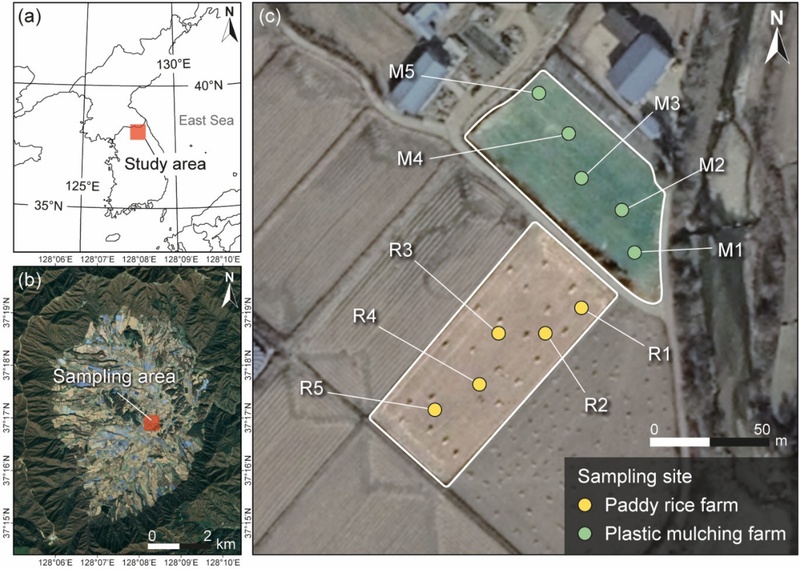
Location of the (a) study area, (b) Haean Basin, and (c) soil sampling points in the paddy rice farm (R=R1, R2, R3, R4, and R5) and plastic mulch area (M=M1, M2, M3, M4, and M5). (Adapted from Chia et al., 2023).
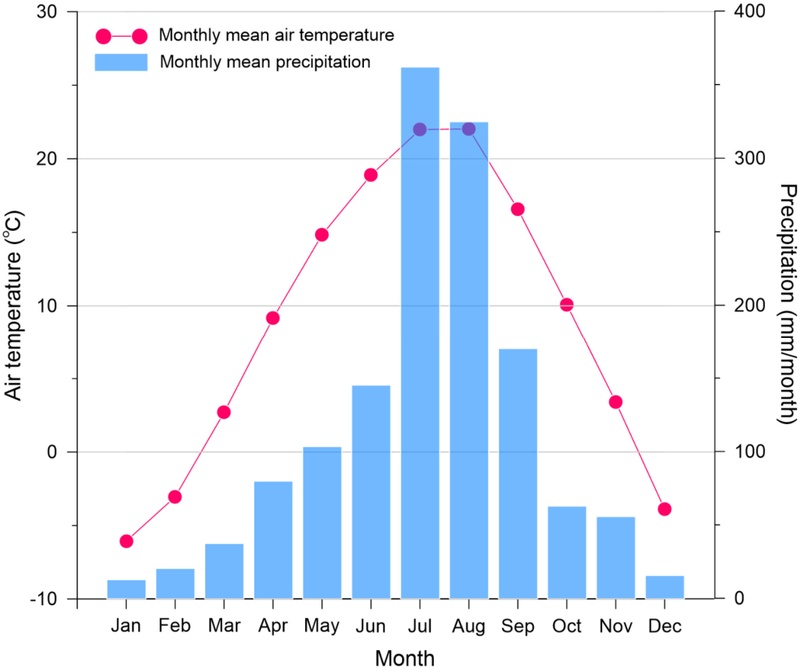
Monthly mean air temperature and precipitation in the study area, Haean Basin from 1997 to 2025.
2.2. Land use history
In the 1950s, before the outbreak of the Korean War from 1950 to 1953, the study site was a natural forested area. However, since the end of the war in 1956, it has been converted to farmland due to human settlement. Today, this site consists of approximately 1,252 residents, most of whom are farmers (Cha et al., 2023). As early as the 1980s, farmers in this region had been using groundwater for irrigation and black polyethylene mulch to keep the soil moist, control weeds, and encourage early plant emergence by raising the soil's temperature. The polyethylene plastic sheets used for mulching must be replaced by legislation eight years after they are used (Lee et al., 2019; Chia et al., 2023). The region's crop-growing season typically runs from April to October.
In this area, the farms from which soil samples were collected such as the PM were initially uncultivated bare land until 2020. In the year 2021, this piece of land was converted into a dry cropland PM used for the cultivation of sweet potatoes and radishes. Meanwhile, the PR cropland from which soil samples were collected was also established in 2021. The PR croplands in the area, is typically irrigated between April and early May in preparation for cultivation. However, the PM is not irrigated or flooded during this time. Unlike other dry farms like ginseng farms and orchards, which are primarily dispersed in areas of intermediate elevation (450-550 m), the PR and PM are primarily distributed in the lowlands (400-450 m elevations) (Cha et al., 2023).
2.3. Soil sample collection
Ten soil samples were taken from the PM and PR, respectively. Top (0-30 cm) and subsoil (30-60 cm) sample cores were collected at five randomly selected points (10 m × 10 m each and 50 m apart) within the PM and PR sites in April 2024 (Fig. 3). To ensure accuracy and precision, a standardized sampling procedure was followed at each point; the soil auger was cleaned between samples to avoid contamination, and separate glass bottles were used to collect the soil samples. The collection of samples from five random locations allowed assessment of precision, and consistent sampling depths ensured accurate representation of soil conditions. These soil samples were used to evaluate soil Hg content, SOC content, P and H content and stocks. From each sampling point, additional intact soil samples were collected using a soil auger sampler with a core sampler at a depth of 0-30 and 30-60 cm in the two study sites and used to determine bulk density (BD) (Chia et al., 2020). In total, 40 soil samples (20 intact soils+20 sub-samples (two depths (0-30 cm; 30-60 cm)×five points×2.0 cropland sites) were collected from the PR farm and PM croplands. Among the 40 samples, 20 intact soil samples were used for BD analysis, while the remaining 20 disturbed sub-samples were analyzed to determine soil H, C, and P content, as well as soil SOC stocks.
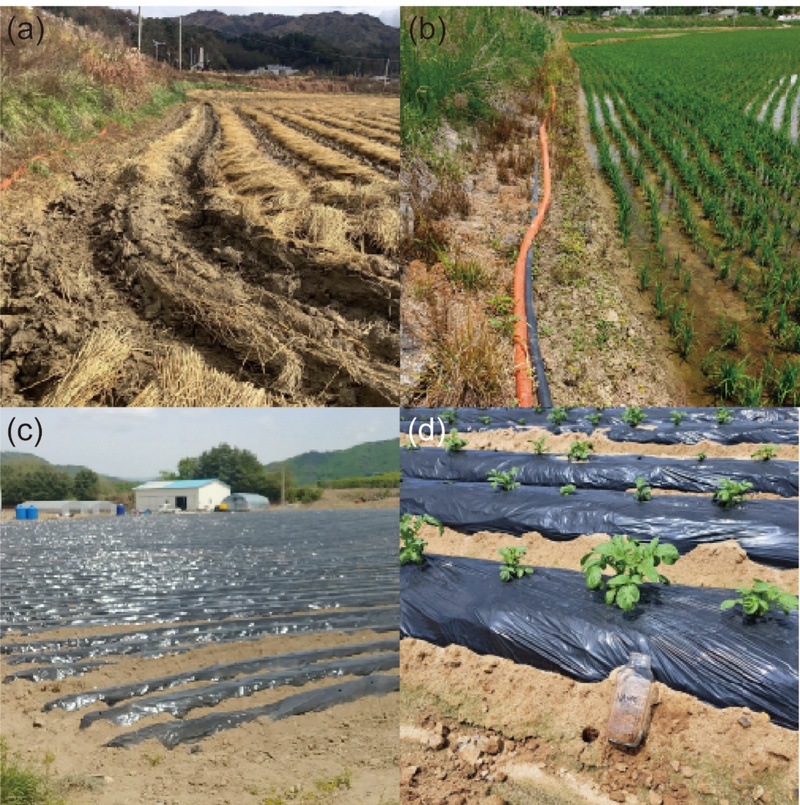
Pictures showing the cropland cultivation styles in the (a) paddy rice farm prior to irrigation, (b) paddy rice farm during irrigation, (c) plastic mulching farm prior to planting, and (d) plastic mulching farm during crop cultivation from where soil samples were collected.
2.4. Laboratory analysis
The soil samples collected from the farm were air dried in the laboratory. Then coarse materials such as large stones, plant roots (especially for soil samples from the PR farm), and leaves were handpicked with tweezers and then the soil was ground with a mortar, passed through a 2 mm nylon mesh screen, and stored in a glass container. The prepared soil samples were divided into three portions. One portion of the prepared soil samples was used to measure soil Hg content using an atomic fluorescence spectrometer according to the method described by Liu et al. (2022) and Yang et al. (2024). Blank samples and standard materials were also analyzed for Hg with recoveries ranging from 95 to 100%. To ensure the precision and quality control of Hg measurements, the certified reference material (CRM) NIST SRM 2709a (San Joaquin Soil) was included in each analytical batch.
The second portion of the soil samples was used to determine soil P content at the Central Laboratory at Kangwon National University, Chuncheon, Korea campus using an Inductively Coupled Plasma Optical Emission Spectrometer (ICP-OES; Agilent 5900, Agilent Technologies, USA) operated in Synchronous Vertical Dual View (SVDV) mode just as reported in Kotelnikova et al. (2024). The third portion of the soil samples was used to determine soil organic carbon (SOC), and H contents using a combustion method at a temperature of 950°C using Flash 2000 Elemental analyzer (Thermo Fisher Scientific, USA) at the Center Laboratory of Kangwon National University, Chuncheon, Korea similarly as reported by Chia et al. (2020) and Tian et al. (2020). The additional intact soil samples collected from the PR and PM cropland were used to determine soil BD by the core method. This involved having the oven dry mass (at 105°C for 72 h) divided by the volume of soil cores (10.0 cm height, 7.2 cm diameter) (Chia et al., 2017, 2020). C, N, and P contents were reported as g kg-1.
2.5. Determination of soil organic carbon stocks
SOC stocks (g m-2) for each sampled depth in the PR farm and PM were calculated using the Eq. (1) (Chia et al., 2017, 2020):
| (1) |
whereby, C = SOC stock (g m-2) of a sample depth, z = thickness of a sample depth (cm), ρb = bulk density (g cm-3) of the PR farm and PM at a sample depth, c = soil organic content (g kg-1 soil) of a sample depth.
2.6. Statistical analysis
Prior to statistical analysis for each soil layer separately, normality was confirmed using the Shapiro-Wilk normality test (Chia et al., 2017, 2020). In the data sets such as BD, H, and Hg, where the normality test failed the Kruskal-Wallis nonparametric analysis test was used as a substitute. A nonparametric test was employed to verify statistical differences between the data sets of the plastic mulch and PR farm (Kruskal and Wallis, 1952; Chia et al., 2020). To look for statistically significant differences between the data sets, a one-way analysis of variance (ANOVA) was performed at the 5.0% significance level. When the analysis of variance revealed statistically significant differences (p < 0.05), Tukey's test was used for mean separation using Sigma Plot version 13.0 (Systat Software Inc., San Jose, CA, USA).
3. Results and discussion
3.1. Comparison of soil Hg, soil organic carbon stock, phosphorus and hydrogen content between paddy rice and plastic mulching farm
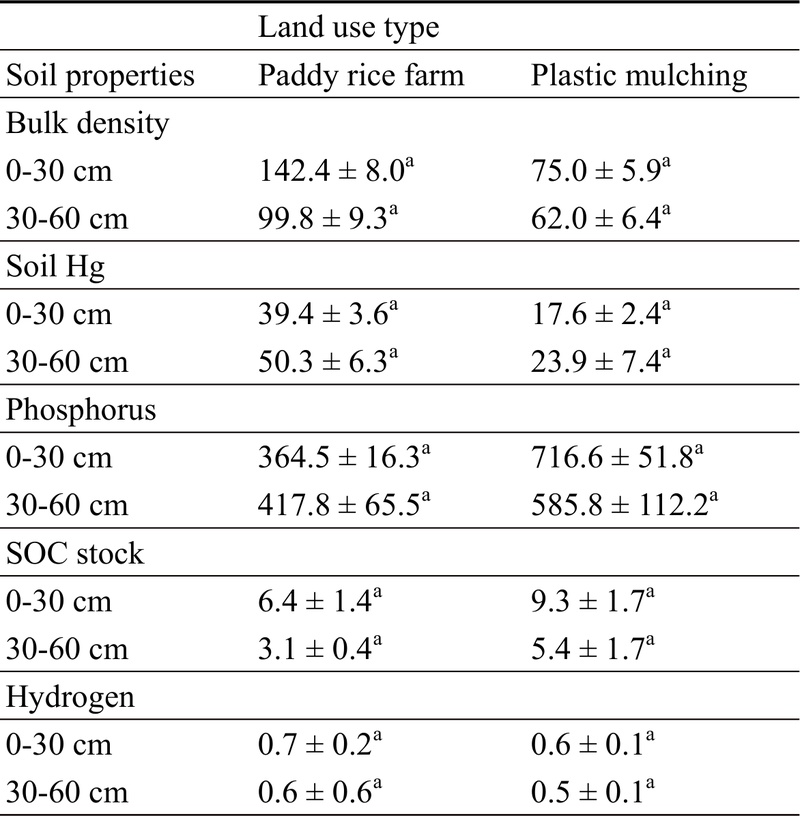
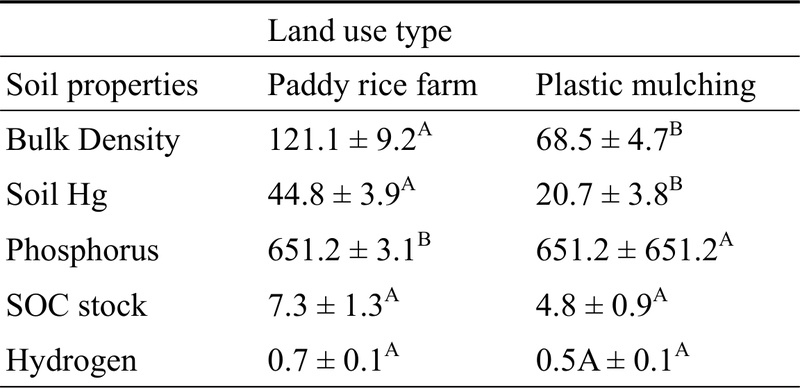
The soil Hg, SOC stock, P, and H content in both PR and PM were inferred among the (0-30 cm and 30-60 cm) and represented on Table 1. Based on these results, no statistically significant changes were observed among the specific soil depths (p = 0.44; Table 1). A possible explanation for this could be that the limited sample size is diminished if considering specific soil depths (e.g., 0-30 cm or 30-60 cm), which affects the statistical power to detect subtle differences related to soil depth. Hence, soil properties such as BD, P, Hg, H, and SOC stock (in the 0-60 cm layer) under PR and PM systems were further compared (Table 2). It was observed that soil BD and Hg content in the PR farm were significantly higher than in the PM site (p < 0.001; Fig. 4). This result is consistent with previous studies, which reported significantly high or increment in Hg following the establishment of PR farms (Tang et al., 2018; Yin et al., 2018). A study by Mondal et al. (2016) showed that the establishment of a PR farm tends to significantly increase soil BD established in the topsoils of 0-15 cm. Also, these studies are in line with the study of de Souza Machado et al. (2018), which documented the tendency for soil BD to decrease following the use of PM for crop cultivation. The higher Hg content and BD in the PR site compared to the PM site suggest that anaerobic conditions in PR farms can enhance the methylation of Hg, making it more bioavailable. The anaerobic environment promotes microbial methylation of inorganic Hg into methylHg, a more toxic and bioavailable form, while reduced leaching allows Hg to accumulate in the soil. These processes reflect how waterlogged conditions simultaneously constrain essential nutrients and enhance the retention of harmful contaminants. Additionally, the higher moisture content and organic matter in PR farm soils could contribute to greater Hg retention and increased BD compared to the well-drained, less organic PM sites.

Bulk density (g cm-3), soil Hg (ng/g), phosphorus (mg/g), soil organic carbon stock (kg m-2), and hydrogen content (%) (0-10 cm and 30-60 cm) in the paddy rice farm and plastic mulching sites. Values are shown as mean ± standard error. Means followed by the same lowercase letters across the column are not significantly different.
Bulk density (g cm-3), soil Hg (ng/g), phosphorus (mg/g), soil organic carbon stock (kg m-2), and hydrogen content (%) (0-60; kg m-2) in paddy rice farm and plastic mulching sites. Values are shown as mean ± standard error. Means followed by the same uppercase letters across the column are not significantly different.
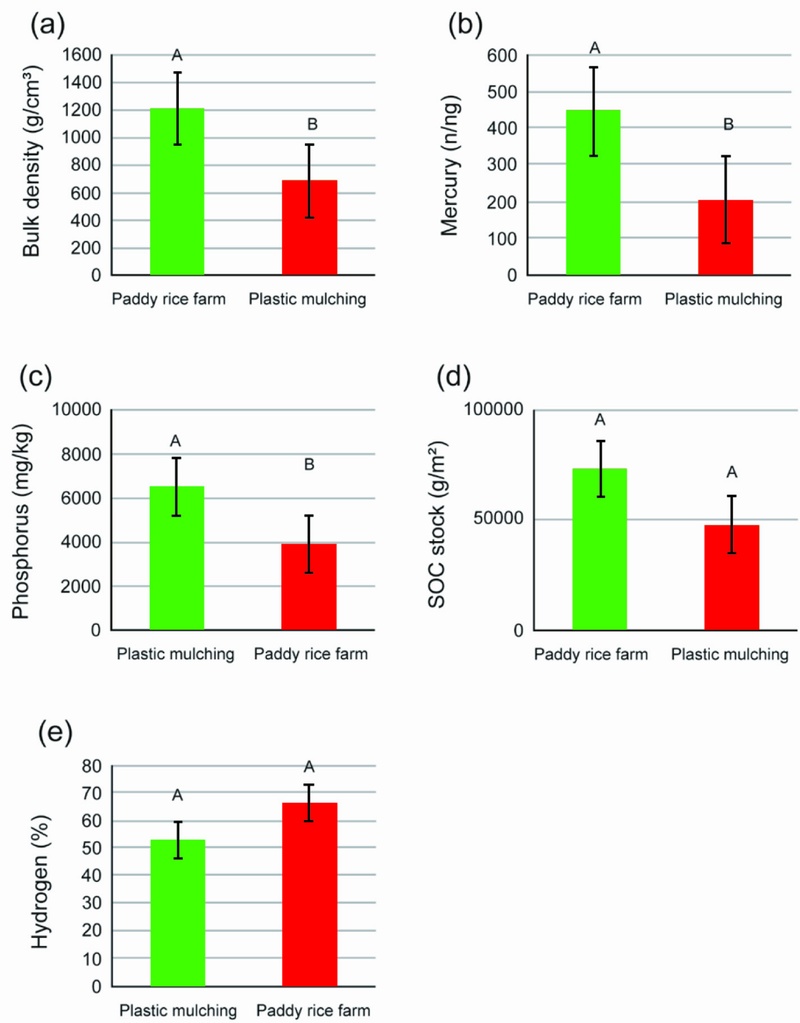
Soil (a) bulk density (b) Hg (c) phosphorus (d) soil organic carbon stock, and (e) hydrogen content in the (0-60 cm) layer in the plastic mulching farm and paddy rice farm. Different uppercase (A, and B) letters show statistical differences and same lowercase (A, and A) letters display no statistical differences in between the plastic mulching and paddy rice farm. The error bars represent standard error.
Meanwhile, results for soil P content were observed to be significantly lower in the PR farm site compared to the PM site (p = 0.002; Fig. 4). These are similar to previous studies which showed that soil P content significantly declined as soil steadily degraded due to about 47% degradation of PR farms (Jin et al., 2022). According to Jiang et al. (2021) and Palihakkara et al. (2024), the significantly low P availability in PR farms can be attributed to the persistent flooded, leaching, and anaerobic conditions that drive key biogeochemical processes, leading to an increase in P sorption capacity and a decrease in P desorption over time. P becomes immobilised through fixation with iron and aluminium compounds or lost during redox fluctuations, resulting in limited plant-available forms (Maranguit et al., 2017).
In contrast, the use of PM for crop cultivation significantly elevated soil P levels (Fig. 4). PM prevents overland flow, improves root zone nutrient availability, and lowers P losses through leaching (Hao et al., 2023; Zhou et al., 2025). SOC stock (p = 0.065) and H storage (p = 0.273) remained statistically similar between PM and PR farms. This is in line with previous studies that found no discernible difference in SOC distribution between farms with plastic mulch and PR farms (Huang et al., 2014; Wang et al., 2016a). According to Chia et al. (2020) when inputs and outputs are balanced, SOC tends to stabilize, resulting in similar SOC levels across different land use regimes and eliminating any apparent differences in SOC stocks between PR and PM systems. SOC is shielded from microbial breakdown by the blockage of organic matter within microaggregates, further preserving this equilibrium. In PR farms, SOC is physically protected, and its stability is increased by the creation of macroaggregates that enclose microaggregates. Similarly, by raising soil temperature and moisture, PM systems stabilize SOC by encouraging the production of macroaggregates that obstruct microaggregates. As a result of this mechanism, SOC stabilizes inside the soil matrix. To further aid in SOC sequestration, PM also boosts microbial activity and root biomass (Wang et al., 2017).
3.2. The association between soil mercury levels and soil organic carbon stock, phosphorus, and hydrogen content
Using Hg and H, P and C contents and SOC data collected from PR and PM sites, the potential relationships among soil chemical characteristics (such as SOC storage, H content, and P and Hg levels) were investigated (Fig. 5). A Pearson's correlation coefficient was used to assess these associations. Under PM conditions, a positive correlation was observed between SOC storage and soil Hg content (r = 0.10; Fig. 5a). The positive correlation between SOC storage and soil Hg concentration under PM may be because Hg has a strong affinity to soil organic matter, especially sulfur-containing functional groups, which can promote Hg retention in soils (Zhang et al., 2024; Chang et al., 2025). Therefore, the higher SOC storage could be linked to a higher capacity of Hg binding and stabilization in the soil organic fraction. However, these associations were not statistically significant (p = 0.01). The weak positive and non-significant relationship between SOC and Hg under plastic mulching indicates that organic carbon is not the main regulator of Hg retention in this system, despite Hg's known affinity for organic matter (Beckers and Rinklebe, 2017; Ignatavičius et al., 2022). The P and Hg levels in the soil showed a positive correlation (r = 0.63) that was statistically significant (p = 0.05; Fig. 5b). This implies that soil Hg associate with P levels. It is important to remember that long-term use of plastic mulching may enhance soil retention of Hg, even if correlation alone cannot prove causality. Conventional plastic mulches can eventually decompose into microplastics, which have been shown to adsorb and bind heavy metals like Hg, possibly influencing their persistence and mobility in soil systems (Chia et al., 2022; Lee et al., 2024b; Xu et al., 2025; Bello et al., 2026). There was a significant negative correlation between the content of H in the soil, but the difference was not statistically significant (r = -0.25, p = 0.49; Fig. 5c). This suggests that soil H has little influence over soil Hg content in PM croplands. This may be the result of an environment that doesn't limit or regulate soil Hg due to the ongoing build-up of MP from plastic mulch. (Meng et al., 2020; Gencer et al., 2026).
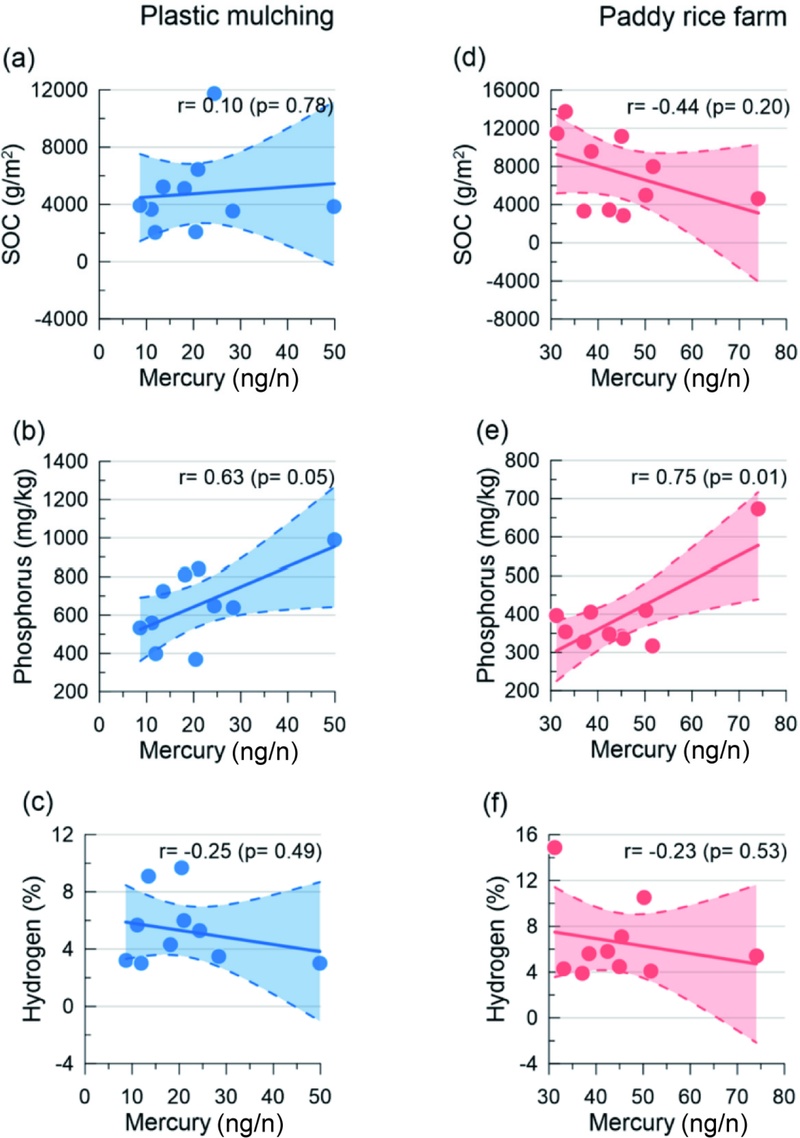
Relationships of Hg contents with (a) soil organic carbon stock, (b) phosphorus and (c) hydrogen in the plastic mulching farm and (d) soil organic carbon, (e) phosphorus, and hydrogen (f) in the paddy rice farm. The shaded regions surrounding the regression lines represent the 95% confidence intervals. The individual data points for both paddy rice and plastic-mulched farms correspond to soil samples collected from depths within the 0-60 cm soil layer.
Meanwhile, under PR conditions, soil organic carbon storage is negatively correlated with soil Hg. concentration. (r = -0.44) (Fig. 5d). However, these correlations were not statistically significant (p = 0.20). The negative correlation between soil SOC and Hg content may be due to anaerobic conditions, which could alter the mobility and form of Hg. Flooding conditions do not allow for the retention of mercury (Hg) in soils. Instead flooding can stimulate the formation of dissolved organic carbon- Hg complexes, thereby increasing Hg mobility (Li et al., 2022). The interaction of the soil's P and Hg content showed a positive correlation (r = 0.75), which was statistically significant (p = 0.01; Fig. 5e). This positive and significant correlation between soil P and Hg content shows that soil P-related processes such as the use of phosphorus-based fertilizers of cropland may enhance Hg retention (Tang et al., 2018, 2021). This is accomplished by increasing the availability of reactive phosphorus which may improve the sorption of Hg on mineral surfaces and promote the formation of stable Hg-P associations, resulting in reduced Hg mobility in soils (Wang et al., 2016b, 2019). Soil H content is negatively correlated with soil Hg content (r = -0.23; Fig. 5f). However, these interactions were not statistically significant (p = 0.53). The negative correlation indicates that soil H has very little influence over Hg dynamics, just like in the PM cropland.
4. Conclusions
The amount of soil Hg contamination, BD, SOC stock, P content, and H content in PM soil and PR farms in an area of Korea that is dominated by agriculture was investigated, compared and correlated in this study. In general, soil BD and Hg content in rice farms were significantly higher than those in PM farms. At the same time, the P content in rice farm soil was significantly lower than that in soil covered with plastic film. This is due to continuous flooding and leaching of PR farms. In addition, there were no significant differences in SOC stock and soil H content between the two sites, indicating that farming practices in the region do not affect SOC stock. To evaluate the association of soil Hg contamination levels and soil chemical properties (such as P and H) and physical qualities (such as BD), Pearson's correlation coefficients were calculated. The PR farm's soil Hg pollution showed negative correlations with SOC stock and H content. There was a statistically significant positive link between soil P and soil Hg, but this correlation does not establish causation and should be interpreted with caution. These findings imply that there might be a relationship between variations in soil P and Hg levels, but further research is necessary to completely comprehend the type and extent of this relationship. At the same time, the soil Hg content calculated on the land covered with PM showed a very weak positive correlation with the soil organic matter reserves. As for soil Hg and P levels, moderate positive correlations were observed, suggesting a real interaction between soil P and Hg contamination. Overall, these results serve as background for future studies focusing on the soil Hg quantification in PR and PM farms in the agricultural regions of Korea, which could be helpful knowledge for preparing measures for reducing and controlling Hg contamination in croplands and variable farming styles such as PR farming and plastic mulch cultivation.
Acknowledgments
This work was supported by the National Research Foundation of Korea (NRF) grant funded by the Korea government (MSIT) (No. RS-2024-00352562). This research was supported by the Basic Science Research Program through the National Research Foundation of Korea (NRF), funded by the Ministry of Education (RS-2019-NR040076).
References
-
Beckers, F. and Rinklebe, J., 2017, Cycling of mercury in the environment: Sources, fate, and human health implications: A review. Critical Reviews in Environmental Science and Technology, 47, 693-794.
[https://doi.org/10.1080/10643389.2017.1326277]

-
Bello, F.A., Fasusi, S.A., Folorunsho, A.B., Lee, J.Y., Okeke, E.S. and Chia, R.W., 2026, Soil Hg contamination sources, impacts on crops and soil organisms, and mitigation: a review. Environmental Geochemistry and Health, 48, 305.
[https://doi.org/10.1007/s10653-026-03178-9]
-
Campos, J.A., Esbrí, J.M., Madrid, M.M., Naharro, R., Peco, J., García-Noguero, E.M., Amorós, J.A., Moreno, M.M. and Higueras, P., 2018, Does Hg presence in soils promote their microbial activity? The Almadenejos case (Almadén Hg mining district, Spain). Chemosphere, 201, 799-806.
[https://doi.org/10.1016/j.chemosphere.2018.02.163]
-
Cha, J., Lee, J.Y. and Chia, R.W., 2023, Microplastics contamination and characteristics of agricultural groundwater in Haean Basin of Korea. Science of the Total Environment, 864, 161027.
[https://doi.org/10.1016/j.scitotenv.2022.161027]
-
Chang, J., Yu, H., Zhang, Y., Yu, B., Gan, C., Hu, Z., Huang, Q. and Sun, Y., 2025, Mechanistic roles of particulate organic carbon in mercury (Hg) immobilization in Hg-contaminated soil around the Yuping mercury mining area, Guizhou, China. Environmental Science: Processes & Impacts, 27, 3890-3902.
[https://doi.org/10.1039/D5EM00486A]
-
Chia, R.W., Kim, D.G. and Yimer, F., 2017, Can afforestation with Cupressus lusitanica restore soil C and N stocks depleted by crop cultivation to levels observed under native systems? Agriculture, ecosystems & environment, 242, 67-75.
[https://doi.org/10.1016/j.agee.2017.03.023]
-
Chia, R.W., Lee, J.Y., Jang, J., Kim, H. and Kwon, K.D., 2022, Soil health and microplastics: a review of the impacts of microplastic contamination on soil properties. Journal of Soils and Sediments, 22, 2690-2705.
[https://doi.org/10.1007/s11368-022-03254-4]
-
Chia, R.W., Lee, J.Y., Lee, M. and Lee, S., 2023, Comparison of microplastic characteristics in mulched and greenhouse soils of a major agriculture area, Korea. Journal of Polymers and the Environment, 31, 2216-2229.
[https://doi.org/10.1007/s10924-022-02746-1]
-
Chia, R.W., Son, Y., Cho, W., Lee, Y.G., Tsetsegmaa, G. and Kang, H., 2020, Do different land use changes in a deciduous forest ecosystem result in alterations in soil organic C and total N stocks? Plant and Soil, 457, 153-165.
[https://doi.org/10.1007/s11104-020-04724-9]
-
de Souza Machado, A.A., Lau, C.W., Till, J., Kloas, W., Lehmann, A., Becker, R. and Rillig, M.C., 2018, Impacts of microplastics on the soil biophysical environment. Environmental Science and Technology, 52, 9656-9665.
[https://doi.org/10.1021/acs.est.8b02212]
-
Gencer, M., Akca, M.O., Acar, M., Abdelrazik, Z.S., Wahab, T.S., Gündogdu, S. and Turgay, O.C., 2026, Microplastic Accumulation and Soil Quality Changes Under Varying Plastic Mulching Durations in the Mediterranean Region. Journal of Soil Science and Plant Nutrition, 26, 2513-2528.
[https://doi.org/10.1007/s42729-026-03010-4]
-
Hao, J.Q., Song, J.J., Gao, G.X., Xu, W., Bai, J.Z., Feng, Y.Z. and Wang, X., 2023, Mitigation of the ratio of soil dissolved organic carbon to available phosphorus effectively improves crop productivity under mulching measures on the Loess Plateau. Agronomy, 13, 1810.
[https://doi.org/10.3390/agronomy13071810]
-
Huang, S., Pan, X., Guo, J., Qian, C. and Zhang, W., 2014, Differences in soil organic carbon stocks and fraction distributions between rice paddies and upland cropping systems in China. Journal of Soils and Sediments, 14, 89-98.
[https://doi.org/10.1007/s11368-013-0789-9]
-
Ignatavičius, G., Unsal, M.H., Busher, P., Wołkowicz, S., Satkūnas, J., Šulijienė, G. and Valskys, V., 2022, Geochemistry of mercury in soils and water sediments. AIMS Environmental Science, 9, 261-281.
[https://doi.org/10.3934/environsci.2022019]
-
Jeong, E., Lee, J.Y., Viaroli, S. and Chia, R.W., 2026, Trends of global concerns on groundwater contamination and future directions. Ecotoxicology and Environmental Safety, 311, 119837.
[https://doi.org/10.1016/j.ecoenv.2026.119837]
-
Jiang, B., Shen, J., Sun, M., Hu, Y., Jiang, W., Wang, J., Li, Y. and Wu, J., 2021, Soil phosphorus availability and rice phosphorus uptake in paddy fields under various agronomic practices. Pedosphere, 31, 103-115.
[https://doi.org/10.1016/S1002-0160(20)60053-4]
-
Jin, Q., Wang, C., Sardans, J., Vancov, T., Fang, Y., Wu, L., Huang, X., Gargallo-Garriga, A., Peñuelas, J. and Wang, W., 2022, Effect of soil degradation on the carbon content and retention of nitrogen and phosphorus across Chinese rice paddy fields. Catena, 209, 105810.
[https://doi.org/10.1016/j.catena.2021.105810]
-
Kotelnikova, A.D., Borisochkina, T.I., Kolchanova, K.A., Shishkin, M.A., Egorov, F.S., Okorkov, V.V. and Rogova, O.B., 2024, Dataset on elemental composition of soils and plants under long-term application of mineral and organic fertilizers on gray forest soils in Vladimir region, Russia. Data in Brief, 53, 110057.
[https://doi.org/10.1016/j.dib.2024.110057]
-
Kruskal, W.H. and Wallis, W.A., 1952, Use of ranks in one-criterion variance analysis. Journal of the American Statistical Association, 47, 583-621.
[https://doi.org/10.1080/01621459.1952.10483441]
-
Lee, J.G., Cho, S.R., Jeong, S.T., Hwang, H.Y. and Kim, P.J., 2019, Different response of plastic film mulching on greenhouse gas intensity (GHGI) between chemical and organic fertilization in maize upland soil. Science of the Total Environment, 696, 133827.
[https://doi.org/10.1016/j.scitotenv.2019.133827]
-
Lee, J.Y., Cha, J., Jeong, E. and Chia, R.W., 2024a, Microplastics in soil and groundwater of Korea: Occurrence, characteristics and risk assessment. Episodes Journal of International Geoscience, 47, 685-696.
[https://doi.org/10.18814/epiiugs/2023/02403s01]
-
Lee, J.Y., Chia, R.W., Veerasingam, S., Uddin, S., Jeon, W.H., Moon, H.S., Cha, J. and Lee, J., 2024b, A comprehensive review of urban microplastic pollution sources, environment and human health impacts, and regulatory efforts. Science of the Total Environment, 946, 174297.
[https://doi.org/10.1016/j.scitotenv.2024.174297]
-
Li, X., Zhang, J., Gong, Y., Yang, S., Ye, M., Yu, X. and Ma, J., 2020, Status of Hg accumulation in agricultural soils across China (1976-2016). Ecotoxicology and Environmental Safety, 197, 110564.
[https://doi.org/10.1016/j.ecoenv.2020.110564]
-
Li, Y., Lu, C., Zhu, N., Chao, J., Hu, W., Zhang, Z., Wang, Y., Liang, L., Chen, J., Xu, D. and Gao, Y., 2022, Mobilization and methylation of mercury with sulfur addition in paddy soil: Implications for integrated water-sulfur management in controlling Hg accumulation in rice. Journal of Hazardous Materials, 430, 128447.
[https://doi.org/10.1016/j.jhazmat.2022.128447]
-
Liang, H., Wang, S., Xu, P., Wang, M., Liang, P., Wu, S., Zhang, J. and Wong, M.H., 2024, Converting flooded rice to dry farming can alleviate MeHg accumulation in grains. Ecotoxicology and Environmental Safety, 283, 116817.
[https://doi.org/10.1016/j.ecoenv.2024.116817]
-
Liu, B., Tian, K., He, Y., Hu, W., Huang, B., Zhang, X., Zhao, L. and Teng, Y., 2022, Dominant roles of torrential floods and atmospheric deposition revealed by quantitative source apportionment of potentially toxic elements in agricultural soils around a historical Hg mine, Southwest China. Ecotoxicology and Environmental Safety, 242, 113854.
[https://doi.org/10.1016/j.ecoenv.2022.113854]
-
Maranguit, D., Guillaume, T. and Kuzyakov, Y., 2017, Effects of flooding on phosphorus and iron mobilization in highly weathered soils under different land-use types: Short-term effects and mechanisms. Catena, 158, 161-170.
[https://doi.org/10.1016/j.catena.2017.06.023]
-
Meng, F., Fan, T., Yang, X., Riksen, M., Xu, M. and Geissen, V., 2020, Effects of plastic mulching on the accumulation and distribution of macro and microplastics in soils of two farming systems in Northwest China. PeerJ, 8, e10375.
[https://doi.org/10.7717/peerj.10375]
-
Mondal, S., Kumar, S., Haris, A.A., Dwivedi, S.K., Bhatt, B.P. and Mishra, J.S., 2016, Effect of different rice establishment methods on soil physical properties in drought-prone, rainfed lowlands of Bihar, India. Soil Research, 54, 997-1006.
[https://doi.org/10.1071/SR15346]
-
Nave, L.E., Drevnick, P.E., Heckman, K.A., Hofmeister, K.L., Veverica, T.J. and Swanston, C.W., 2017, Soil hydrology, physical and chemical properties and the distribution of carbon and Hg in a postglacial lake-plain wetland. Geoderma, 305, 40-52.
[https://doi.org/10.1016/j.geoderma.2017.05.035]
-
Palihakkara, J., Burkitt, L., Jeyakumar, P. and Attanayake, C.P., 2024, Exploring phosphorus dynamics in submerged soils and its implications on the inconsistent rice yield response to added inorganic phosphorus fertilisers in paddy soils in Sri Lanka. Journal of Soil Science and Plant Nutrition, 24, 1-20.
[https://doi.org/10.1007/s42729-023-01553-4]
-
Pei, P., Sun, T., Xu, Y. and Sun, Y., 2021, Soil aggregate-associated Hg (Hg) and organic carbon distribution and microbial community characteristics under typical farmland-use types. Chemosphere, 275, 129987.
[https://doi.org/10.1016/j.chemosphere.2021.129987]
-
Raza, M. and Lee, J.Y., 2019, Factors affecting spatial pattern of groundwater hydrochemical variables and nitrate in agricultural region of Korea. Episodes Journal of International Geoscience, 42, 135-148.
[https://doi.org/10.18814/epiiugs/2019/019011]
-
Santos-Echeandía, J., Rivera-Hernández, J.R., Rodrigues, J.P. and Moltó, V., 2020, Interaction of Hg with beached plastics with special attention to zonation, degradation status and polymer type. Marine Chemistry, 222, 103788.
[https://doi.org/10.1016/j.marchem.2020.103788]
-
Šípková, A., Száková, J., Hanč, A. and Tlustoš, P., 2016, Mobility of Hg in soil as affected by soil physicochemical properties. Journal of Soils and Sediments, 16, 2234-2241.
[https://doi.org/10.1007/s11368-016-1420-7]
-
Soares, L.C., Egreja Filho, F.B., Linhares, L.A., Windmoller, C.C. and Yoshida, M.I., 2015, Accumulation and oxidation of elemental Hg in tropical soils. Chemosphere, 134, 181-191.
[https://doi.org/10.1016/j.chemosphere.2015.04.020]
-
Tang, Z., Fan, F., Wang, X., Shi, X., Deng, S. and Wang, D., 2018, Mercury in rice (Oryza sativa L.) and rice-paddy soils under long-term fertilizer and organic amendment. Ecotoxicology and Environmental Safety, 150, 116-122.
[https://doi.org/10.1016/j.ecoenv.2017.12.021]
-
Tang, Z., Fan, F., Wang, X., Shi, X. and Wang, D., 2021, Understanding the effects of long-term different fertilizer applications on methylmercury accumulation in rice (Oryza sativa L.) plants. Science of the Total Environment, 777, 146125.
[https://doi.org/10.1016/j.scitotenv.2021.146125]
-
Tian, L., Guo, Q., Yu, G., Zhu, Y., Lang, Y., Wei, R., Hu, J., Yang, X. and Ge, T., 2020, Phosphorus fractions and oxygen isotope composition of inorganic phosphate in typical agricultural soils. Chemosphere, 239, 124622.
[https://doi.org/10.1016/j.chemosphere.2019.124622]
-
Wang, J., Xing, Y., Xie, Y., Meng, Y., Xia, J. and Feng, X., 2019, The use of calcium carbonate-enriched clay minerals and diammonium phosphate as novel immobilization agents for mercury remediation: Spectral investigations and field applications. Science of the total environment, 646, 1615-1623.
[https://doi.org/10.1016/j.scitotenv.2018.07.225]
-
Wang, L., Li, X.G., Lv, J., Fu, T., Ma, Q., Song, W., Wang, Y.P. and Li, F.M., 2017, Continuous plastic-film mulching increases soil aggregation but decreases soil pH in semiarid areas of China. Soil and Tillage Research, 167, 46-53.
[https://doi.org/10.1016/j.still.2016.11.004]
-
Wang, Q., Zhang, J., Xin, X., Zhao, B., Ma, D. and Zhang, H., 2016a, The accumulation and transfer of arsenic and mercury in the soil under a long-term fertilization treatment. Journal of Soils and Sediments, 16, 427-437.
[https://doi.org/10.1007/s11368-015-1227-y]
-
Wang, Y.P., Li, X.G., Fu, T., Wang, L., Turner, N.C., Siddique, K.H. and Li, F.M., 2016b, Multi-site assessment of the effects of plastic-film mulch on the soil organic carbon balance in semiarid areas of China. Agricultural and Forest Meteorology, 228, 42-51.
[https://doi.org/10.1016/j.agrformet.2016.06.016]
-
Xia, J., Wang, J., Zhang, L., Anderson, C.W., Wang, X., Zhang, H., Dai, Z. and Feng, X., 2020, Screening of native low Hg accumulation crops in a Hg-polluted mining region: Agricultural planning to manage Hg risk in farming communities. Journal of Cleaner Production, 262, 121324.
[https://doi.org/10.1016/j.jclepro.2020.121324]
-
Xu, T., Zheng, S., Duo, X., Hou, Z. and Wu, J., 2025, Long-term plastic mulching exacerbates the co-limitation of carbon and phosphorus in farmland by altering physicochemical properties and microbial interactions. Frontiers in Microbiology, 16, 1694370.
[https://doi.org/10.3389/fmicb.2025.1694370]
-
Xue, W., Kwon, S.Y., Grasby, S.E., Sunderland, E.M., Pan, X., Sun, R., Zhou, T., Yan, H. and Yin, R., 2019, Anthropogenic influences on Hg in Chinese soil and sediment revealed by relationships with total organic carbon. Environmental Pollution, 255, 113186.
[https://doi.org/10.1016/j.envpol.2019.113186]
-
Yang, W., Zhang, L., Gao, B., Liu, X., Duan, X., Wang, C., Zhang, Y., Li, Q. and Wang, L., 2024, Integrated assessment of potentially toxic elements in soil of the Kangdian metallogenic province: A two-point machine learning approach. Ecotoxicology and Environmental Safety, 276, 116248.
[https://doi.org/10.1016/j.ecoenv.2024.116248]
-
Yin, D., He, T., Yin, R. and Zeng, L., 2018, Effects of soil properties on production and bioaccumulation of methylHg in rice paddies at a Hg mining area, China. Journal of Environmental Sciences, 68, 194-205.
[https://doi.org/10.1016/j.jes.2018.04.028]
-
Zhang, Y., Liu, J., Ge, Z., Ou, C., Wei, J., Liu, H. and Wei, Y., 2024, The binding effects and mechanisms of dissolved organic matter (DOM) on the fate of mercury in sludge anaerobic digestion combined with thermal hydrolysis. Water Research, 259, 121845.
[https://doi.org/10.1016/j.watres.2024.121845]
-
Zhou, B., Li, H., Zhuo, Z., Wang, L., Yang, M., Lin, J., Jiang, F., Huang, Y. and Zhang, Y., 2025, Effects of different mulching measures on soil physicochemical properties and phosphorus fractions in orchards in the southeast hilly region of China. Plant, Soil and Environment, 71.
[https://doi.org/10.17221/675/2024-PSE]