
자생광물 지화학 분석을 통한 극지 고환경 복원의 새로운 패러다임

초록
북극해는 빙하기 동안 광범위한 담수화, 산소 고갈, 해빙 및 빙붕 확장 등 극한의 환경 변화를 겪었다. 이러한 환경에서는 유공충 및 규조류와 같은 생물 기원 지시자의 생산과 보존이 제한되고 퇴적 기록이 불연속적으로 나타날 수 있어, 이를 기반으로 한 전통적인 고해양 복원에 상당한 제약이 따른다. 특히 중앙 북극해와 같은 극저퇴적(ultra low-sedimentation) 환경에서는 생장 기간이 짧은 생물 기원 기록이 해당 퇴적 구간의 장기적·우세한 환경 조건을 충분히 대표하지 못할 가능성이 있다. 본 리뷰에서는 이러한 한계를 보완할 수 있는 접근법으로서 자생광물(authigenic minerals) 지화학 분석의 활용 가능성을 세 가지 대표 사례를 중심으로 고찰하였다. 첫째, 해양 퇴적물 내 자생 철-망간 산화수산화물 분획에 보존된 네오디뮴 동위원소 비는 북극해로의 간헐적 융빙수 유입과 이에 수반된 고해양 순환 변동을 복원하는 데 효과적으로 활용될 수 있음을 보여준다. 둘째, 자생 분획의 희토류 원소 패턴은 빙하의 기계적 마모와 연계된 황화광물 산화 풍화의 영향을 반영하며, 극지 연안 환경에서 과거 빙하 거동과 육상 화학 풍화 변화를 추적할 수 있는 지시자로 활용될 가능성을 제시한다. 셋째, 자생성 방해석 결정체의 원소 조성과 안정 동위원소 비는 빙하기 북극해 심층수가 기수(brackish water) 상태였으며, 동시에 강한 산소 고갈 환경에 놓였을 가능성을 제시하였다. 이들 연구 사례는 자생광물 지화학 분석이 생물 기원 지시자의 한계를 보완하는 유용한 극지 고환경 복원 기법임을 보여주며, 북극 빙하 거동, 수문 환경 변화, 심층수 산화환원 상태 및 빙하기 해양 탄소순환에 대한 이해를 확장할 수 있는 가능성을 제시한다.
Abstract
The Arctic Ocean underwent extreme environmental changes during past glacial periods, including widespread freshening, oxygen depletion, and extensive sea-ice and ice-shelf coverage. These environments pose major challenges for conventional paleoceanographic reconstructions based on biogenic proxies such as foraminifera and diatoms because biological productivity and preservation can be severely limited. Furthermore, in the ultra-low-sedimentation-rate settings characteristic of the central Arctic Ocean, short-lived organisms may not fully represent the long-term environmental conditions recorded by a given sedimentary interval. This review examines the potential of authigenic mineral geochemistry as a complementary approach to overcome these limitations, focusing on three representative case studies. First, neodymium isotope ratios preserved in authigenic Fe–Mn oxyhydroxide fractions of marine sediments have been applied to reconstruct episodic meltwater discharge events and associated paleoceanograhic circulation changes in the Arctic Ocean. Second, rare earth element patterns in authigenic sediment fractions can reflect oxidative sulfide weathering linked to glacial abrasion, providing a potential proxy for tracing past glacial dynamics and terrestrial chemical weathering in polar coastal environments. Third, elemental and stable isotope analyses of authigenic calcite crystals suggest that Arctic deep waters during stadial periods were brackish and characterized by severe oxygen depletion. Collectively, these studies highlight authigenic mineral geochemistry as a promising approach for complementing biogenic proxy records and improving our understanding of Arctic glacial dynamics, hydrological variability, deep-water redox conditions, and glacial ocean carbon cycling.
Keywords:
authigenic fraction, neodymium isotopes, rare earth elements, authigenic calcite, Arctic freshening키워드:
자생 분획, 네오디뮴 동위원소, 희토류 원소, 자생성 방해석, 북극해 담수화1. 서 론
전 지구적 기후 시스템의 변화를 가장 민감하게 반영하는 북극해는 현재 급격한 해빙 감소와 대기 온난화가 초래하는 '북극 증폭(Arctic amplification)' 현상의 중심지로 알려져 있다(Screen and Simmonds, 2010). 이러한 고위도의 환경 변화는 극지와 중위도 간 기온 구배 약화 및 제트기류 불안정화를 통해 한반도를 포함한 북반구 중위도 지역의 기상 이변과 직결된다(Kim et al., 2014; Cohen et al., 2020). 이러한 점에서 북극 기후 시스템의 중장기적 변동 양상을 파악하는 것은 오늘날 전 지구적 기후변화를 보다 면밀히 이해하는 데 필수적이다. 그러나 수십 년에 불과한 현대 관측 기록은 지구 시스템의 긴 자연적 변동성을 이해하기에 시간적으로 불충분하기 때문에, 과거 빙하기-간빙기 주기 전반에 걸친 극지 고환경 복원(paleoenvironmental reconstruction) 연구의 필요성이 강조되고 있다.
20세기 후반부터 본격화된 쇄빙선(icebreaker) 기반 극지 탐사의 발전은 북극해 심해 퇴적물 코어의 획득을 가능하게 하였고, 이를 통해 과거 빙하기 북극해의 해양 환경 복원 연구가 활발히 진행되어 왔다. 그 중에서도 빙하기 북극해의 수문 환경, 즉 염분과 해수 조성의 변화는 전 지구적 탄소 순환 및 열염순환과 직결되는 핵심 연구 주제로 자리잡아 왔다. 이러한 맥락에서 Geibert et al. (2021)은 퇴적물 내 과잉 230Th (230Thex) 농도 기록을 근거로, Marine Isotope Stage (MIS) 4와 MIS 6 중 일부 시기(각각 약 70,000~62,000년 전 및 약 150,000~131,000년 전)동안, 북극해가 거대 빙붕에 의해 외부와 차단되어 염분도 0 ‰에 달하는 완전 담수화 상태에 놓였다는 급진적인 가설을 네이처 지에 제안하며 북극 고기후학계에 큰 파장을 일으켰다.
이 가설은 즉각적인 반론에 직면하였다. 완전 담수화 환경에서는 생존이 불가능한 해양 유공충 미화석이 해당 시기를 대변하는 빙하기 퇴적물에서 간헐적으로 산출된다는 사실이 핵심적인 반증으로 제시되었고(Spielhagen et al., 2022), 결과적으로 완전 담수화 가설은 학계의 주류 이론으로 자리잡지 못한 채 논쟁이 지속되었다. 그러나 이 반론 역시 재고의 여지가 있다. 빙하기 동안 중앙 북극해 분지는 두꺼운 해빙과 빙붕의 발달로 퇴적물 공급이 극도로 제한되어, 수천 년에 걸쳐 1cm 두께의 퇴적층이 축적되는 극저퇴적(ultra low-sedimentation) 환경을 형성한다(Polyak et al., 2009; Jang et al., 2013). 이처럼 극단적으로 압축된 시공간적 환경에서, 수 년에서 수십 년의 짧은 생장 기간을 갖는 유공충은 해당 퇴적층이 대표하는 수천 년의 환경 조건 전반을 온전히 반영하지 못하고, 자신의 생장에 일시적으로 유리했던 특정 조건만을 선택적으로 대변하는 편향된 신호(biased signal)를 생성할 가능성이 있다(Jang et al., 2023). 따라서 빙하기 퇴적물에서의 유공충 산출 자체를 담수화 가설의 결정적 반증으로 해석하는 것은 방법론적으로 재검토가 필요하다. 이러한 문제 인식은 생물 기원 지시자를 대체하거나 보완할 수 있는 새로운 고환경 기록물(archive)의 필요성을 강하게 제기한다.
자생광물(authigenic minerals)은 생물 생산성에 직접적으로 의존하지 않고, 해수-퇴적물 경계부(sediment-water interface) 또는 공극수 내에서 일어나는 침전, 흡착 및 원소 포획 등의 지화학적 과정을 통해 주변 유체의 화학 조성과 동위원소 특성을 보존할 수 있다. 따라서 생물 기원 지시자의 생산이나 보존이 제한되는 극지 퇴적 환경에서, 자생광물은 기존 기록의 공백을 보완할 수 있는 유용한 고환경 기록물로 활용될 수 있다(Jang et al., 2023). 이에 본 리뷰 논문에서는 극지 고환경 복원에 적용된 세 가지 대표적인 자생광물 지화학 연구 성과를 고찰한다. 구체적으로 (1) 자생 분획(authigenic fraction)의 네오디뮴(Nd) 동위원소를 활용한 고해양 순환 복원(Haley et al., 2008; Jang et al., 2013), (2) 자생 분획 희토류 원소(rare earth elements, REE) 분별 패턴을 통한 빙하 침식 및 황화광물 산화풍화 메커니즘 추적(Jang et al., 2024), (3) 무기 자생 방해석 결정체(inorganic authigenic calcite crystals)를 활용한 빙하기 북극해 담수화 및 탈산소화 현상 규명 사례(Jang et al., 2023)를 순차적으로 논의하고, 향후 극지 고환경 복원 연구의 방향성을 제시하고자 한다.
2. 자생광물의 정의 및 고환경 지시자로서의 특성
2.1. 자생광물의 정의와 형성 환경
자생광물 및 자생성 성분은 육상 기원 쇄설물 혹은 쇄설성 입자(detritus 혹은 detrital grains)와 달리, 퇴적 환경 내에서 주변 해수나 공극수(interstitial/pore water)의 화학 성분으로부터 새롭게 침전·성장하거나, 기존 입자 표면에 피막 형태로 발달하면서 원소를 흡착·포획하는 광물 또는 반응성 성분을 포괄한다. 이들은 주로 해수-퇴적물 경계부 또는 그 아래의 공극수 환경에서 형성되며, 기원지에서 생성·운반된 후 퇴적되는 쇄설성 광물과 구별된다.
해양 퇴적 환경에서 형성되는 대표적인 자생광물 및 자생성 성분으로는 철망간 산화수산화물 피막(Fe-Mn oxyhydroxide coating), 자생성 방해석(authigenic calcite) 및 아라고나이트(aragonite), 황철석(authigenic pyrite), 인회석(authigenic apatite), 제올라이트(zeolite) 등이 있다. 이 중 철망간 산화수산화물 피막은 형성 및 성장 과정에서 주변 해수 또는 공극수로부터 희토류 원소와 Nd 동위원소를 흡착·포획할 수 있으며, 이러한 피막을 포함하는 자생 분획(authigenic fraction)의 지화학 조성은 고해양 순환, 수괴 기원 및 풍화 환경 복원에 광범위하게 활용되어왔다(Rutberg et al., 2000; Piotrowski et al., 2005). 한편 자생성 탄산염 광물은 침전 당시 유체의 탄소·산소 동위원소 조성과 원소 조성을 반영할 수 있어, 수문 환경과 탄소순환 변화를 추적하는 지시자로 활용 가능성이 주목받고 있다(Jang et al., 2023). 특히 본 논문에서 고찰하는 바와 같이 무기 기원 자생성 방해석 결정체를 물리적으로 분리하여 직접 분석하는 접근법은 생물 기원 탄산염 기록이 제한되는 극지 퇴적 환경에서 고환경 복원의 새로운 가능성을 제시한다.
2.2. 자생광물이 고환경 지시자로서 갖는 장점
자생광물이 전통적인 생물 기원 지시자를 보완하는 대안으로 주목받는 이유는, 그 형성이 유기체의 생존이나 생물 생산성에 직접적으로 좌우되지 않는다는 점에 있다(그림 1). 즉, 적절한 지화학적 조건이 유지되는 경우 자생광물 및 자생성 성분은 주변 해수 또는 공극수의 화학 조성과 동위원소 특성을 기록할 수 있으므로, 생물 생산성이 저하되거나 생물 기원 물질의 보존이 불량한 환경에서도 퇴적 환경의 지화학적 정보를 보완적으로 제공할 수 있다. 이러한 특성은 특히 빙하기 북극환경과 같이 담수화, 무산소화, 또는 광범위한 빙붕 발달로 인해 생물 기원 지시자의 기록 공백이 발생하기 쉬운 환경에서 그 유용성이 두드러진다(Jang et al., 2023).
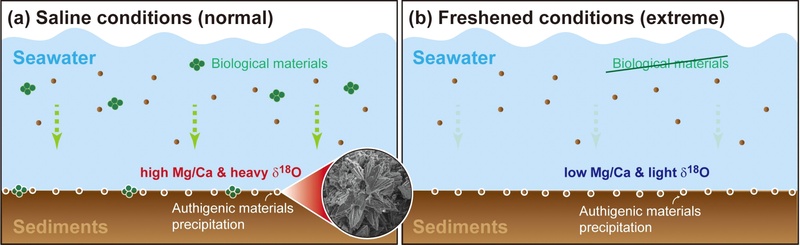
Conceptual diagram illustrating the potential formation and preservation of biogenic materials and authigenic minerals under contrasting seawater salinity conditions. (a) Under normal saline conditions, biological materials are produced and deposited on the seafloor, and authigenic calcite formed from seawater-influenced fluids may record high Mg/Ca ratios and heavier oxygen isotope compositions (δ18O). (b) Under strongly freshened conditions, biological productivity and/or preservation may be limited, whereas authigenic minerals can form at the sediment-water interface or within pore waters under favorable geochemical conditions. Authigenic calcite formed under such conditions may record low Mg/Ca ratios and lighter δ18O values. The authigenic calcite crystal image used here is presented as a representative example of crystal morphology and is reproduced from Jang et al. (2023).
퇴적율이 극도로 낮은 중앙 북극해 분지와 같은 환경에서는 생물 기원 지시자의 또 다른 한계가 부각된다. 수천 년에 걸쳐 1 cm 두께의 퇴적층이 축적되는 극저퇴적 환경에서(Polyak et al., 2009; Jang et al., 2013), 비교적 짧은 생장 기간을 갖는 유공충 등의 미화석은 해당 퇴적층이 대표하는 장구한 시간 구간의 환경 조건 전반을 대변하지 못하고(Polyak et al., 2009), 생장에 일시적으로 유리했던 특정 조건만을 선택적으로 기록할 가능성이 있다(Jang et al., 2023). 반면 자생광물 및 자생성 성분은 적절한 지화학적 조건이 유지되는 동안 퇴적물-유체 상호작용을 통해 형성·성장할 수 있으므로, 특정 생물체의 생장 시점에 한정되지 않는 보다 통합적인 환경 정보를 제공할 수 있다.
또한 자생광물, 특히 철망간 산화물 피막은 형성 및 성장 과정에서 주변 해수 또는 공극수로부터 원소와 동위원소를 직접 흡착·포획할 수 있기 때문에, 당시 유체의 지화학적 특성을 보존하는 기록물로 활용될 수 있다(Rutberg et al., 2000; Piotrowski et al., 2005; Haley et al., 2008). 다만 자생광물의 형성과 보존은 모든 퇴적 환경에서 동일하게 일어나는 것이 아니라, 주변 유체의 포화 상태, 산화환원 조건, 알칼리도, 용존 성분 공급 및 이후 속성 변질 여부에 따라 달라질 수 있다(Jang et al., 2018). 따라서 자생광물 기반 고환경 기록을 해석할 때에는 각 광물 또는 자생성 성분의 형성 환경과 보존 가능성을 함께 검토하는 것이 중요하다.
2.3. 자생광물 분석의 핵심 방법론
자생광물 및 자생성 성분은 종류와 존재 형태에 따라 분리·추출 방법이 달라지므로, 분석 목적에 맞는 전처리 전략을 설정하는 것이 중요하다. 철망간 산화수산화물 피막을 포함하는 자생 분획을 쇄설성 성분으로부터 분리하는 데에는 전통적으로 순차적 침출법(sequential leaching)이 사용되어 왔다(Bayon et al., 2002; Gutjahr et al., 2007). 이 방법은 교환성 양이온 제거를 위한 MgCl2 용액, 탄산염 성분 용해를 위한 아세트산(acetic acid), 그리고 Fe-Mn 산화수산화물 분획의 선택적 용출을 위한 하이드록실아민 염산염-아세트산 혼합 용액(hydroxylamine hydrochloride dissolved in acetic acid)을 단계적으로 적용하여, 반응성이 서로 다른 퇴적물 성분들을 순차적으로 분리·추출하는 기법이다. Fe-Mn 산화수산화물에 결합된 Nd 및 REE는 주로 마지막 환원성 용출 단계에서 용액으로 분리되며, 동일 조건에서 용해되지 않고 잔류하는 규산염 기반 쇄설성 분획(silicate-bound detrital fraction)과 효과적으로 구분된다.
한편, 연구 목적과 시료 특성에 따라, 탄산염 및 Fe-Mn 산화수산화물 등 반응성 분획을 함께 용출하는 단순화된 침출법도 활용되고 있다(Wilson et al., 2013)(그림 2). 어느 방식을 적용하든, 침출 조건(pH, 온도, 시약 농도, 반응 시간)은 자생 성분의 선택성과 순도를 결정짓는 핵심 변수이므로, 분석 결과의 신뢰성을 확보하기 위해 방법론적 검증이 요구된다(Wilson et al., 2013; Jang et al., 2017). 즉, 침출 용액은 분석 목적에 따라 나누어 사용될 수 있으며, REE 농도는 주로 유도결합플라즈마 질량분석기(Inductively Coupled Plasma Mass Spectrometry, ICP-MS)를 이용해 측정한다. Nd 동위원소 분석의 경우, 이온 교환 크로마토그래피(ion exchange chromatography)를 통해 Nd 를 다른 매트릭스 원소로부터 분리·정제한 후(Pin and Zalduegui, 1997), 열이온화 질량분석기(Thermal Ionization Mass Spectrometry, TIMS) 또는 다중검출기 유도결합플라즈마 질량분석기(Multi-Collector Inductively Coupled Plasma Mass Spectrometry, MC-ICP-MS)를 이용하여 동위원소 비를 정밀 분석한다(그림 2).
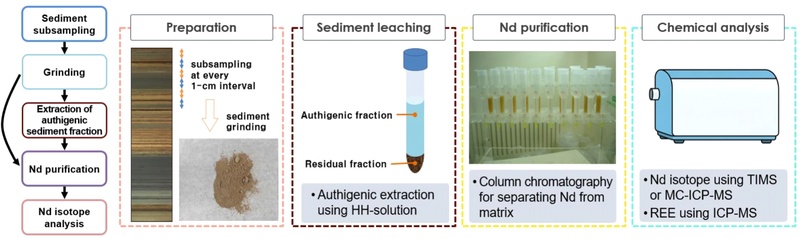
Schematic workflow for authigenic Nd isotope and REE analysis from marine sediments. Sediment cores are subsampled at 1-cm intervals, followed by grinding to homogenize each sample. The authigenic Fe-Mn oxyhydroxide fraction is selectively extracted via mild leaching using hydroxylamine hydrochloride in acetic acid (HH) solution. The leachate is then split for two analytical pathways: REE concentrations are directly measured by Inductively Coupled Plasma Mass Spectrometry (ICP-MS), while Nd isotope ratios require an additional purification step using column chromatography to separate Nd from matrix elements prior to measurement by Thermal Ionization Mass Spectrometry (TIMS) or Multi-Collector Inductively Coupled Plasma Mass Spectrometry (MC-ICP-MS). The analytical procedure summarized in this workflow follows Jang et al. (2017).
한편, 자생성 방해석 결정체의 경우에는 침출법이 아닌 물리적 분리법이 적용된다. 퇴적물 시료를 63 μm 체를 이용해 습식 체질(wet sieving)하여 모래 입도 이상의 조립질 분획을 분리한 후, 실체현미경 하에서 무기 기원 결정체를 육안으로 선별한다(Jang et al., 2023)(그림 3). 이후 밀도 분리(density separation)를 통해 아라고나이트와 방해석 광물상을 구분하고, 주사전자현미경(Scanning Electron Microscopy, SEM) 관찰을 통해 결정 형태, 표면 조직 및 과성장(overgrowth) 여부 등을 검토하여 생물 기원 입자와의 구분 및 자생 기원 여부를 확인한다. 본 논문에서 논의하는 사례에서는 이러한 형태학적·광물학적 검증을 거쳐 자생성 방해석 결정체를 분석 대상으로 활용하였다.
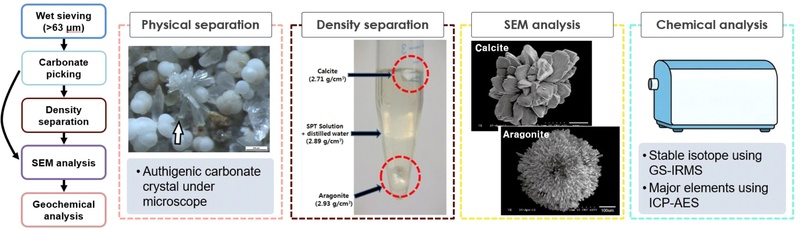
Schematic workflow for geochemical analysis of authigenic calcite crystals within marine sediments. Sediment samples are first wet-sieved at 63 μm, and carbonate grains are manually picked under a stereomicroscope. Density separation using sodium polytungstate (SPT) solution diluted with distilled water (2.89 g/cm3) further distinguishes calcite (2.71 g/cm3) from aragonite (2.93 g/cm3). The mineralogical identity and authigenic origin of isolated crystals are confirmed by scanning electron microscopy (SEM), which reveals distinctive inorganic textures. Geochemical analysis includes stable isotope ratio measurements (δ13C and δ18O) by Gas Source Isotope Ratio Mass Spectrometry (GS-IRMS) and major element concentrations by Inductively Coupled Plasma Atomic Emission Spectrometry (ICP-AES). The physical separation procedure, analytical workflow, and SEM images summarized here are based on Jang et al. (2023).
분리된 자생성 방해석 결정체는 가스 질량분석기(Gas Source Isotope Ratio Mass Spectrometry, GS-IRMS)를 이용한 안정 탄소·산소 동위원소 비(δ13C, δ18O) 분석과 함께, 유도결합플라즈마 원자방출분광기(Inductively Coupled Plasma Atomic Emission Spectrometry, ICP-AES)를 통한 Mg, Ca 등 원소 농도 분석을 병행하여 퇴적 당시 유체의 화학 조성과 수문 환경을 복원하는 데 활용된다(그림 3). 다만 자생성 탄산염 기록은 침전 이후 용해, 재결정 또는 속성 변질의 영향을 받을 수 있으므로, 광물상 분리, SEM 관찰, 원소 조성 및 안정 동위원소 조성을 함께 검토하는 과정이 필요하다. 이와 같이 자생광물 분석은 대상 광물의 종류와 형성 메커니즘에 따라 서로 다른 전처리 및 검증 전략을 요구하며, 이하 장에서 고찰할 각 연구 사례들은 이러한 방법론적 다양성을 잘 보여준다.
3. 적용 사례
3.1. 자생성 네오디뮴 동위원소 비 분석을 통한 고해양 순환 복원
네오디뮴은 자연계에서 142Nd, 143Nd, 144Nd, 145Nd, 146Nd, 148Nd, 150Nd 등 여러 동위원소로 존재하며, 고환경 및 기원지 추적 연구에서는 주로 143Nd/144Nd 비가 활용된다. 이는 143Nd가 같은 희토류 원소 중 하나인 147Sm (사마리움)의 방사성 붕괴로부터 시간에 따라 생성·축적되는 반면, 144Nd는 안정 동위원소로서 이러한 143Nd의 증가를 평가하기 위한 기준 동위원소로 사용되기 때문이다. 따라서, 143Nd/144Nd 비는 기원 물질의 초기 Sm/Nd 비와 지질학적 시간의 영향을 함께 반영한다. 다만 자연계에서 관찰되는 143Nd/144Nd 비의 변화 폭은 매우 작기 때문에, 이를 보다 명확하게 비교하기 위해 일반적으로 chondritic uniform reservoir (CHUR)에 대한 편차를 10,000배 한 εNd 값으로 표현한다(Jacobsen and Wasserburg, 1980). 즉, εNd 값은 기원 물질의 지질학적 배경을 반영하므로, 일반적으로 젊은 맨틀 기원 또는 현무암질 물질은 상대적으로 높은 값을 보이는 반면, 오래된 대륙지각 또는 화강암질 물질은 낮은 값을 갖는 경향이 있다(Frank, 2002).
이러한 기원 물질의 Nd 동위원소적 차이는 풍화와 침식을 통해 해양으로 공급되는 용존 및 입자상 물질에 전달된다. Nd 동위원소 조성은 저온 지표 과정에서 질량 의존적 동위원소 분별의 영향이 작기 때문에, 주변 대륙의 암석 종류와 지질학적 연령에 따른 차이를 비교적 잘 보존한다(Frank, 2002). 또한 해수 내 용존 Nd의 체류 시간(residence time)은 약 300–1,000년으로 전 지구적 해양 혼합 시간인 약 1,500년보다 짧아(Tachikawa et al., 2003), 서로 다른 주변 지질과 물질 공급원을 갖는 해양 분지 또는 수괴는 서로 구별되는 Nd 동위원소 조성을 유지할 수 있다. 실제로 오래된 대륙지각의 영향을 강하게 받는 북대서양 심층수(North Atlantic Deep Water, NADW)는 낮은 εNd 값(약 −13.5)을 갖는 반면, 젊은 화산호 및 현무암질 물질의 영향을 받는 태평양 수괴는 상대적으로 높은 εNd 값을 보인다(약 0~−4)(Albarède and Goldstein, 1992 and references therein; Albarède et al., 1997). 해수의 εNd 값은 주변 지질로부터 공급되는 풍화 산물의 조성과 해수 순환 변화에 따라 시간적으로 달라질 수 있으며, 이를 반영하는 자생 분획 내 εNd 값은 수괴의 기원지와 이동 경로를 추적하는 준보존적(quasi-conservative) 지화학 지시자로 활용될 수 있다(Rutberg et al., 2000; Frank, 2002).
남빙양은 이러한 자생성 εNd 접근법의 적용 가능성을 보여주는 대표적인 해역이다. 과거 해양 순환 복원, 특히 마지막 최대 빙하기(Last Glacial Maximum, ca. 26.5–19.0 ka BP)를 포함한 빙하기 동안의 전 지구적 심층수 순환 변화는 전통적으로 유공충 미화석 골격의 탄소 동위원소 비(δ13C)나 원소 함량비(Cd/Ca) 등 영양염 기반의 지시자를 통해 해석되어 왔다(Boyle, 1992; Charles and Fairbanks, 1992). 그러나 이러한 생물 기원 지시자는 해양 생물 생산성 변화, 국지적 유기물 분해, 탄산염 보존 상태 등의 영향을 받을 수 있어, 해수의 기원과 순환 변화를 독립적으로 검증할 수 있는 무기 지화학 지시자의 필요성이 제기되어 왔다. 이러한 맥락에서 남빙양의 Nd 동위원소 조성은 북대서양 기원 심층수의 유입 정도를 평가하는 데 유용한 정보를 제공한다. 남빙양은 북대서양에서 남하하는 낮은 εNd의 NADW와, 인도양·태평양을 거치며 상대적으로 높은 εNd 특성을 갖게 된 심층수가 만나는 해역이기 때문에, 이곳의 εNd 조성은 전 지구 심층수 순환의 상대적 기여도를 반영할 수 있다. 따라서 남빙양, 특히 남대서양 구간의 심층 퇴적물에서 자생성 εNd 값이 북대서양형 조성에서 태평양형 조성에 가까운 방향으로 변화하는 경우, 이는 NADW의 남빙양 유입 또는 전 지구 심층 순환 내 기여가 약화되었음을 지시할 수 있다. 이러한 원리에 기반하여 Rutberg et al. (2000)은 남동대서양 심해 퇴적물 코어의 철망간 산화수산화물 피막을 침출하여 자생성 εNd를 분석하였고, MIS 2 및 4 동안 남빙양으로 유입된 NADW의 영향이 MIS 1 및 3에 비해 현저히 감소했음을 제시하였다.
Rutberg et al. (2000) 이후, Piotrowski et al. (2005)는 남대서양-남빙양 지역의 고해양 기록에서 자생성 εNd 분석의 시간 해상도를 높여, 마지막 빙하기 전반에 걸친 심층수 기원 변화의 고해상도 복원을 수행하였다. 이들은 북대서양 기원 심층수와 남극 기원 저층수의 상대적 기여도가 하인리히 사건(Heinrich events) 및 단스가드-오슈거 순환(Dansgaard-Oeschger cycles)과 같은 천년 단위(millennial-scale)의 급격한 북반구 기후 진동과 동조하며 변동했음을 제시하였다. 이는 자생성 Nd 동위원소 비가 장주기적인 빙하기-간빙기 변화뿐만 아니라, 단주기 기후 변동에 따른 해양 순환 재편을 추적하는 데에도 유효함을 보여준다.
이후 이러한 접근은 북극해 퇴적 기록으로 확장되었다. Haley et al. (2008)은 중앙 북극해 로모노소프 해령(Lomonosov Ridge) 시추 코어(PS2185 및 ACEX, 수심 1051 및 1250 m; 그림 4a)에서 자생성 εNd을 분석하여, 과거 1,500만 년에 걸친 북극 중층수(Arctic Intermediate Water)의 장기 진화 과정을 복원하였다. 그 결과, 빙하기 동안 유라시아 빙상(Eurasian Ice Sheet)의 발달과 연계된 현무암질 풍화산물이 결빙 과정에서 발생하는 염수 배출(brine rejection)과 함께 북극해 중층수까지 유입되었고, 이로 인해 북극 중층수의 εNd 값이 상대적으로 높은 방향으로 변화시켰음을 제시하였다.
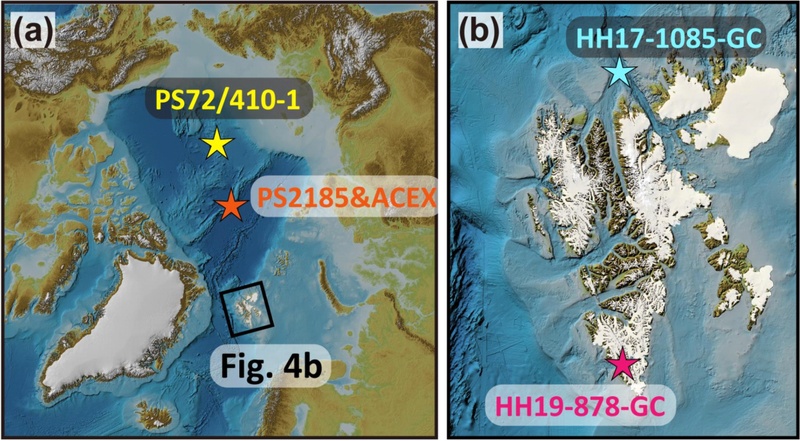
Location maps of sediment cores discussed in this study. (a) Map of the Arctic Ocean showing the locations of cores PS72/410-1 (yellow star, Mendeleev Ridge, western Arctic Ocean) and PS2185 & ACEX (orange star, Lomonosov Ridge, central Arctic Ocean). The black box indicates the area enlarged in (b). (b) Enlarged map of the Svalbard Archipelago showing the locations of cores HH17-1085-GC (cyan star, northern Svalbard continental shelf) and HH19-878-GC (magenta star, Hornsund Fjord, southern Svalbard).
Jang et al. (2013)은 이러한 접근을 서북극해 멘델레예프 해령(Mendeleev Ridge) 퇴적물 코어(PS72/410-1, 수심 1,808 m; 그림 4a)에 적용하여, 약 76,000년 전부터 현재에 이르는 자생성 εNd 연속 기록을 구축하였다(그림 5). 이 기록에서는 세 차례의 뚜렷한 εNd 이상 변동이 확인되었다. 높은 εNd 방향으로의 변화는 바렌츠-카라 빙상(Barents-Kara Ice Sheet)의 붕괴와 연계된 유라시아 기원 융빙수의 유입을 지시하며, 이는 Haley et al. (2008)의 중앙 북극해 기록과도 일치한다. 반대로 낮은 εNd 방향으로의 변화는 로렌타이드 빙상(Laurentide Ice Sheet, LIS) 기원 담수가 서북극해로 유입되었음을 반영하는 것으로 해석되었다.
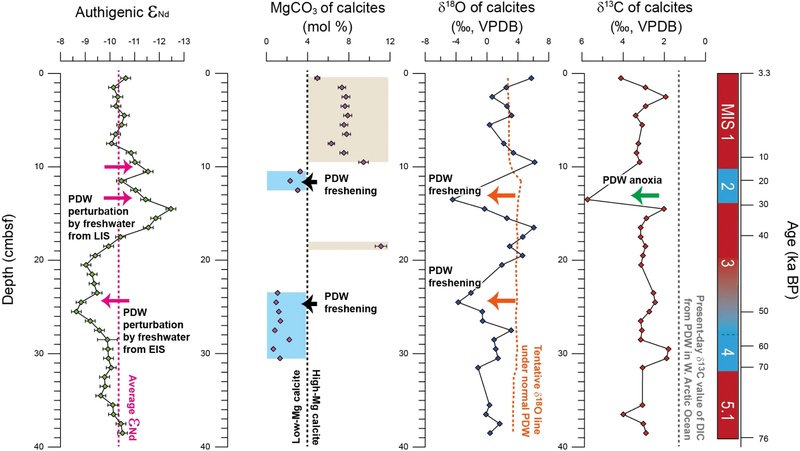
Downcore variability in geochemical records from sediment core PS72/410-1 (Mendeleev Ridge, western Arctic Ocean), including authigenic εNd (Jang et al., 2013) and MgCO3 content, δ18O, and δ13C of authigenic calcite (Jang et al., 2023). The right panel shows the Marine Isotope Stage (MIS) stratigraphy. Pink arrows indicate freshwater intrusion events recorded in authigenic εNd, with low values reflecting input from the Laurentide Ice Sheet (LIS) and high values from the Eurasian Ice Sheet (EIS). Blue shaded intervals indicate stadial periods (MIS 2 and MIS 4) characterized by Low-Magnesium Calcite (LMC) precipitation, reflecting freshwater intrusion into the Polar Deep Water (PDW), consistent with εNd. The orange dashed line represents the tentative δ18O line expected under normal PDW conditions, with negative excursions from which reflecting PDW freshening. The green arrow marks the present-day δ13C value of dissolved inorganic carbon (DIC) from PDW in the western Arctic Ocean. The positive δ13C excursion during MIS 2 is interpreted as evidence of deep-water anoxia associated with microbial methanogenesis. This figure was modified from Jang et al. (2023).
이들 연구는 퇴적물 내 자생 분획의 Nd 동위원소 분석이 과거 수괴의 기원, 빙상 기원 담수 유입, 그리고 해양 순환 변화를 추적하는 데 효과적으로 활용될 수 있음을 보여준다. 특히 자생성 εNd 기록은 생물 기원 지시자의 생산이나 보존이 제한되는 극지 고해양 환경에서도 독립적인 무기 지화학 정보를 제공할 수 있다는 점에서, 빙하기 북극해의 수문 및 순환 변화를 복원하는 데 중요한 보완 지시자로 평가된다. 다만 자생성 εNd 해석에서는 침출 분획의 선택성, 쇄설성 Nd의 혼입 가능성, 해양 경계부에서의 원소 교환 및 공극수 영향 등을 함께 검토할 필요가 있다(Wilson et al., 2012; Abbott et al., 2015; Jang et al., 2018).
3.2. 자생성 희토류 원소 패턴을 활용한 화학적 풍화 양상 및 황화광물 산화 추적
퇴적물의 자생 분획은 네오디뮴 동위원소 비 외에도 REE 전반의 분별 패턴(fractionation pattern)을 통해 해양 순환뿐만 아니라 인근 대륙 지괴에서 발생하는 화학적 풍화 체제(regime)의 특성을 지시하는 중요한 지화학 정보를 제공한다. 서로 다른 화학적 풍화 체제는 반응에 참여하는 암석과 광물의 종류, 그리고 이들의 상대적인 반응성 차이에 의해 구분된다. 예를 들어 규산염 암석의 풍화는 주로 장석, 운모, 휘석, 각섬석 등 규산염 광물의 용해와 관련되는 반면, 퇴적암 기반 유역에서는 쇄설성 규산염 광물뿐 아니라 탄산염, 인산염, 유기물 및 해양 기원 침전물 등 다양한 반응성 성분이 풍화 과정에 함께 관여할 수 있다. 또한 황철석과 같은 황화광물을 포함하는 암석이 산화될 경우 황산이 생성되어 국지적으로 산성 풍화 환경을 형성하고, 이로 인해 REE를 함유한 부속 광물의 용해가 촉진될 수 있다. 이처럼 풍화에 참여하는 광물 조합과 반응성의 차이는 수계로 공급되는 용존 성분의 조성과 REE 분별 양상에 영향을 미칠 수 있다(Bayon et al., 2020).
해수 및 공극수 내 REE의 가용성은 pH, 산화환원 상태, 그리고 용존 유기·무기 리간드 복합체 형성에 매우 민감하게 반응하므로(Elderfield and Greaves, 1982; Elderfield, 1988; Sholkovitz et al., 1992), 철망간 산화수산화물 형성 당시 구조 내로 포획된 REE의 지화학적 기록은 용존 성분을 공급한 수계의 고유한 풍화 특성을 반영할 수 있다(Bayon et al., 2020). 이러한 지화학적 메커니즘에 착안하여 Bayon et al. (2020)은 전 세계 주요 대형 하천 퇴적물 내 철망간 산화수산화물 분획의 REE 데이터를 광범위하게 수집·분석하였고, 기원지의 지질학적 특성과 화학적 풍화 체제를 정량적으로 판별할 수 있는 새로운 가이드라인으로서 오목 지수(concavity index, 이하 CI)를 도입하였다(Bayon et al., 2020).
이 지수는 Bayon et al. (2015)에 의해 정립된 세계 하천 평균 실트(World River Average Silt, WRAS)의 REE 값에 대해 표준화(normalization, 아래첨자 N으로 표기)된 REE 패턴에서 경희토류(Light REE, LREE; La, Ce, Pr, Nd) 및 중(重)희토류(Heavy REE, HREE; Ho, Er, Tm, Yb, Lu) 대비 중간희토류(Middle REE, MREE; Sm, Eu, Gd, Tb, Dy)의 상대적인 부화(enrichment) 정도를 수학적으로 정량화한 지표로 아래의 식을 따라 계산된다(Bayon et al., 2020).
Bayon et al. (2020)의 광범위한 데이터 분석 결과에 따르면, CI는 기원 암종과 풍화 체제에 따라 구분되는 수치 범위를 나타낸다. 규산염 암석의 풍화에서 유래한 철망간 산화수산화물 분획은 대체로 1.2~2.0 범위의 CI를 보이며, 퇴적암 기반 유역에서 유래한 분획은 2.0~2.5의 값을 나타내는 경향을 보인다(Bayon et al., 2020). 한편, CI > 2.5를 초과하는 극단적인 MREE 부화는 전 지구적 대형 하천 분석 결과의 일반적인 범주를 벗어나는 영역으로, Bayon et al. (2020)은 황화광물의 산화 풍화(oxidative weathering of sulphide minerals)가 활발히 진행되는 유역에서 주로 형성될 수 있다는 가설을 제안하였다(그림 6). 이러한 CI 기반의 풍화 체제 판별 기능은 최근 극지 대륙붕 환경에 적용되면서 대륙빙하의 거동과 육상 지화학 순환을 연결하는 유용한 지화학 툴로 주목받고 있다. Jang et al. (2024)은 북극 스발바르(Svalbard) 군도 북부 대륙붕에서 획득한 시추 코어(HH17-1085-GC, 수심 322 m; 그림 4b)의 자생 분획을 분리하여 과거 약 16,300년 전부터 현재에 이르는 REE 변동 기록을 분석하였다. 연구 결과, 스발바르 대륙붕 퇴적물의 자생 분획은 홀로세 전반에 걸쳐 CI 값이 2.5 이상을 지속적으로 유지하였으며, 대륙빙하 활동이 활발했던 특정 시기에는 최대 3.8에 달하는 극단적인 MREE 부화 신호를 나타냈다(그림 6). 이는 Bayon et al. (2020)이 제안한 황화광물 산화 풍화가 우세한 환경에 해당하는 범위로, Jang et al. (2024)은 그 구체적인 메커니즘으로 빙하에 의한 황철석의 산화 작용을 제시하였다.
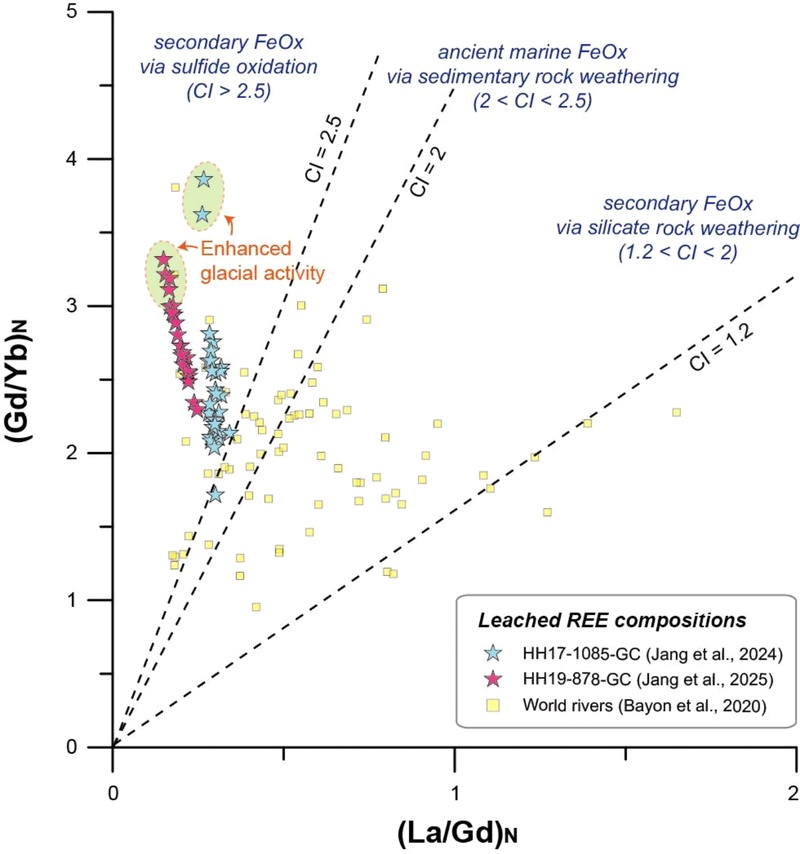
(La/Gd)N versus (Gd/Yb)N plot of leached Fe-Mn oxyhydroxide (FeOx) fractions from Svalbard sediment cores (HH17-1085-GC and HH19-878-GC; ) compared to global river data (Bayon et al., 2020). REE abundances are normalized to the World River Average Silt (Bayon et al., 2015). The concavity index (CI) increases as the slope of the data array steepens toward the upper-left, reflecting greater relative enrichment of middle REE over light REE and heavy REE. Svalbard samples from both cores cluster within or near the sulfide oxidation field (CI > 2.5), with samples corresponding to periods of enhanced glacial activity plotting at the highest CI values (orange ellipse). This figure was updated after Jang et al. (2024).
구체적인 생지화학적 인과관계를 살펴보면, 극지 환경에서 대륙빙하의 확장과 후퇴에 수반되는 강력한 기계적 마모 과정(glacial abrasion)은 기반암을 미세하게 분쇄하여 반응 표면적이 큰 신선한 광물 입자들을 지표 환경에 공급한다(Calmels et al., 2007). 이렇게 노출된 기반암, 특히 황철석을 포함하는 흑색 셰일과 같은 암석은 대기 중 산소 및 융빙수와 반응하면서 황화광물 산화 풍화를 겪을 수 있으며, 이 과정에서 생성된 황산은 국지적으로 산성화된 풍화 환경을 형성할 수 있다(Torres et al., 2017). 이러한 산성 조건에서 광물별 반응성 및 안정성 차이에 따라 인회석 등 REE, 특히 MREE를 상대적으로 많이 함유하는 부속 광물의 차별적 용해(preferential dissolution)가 촉진될 수 있어, 이로 인해 형성된 MREE 부화 신호가 연안 해수 및 공극수로 전달되어 당시 형성되던 자생 철망간 산화수산화물 피막에 높은 CI 값이 기록될 수 있다는 설명이다(Jang et al., 2024).
나아가 Jang et al. (2025)은 스발바르 군도 남부 호르준드(Hornsund) 피오르드의 퇴적물 코어 기록(HH19-878-GC, 수심 125 m; 그림 4b)을 분석하여, 중기 홀로세 이후 빙하 환경 변화에 따른 CI의 변동성을 확인하였다. 호르준드 피오르드는 기후 변화에 따라 빙하 말단부의 위치가 육상 쪽으로 후퇴하거나 해양 방향으로 재전진하는 과정이 뚜렷하게 기록되는 해역으로(Osika et al., 2022), 자생성 CI 기록이 이러한 빙하 경계부의 위치 및 규모 변화에 민감하게 반응함이 확인되었다(그림 6). 이는 황철석 산화 풍화가 빙하의 전진·후퇴와 직접적으로 연동됨을 시사하며, 결과적으로 퇴적물 내 자생 분획의 REE 패턴이 과거 극지 빙하의 전진·후퇴 이력을 추적하는 무기 지화학 지시자로 활용될 수 있음을 제시한다.
3.3. 자생성 방해석 결정체 분석을 통한 빙하기 북극해 담수화 및 탈산소화 현상 규명
3.1절에서 살펴본 바와 같이, 자생성 εNd 기록은 과거 빙하기 동안 북극해로의 담수 유입 사건을 지시하는 무기 지화학적 증거를 제공하였다(Haley et al., 2008; Jang et al., 2013). 그러나 담수 유입의 규모나 심층수에 미친 영향에 대해서는 해당 빙하기 퇴적층에서 유공충 미화석이 간헐적으로 산출된다는 사실을 근거로, 대규모 담수화보다는 제한적인 염분 변동 수준에 머물렀을 것이라는 시각이 우세하였다. 이러한 인식에 전환점을 제시한 것이 Geibert et al. (2021)로, 이들은 230Thex 농도 급감을 근거로 특정 빙하기 시기 동안 북극해가 염분도 0‰에 가까운 완전 담수화 상태였다는 가설을 제안하였다. 이 가설은 여전히 완전 담수 환경에서 생존이 불가능한 유공충 산출을 근거로 주류 이론으로 받아들여지지는 않았으나(Spielhagen et al., 2022), 빙하기 동안 북극해의 수문 환경에 대한 재고의 필요성을 환기시켰다. 이에 Jang et al. (2023)은 생물 생산성으로부터 독립적인 무기 기원 자생성 방해석 결정체를 활용한 새로운 지화학적 접근법을 도입하여 이 논쟁에 정량적 근거를 제시하고자 하였다.
Jang et al. (2023)은 서북극해 멘델레예프 해령 시추 코어(PS72/410-1, 수심 1,808 m; 그림 4a)의 빙하기 퇴적층에서 습식 체질 후 실체현미경 하에서 무기 기원 탄산염 결정을 물리적으로 분리하였다(그림 3). SEM 분석 결과, 분리된 탄산염 결정체에서는 판상(tabular) 결정 다발 및 엽상 구조(foliated ultrastructure) 등 생물 골격과 구별되는 형태학적 특성이 확인되었으며, 이는 해당 결정체들이 해수-퇴적물 경계부 또는 초기 공극수 환경에서 무기적으로 침전된 자생성 탄산염 광물임을 뒷받침한다. 한편 아라고나이트는 방해석과 함께 일부 층준에서 산출되었으나, 코어 최상부층에서는 확인되지 않았고 일부 시료에서는 방해석 표면의 과성장 형태로도 관찰되었다. 이러한 산출 양상은 아라고나이트가 방해석에 비해 상대적으로 후속 공극수 환경에서 형성되었거나 속성 과정의 영향을 더 크게 받았을 가능성을 시사한다. 이에 Jang et al. (2023)은 밀도 분리를 통해 방해석과 아라고나이트를 구분한 뒤, 해수-퇴적물 경계부 또는 초기 공극수 환경을 보다 안정적으로 반영하는 기록물로서 자생성 방해석 결정체를 선별하여 지화학 분석 및 고환경 복원에 활용하였다.
이러한 자생성 방해석의 산출은 북극해 심층 환경의 탄산염 포화도 및 보존 조건과도 관련된다. 일반적인 심해 환경에서는 수심 증가에 따른 탄산염 포화도 감소와 유기물 분해에 따른 CO2 증가로 인해 탄산염 용해가 촉진될 수 있다. 그러나 현대 북극해의 경우 방해석에 대해 비교적 유리한 포화 조건이 유지되며, 이는 낮은 퇴적률과 낮은 유기물 침강·호흡률로 인해 유기물 분해에 따른 pH 감소와 탄산염 용해가 상대적으로 제한되기 때문으로 해석된다(Jutterström and Anderson, 2005). Jang et al. (2023)은 PS72/410-1 코어에서 자생성 방해석이 최상부 퇴적층부터 산출된다는 점, 그리고 지난 빙하기 동안 해당 지점의 퇴적률과 총유기탄소 함량이 현재와 유사하거나 더 낮은 수준이었다는 점을 근거로, 서북극해 심해 환경에서 방해석 포화 조건이 장기간 유지되었을 가능성을 제시하였다. 이러한 조건은 코어 전반에서 자생성 방해석 결정체가 비교적 연속적으로 산출되는 배경으로 해석될 수 있다. 다만 이는 자생성 탄산염이 항상 일정한 속도로 침전된다는 의미는 아니며, 그 형성과 보존은 유체의 탄산염 포화도, 알칼리도, pH, DIC 조성, 산화환원 조건 및 후속 속성 변질 여부에 의해 조절될 수 있다.
원소 조성 분석 결과, 한랭한 아빙기(stadial periods)인 MIS 4-3 및 MIS 2 시기에 형성된 자생성 방해석은 저마그네슘 방해석(Low-Magnesium Calcite, LMC; MgCO3 < 4 mol%)의 특성을 보인 반면, 홀로세 및 MIS 3 내 아간빙기(interstadial) 시기에는 고마그네슘 방해석(High-Magnesium Calcite, HMC) 이 우세하게 산출되는 대조적인 양상이 확인되었다(그림 5). 방해석의 MgCO3 함량은 침전 당시 유체의 Mg/Ca 비에 의해 주로 조절되는 것으로 알려져 있다(Hardie, 1996; Ries, 2010). 현대 대양의 200 m 이하 수괴는 약 5.0–5.1 mol/mol 수준의 Mg/Ca 비를 보이며 대양 간 차이가 매우 작고, 이와 같은 높은 Mg/Ca 조건에서는 HMC나 아라고나이트와 같은 탄산염이 우세하게 침전된다(Stanley, 2008; Lebrato et al., 2020). 또한 전 지구적 대양 심층수의 Mg/Ca 비는 해당 연구의 분석 시간 범위(~76,000년) 내에서 유의미한 변화 없이 균일하게 유지되었으므로(Lebrato et al., 2020), 빙하기 동안 북극 분지 퇴적물에서 LMC가 형성되었다는 것은 해수 대비 Mg/Ca 비가 현저히 낮은 유체가 심층 해역까지 대량 유입되어 해수 화학 조성을 희석시켰음을 지시한다(Jang et al., 2023). 실제로 북극 주변 주요 하천수의 Mg/Ca 비는 매켄지 강(Mackenzie River) 0.382 ± 0.101, 레나 강(Lena River) 0.526 ± 0.245, 오브 강(Ob River) 0.334 ± 0.026 mol/mol로, 해수보다 대략 한 자릿수 낮은 값을 보인다(Reeder et al., 1972; Huh et al., 1998; Vorobyev et al., 2019). 따라서 Jang et al. (2023)은 빙하기 동안 Mg/Ca 비가 낮은 육상 기원 담수가 북극 심층수로 유입되어 침전 유체의 Mg/Ca 비를 낮추었고, 그 결과 LMC가 형성된 것으로 해석하였다.
나아가 LMC가 산출되는 MIS 4-3 및 MIS 2 시기에 자생성 방해석의 안정 산소 동위원소 비(δ18O) 역시 −4.5‰까지 낮아지는 값을 보였다(그림 5). 방해석의 δ18O 값은 침전 당시 유체의 산소 동위원소 조성과 수온을 함께 반영하지만, 약 11‰에 달하는 자생성 방해석의 δ18O 변동폭은 빙하기-간빙기 심층수 온도 변화만으로 설명되기 어렵다. 이에 Jang et al. (2023)은 북극 하천수와 융빙수가 일반 해수 대비 매우 낮은 δ18O 값을 갖는다는 점에 주목하여(−20.5‰; Cooper et al., 2005), 해당 신호를 육상 기원 담수가 북극 심층수로 유입된 결과로 해석하였다. 산소 동위원소 비를 활용한 담수-해수 혼합 엔드멤버 기반 질량 균형 계산(mass-balance calculation)에 따르면, MIS 2 및 MIS 4–3 동안 서북극해 심층수에 각각 약 41% 및 37%의 담수가 혼합되었을 가능성이 제시되었다(Jang et al., 2023). 이는 당시 북극 심층수가 염분도 0‰의 완전 담수가 아니라, 염분도 약 20‰ 내외의 기수(brackish water) 상태였음을 의미한다(Jang et al., 2023). 이러한 결과는 가혹한 저염분 환경에서도 유공충이 간헐적으로 생존할 수 있었던 수문학적 배경을 제공하며, 완전 담수화 가설과 유공충 산출이라는 상반된 관측을 조화롭게 설명한다.
한편, 자생성 방해석의 안정 탄소 동위원소 비(δ13C)는 MIS 2 기간 동안 +5.7‰에 달하는 높은 값을 보였다(그림 5). 이는 현대 북극 심층수의 용존무기탄소(dissolved inorganic carbon, DIC) 및 저서성 유공충의 평균 δ13C 값이 각각 1.26‰ 및 1.44‰ 수준인 것과 비교할 때 매우 높은 값이다(Mackensen, 2013). 자생성 탄산염의 δ13C 값은 침전 당시 유체 내 DIC의 동위원소 조성을 반영하므로, 유기물 분해, 메탄 산화, 탄산염 용해, 메탄생성작용 등 퇴적물공극수계에서 일어나는 다양한 탄소순환 과정의 영향을 받을 수 있다. 그러나 유기물 및 메탄 산화 과정은 일반적으로 12C가 풍부한 탄소를 DIC 저장고에 공급하여 자생성 탄산염의 δ13C 값을 낮추는 방향으로 작용하며(Chow et al., 2000; Loyd and Smirnoff, 2022), 쇄설성 탄산염 용해 역시 이처럼 높은 양의 δ13C 값을 설명하기 어렵다(Hitchon and Krouse, 1972). 반면 메탄생성작용(methanogenesis)은 가벼운 탄소 동위원소(12C)를 메탄으로 선택적으로 방출함으로써 잔류 DIC 저장고를 13C가 상대적으로 농축된 조성으로 변화시킬 수 있으며, 이러한 DIC로부터 침전된 자생성 방해석에는 높은 δ13C 값이 기록될 수 있다. 중요한 점은 메탄생성작용은 유기물 분해 과정에서 용존산소가 먼저 소비되고, 이후 질산염, 철·망간 산화물, 황산염 등 대체 전자수용체가 순차적으로 이용·소진된 뒤 도달하는 강한 환원 환경의 말기 단계에 해당한다(Torres et al., 2020; Loyd and Smirnoff, 2022). 이를 바탕으로 Jang et al. (2023)은 MIS 2 시기의 높은 자생성 방해석 δ13C 값을, 북극 심층수의 산소 고갈과 메탄생성작용을 수반한 강한 환원 환경의 증거로 해석하였다.
이러한 결과는 빙하기 동안 북극해 심층수가 기수 상태였을 뿐만 아니라 강한 산소 고갈 환경에 놓였음을 무기 지화학 지시자를 통해 제시한 대표적 사례로, 생물 기원 기록이 제한되는 극지 심해 환경에서 자생광물 기반 접근법이 수문 환경, 산화환원 조건 및 탄소순환 변화를 복원하는 데 유용한 보완 수단이 될 수 있음을 보여준다.
4. 결론 및 시사점
본 리뷰 논문에서는 생물 기원 지시자의 적용이 제한될 수 있는 극지 고환경 복원 연구에서 자생광물 지화학 분석이 갖는 유용성을 세 가지 대표적인 연구 사례를 통해 고찰하였다. 첫째, 퇴적물의 자생 분획에 포획된 Nd 동위원소 비는 주변 지질로부터 공급되는 물질의 기원과 해수 순환 변화를 반영하므로, 생물 기원 지시자의 공백이 발생하기 쉬운 극지 심해 환경에서 과거 수괴의 기원과 거동을 추적하는 유효한 무기 지화학 지시자로 활용될 수 있음이 제시되었다(Haley et al., 2008; Jang et al., 2013).
둘째, 자생 분획의 REE 오목 지수(CI)는 빙하의 기계적 마모와 연계된 황화광물 산화 풍화의 영향을 반영할 수 있으며, 빙하의 전진·후퇴와 관련된 육상 화학 풍화 체제의 변화를 추적하는데 활용될 수 있음이 확인되었다. 이는 CI가 극지 연안 환경에서 빙하 거동과 풍화 과정의 연계를 평가하는 유용한 지시자로 확장될 가능성을 보여준다(Jang et al., 2024, 2025).
셋째, 무기 기원 자생성 방해석 결정체의 원소 조성 및 안정 동위원소 분석은 빙하기 동안 서북극해 심층수가 완전 담수가 아닌 기수 상태였으며, 동시에 강한 산소 고갈 환경에 놓였을 가능성을 제시하였다. 이는 완전 담수화 가설과 유공충 산출이라는 상반된 관측을 조화롭게 설명하는 동시에, 자생광물이 생물 기원 지시자의 기록 공백을 보완할 수 있는 고환경 기록물로 활용될 수 있음을 보여준다(Jang et al., 2023).
이상의 연구 사례들은 자생광물 지화학 분석이 극지 고환경 복원 연구에서 생물 기원 지시자를 보완하는 유력한 접근법임을 보여준다. 향후 더 넓은 지역과 긴 지질 시대를 대상으로 한 자료 축적과 다중 지시자 통합 연구가 이루어진다면, 극지 빙하 거동, 수문 환경 변화, 심층수 산화환원 상태, 그리고 전 지구적 탄소순환과의 연계에 대한 이해를 더욱 심화시킬 수 있을 것으로 기대된다.
Acknowledgments
이 성과는 정부(과학기술정보통신부)의 재원으로 한국연구재단의 지원을 받아 수행된 연구임(No. RS-2024-00336841).
References
-
Abbott, A.N., Haley, B.A. and McManus, J., 2015, Bottoms up: Sedimentary control of the deep North Pacific Ocean’s εNd signature. Geology, 43, 1035-1035.
[https://doi.org/10.1130/G37114.1]

-
Albarède, F. and Goldstein, S.L., 1992, World map of Nd isotopes in sea-floor ferromanganese deposits. Geology, 20, 761-763.
[https://doi.org/10.1130/0091-7613(1992)020<0761:WMONII>2.3.CO;2]
-
Albarède, F., Goldstein, S.L. and Dautel, D., 1997, The neodymium isotopic composition of manganese nodules from the Southern and Indian oceans, the global oceanic neodymium budget, and their bearing on deep ocean circulation. Geochimica et Cosmochimica Acta, 61, 1277-1291.
[https://doi.org/10.1016/S0016-7037(96)00404-8]
-
Bayon, G., German, C.R., Boella, R.M., Milton, J.A., Taylor, R.N. and Nesbitt, R.W., 2002, An improved method for extracting marine sediment fractions and its application to Sr and Nd isotopic analysis. Chemical Geology, 187, 179-199.
[https://doi.org/10.1016/S0009-2541(01)00416-8]
-
Bayon, G., Lambert, T., Vigier, N., De Deckker, P., Freslon, N., Jang, K., Larkin, C.S., Piotrowski, A.M., Tachikawa, K., Thollon, M. and Tipper, E.T., 2020, Rare earth element and neodymium isotope tracing of sedimentary rock weathering. Chemical Geology, 553, 119794.
[https://doi.org/10.1016/j.chemgeo.2020.119794]
-
Bayon, G., Toucanne, S., Skonieczny, C., Andre, L., Bermell, S., Cheron, S., Dennielou, B., Etoubleau, J., Freslon, N., Gauchery, T., Germain, Y., Jorry, S.J., Menot, G., Monin, L., Ponzevera, E., Rouget, M.L., Tachikawa, K. and Barrat, J.A., 2015, Rare earth elements and neodymium isotopes in world river sediments revisited. Geochimica et Cosmochimica Acta, 170, 17-38.
[https://doi.org/10.1016/j.gca.2015.08.001]
-
Boyle, E.A., 1992, Cadmium and delta 13C paleochemical ocean distributions during the stage 2 Glacial Maximum. Annual Review of Earth and Planetary Sciences, 20, 245.
[https://doi.org/10.1146/annurev.ea.20.050192.001333]
-
Calmels, D., Gaillardet, J., Brenot, A. and France-Lanord, C., 2007, Sustained sulfide oxidation by physical erosion processes in the Mackenzie River basin: Climatic perspectives. Geology, 35, 1003-1006.
[https://doi.org/10.1130/G24132A.1]
-
Charles, C.D. and Fairbanks, R.G., 1992, Evidence from Southern Ocean sediments for the effect of North Atlantic deep-water flux on climate. Nature, 355, 416-419.
[https://doi.org/10.1038/355416a0]
-
Chow, N., Morad, S. and Al-Aasm, I.S., 2000, Origin of authigenic Mn-Fe carbonates and pore-water evolution in marine sediments: Evidence from Cenozoic Strata of the Arctic Ocean and Norwegian-Greenland Sea (ODP Leg 151). Journal of Sedimentary Research, 70, 682-699.
[https://doi.org/10.1306/2DC40930-0E47-11D7-8643000102C1865D]
-
Cohen, J., Zhang, X., Francis, J., Jung, T., Kwok, R., Overland, J., Ballinger, T.J., Bhatt, U.S., Chen, H.W., Coumou, D., Feldstein, S., Gu, H., Handorf, D., Henderson, G., Ionita, M., Kretschmer, M., Laliberte, F., Lee, S., Linderholm, H.W., Maslowski, W., Peings, Y., Pfeiffer, K., Rigor, I., Semmler, T., Stroeve, J., Taylor, P.C., Vavrus, S., Vihma, T., Wang, S., Wendisch, M., Wu, Y. and Yoon, J., 2020, Divergent consensuses on Arctic amplification influence on midlatitude severe winter weather. Nature Climate Change, 10, 20-29.
[https://doi.org/10.1038/s41558-019-0662-y]
-
Cooper, L.W., Benner, R., McClelland, J.W., Peterson, B.J., Holmes, R.M., Raymond, P.A., Hansell, D.A., Grebmeier, J.M. and Codispoti, L.A., 2005, Linkages among runoff, dissolved organic carbon, and the stable oxygen isotope composition of seawater and other water mass indicators in the Arctic Ocean. Journal of Geophysical Research: Biogeosciences, 110.
[https://doi.org/10.1029/2005JG000031]
-
Elderfield, H., 1988, The oceanic chemistry of the rare-earth elements. Philosophical Transactions of the Royal Society of London. Series A, Mathematical and Physical Sciences, 325, 105-126.
[https://doi.org/10.1098/rsta.1988.0046]
-
Elderfield, H. and Greaves, M.J., 1982, The rare earth elements in seawater. Nature, 296, 214-219.
[https://doi.org/10.1038/296214a0]
-
Frank, M., 2002, Radiogenic isotopes: tracers of past ocean circulation and erosional input. Reviews of Geophysics, 40.
[https://doi.org/10.1029/2000RG000094]
-
Geibert, W., Matthiessen, J., Stimac, I., Wollenburg, J. and Stein, R., 2021, Glacial episodes of a freshwater Arctic Ocean covered by a thick ice shelf. Nature, 590, 97-102.
[https://doi.org/10.1038/s41586-021-03186-y]
-
Gutjahr, M., Frank, M., Stirling, C.H., Klemm, V., van de Flierdt, T. and Halliday, A.N., 2007, Reliable extraction of a deepwater trace metal isotope signal from Fe-Mn oxyhydroxide coatings of marine sediments. Chemical Geology, 242, 351-370.
[https://doi.org/10.1016/j.chemgeo.2007.03.021]
-
Haley, B.A., Frank, M., Spielhagen, R.F. and Eisenhauer, A., 2008, Influence of brine formation on Arctic Ocean circulation over the past 15 million years. Nature Geoscience, 1, 68-72.
[https://doi.org/10.1038/ngeo.2007.5]
-
Hardie, L.A., 1996, Secular variation in seawater chemistry: An explanation for the coupled secular variation in the mineralogies of marine limestones and potash evaporites over the past 600 m.y. Geology, 24, 279-283.
[https://doi.org/10.1130/0091-7613(1996)024<0279:SVISCA>2.3.CO;2]
-
Hitchon, B. and Krouse, H.R., 1972, Hydrogeochemistry of the surface waters of the Mackenzie River drainage basin, Canada—III. Stable isotopes of oxygen, carbon and sulphur. Geochimica et Cosmochimica Acta, 36, 1337-1357.
[https://doi.org/10.1016/0016-7037(72)90066-X]
-
Huh, Y., Tsoi, M.-Y., Zaitsev, A. and Edmond, J.M., 1998, The fluvial geochemistry of the rivers of Eastern Siberia: I. tributaries of the Lena River draining the sedimentary platform of the Siberian Craton. Geochimica et Cosmochimica Acta, 62, 1657-1676.
[https://doi.org/10.1016/S0016-7037(98)00107-0]
-
Jacobsen, S.B. and Wasserburg, G.J., 1980, Sm-Nd isotopic evolution of chondrites. Earth and Planetary Science Letters, 50, 139-155.
[https://doi.org/10.1016/0012-821X(80)90125-9]
-
Jang, K., Bayon, G., Ahn, Y., Joe, Y.J., Son, E.J., Kwon, S.Y., Kim, J.-H., Vogt, C., Forwick, M., Byun, E. and Nam, S.-I., 2025, Geochemical and mineralogical characteristics of fjord sediments in Arctic Svalbard: insights into Holocene glacial activity and weathering variability. Journal of Sedimentary Research, 95, 223-238.
[https://doi.org/10.2110/jsr.2024.088]
-
Jang, K., Bayon, G., Pourret, O., Joe, Y.J., Kim, J.-H., Byun, E., Forwick, M., León, R. and Nam, S.-I., 2024, A distinctive rare earth element signature for pyrite oxidation and glacial weathering. Chemical Geology, 660, 122167.
[https://doi.org/10.1016/j.chemgeo.2024.122167]
-
Jang, K., Han, Y., Huh, Y., Nam, S.-I., Stein, R., Mackensen, A. and Matthiessen, J., 2013, Glacial freshwater discharge events recorded by authigenic neodymium isotopes in sediments from the Mendeleev Ridge, western Arctic Ocean. Earth and Planetary Science Letters, 369, 148-157.
[https://doi.org/10.1016/j.epsl.2013.03.018]
-
Jang, K., Huh, Y. and Han, Y., 2017, Authigenic Nd isotope record of North Pacific Intermediate Water formation and boundary exchange on the Bering Slope. Quaternary Science Reviews, 156, 150-163.
[https://doi.org/10.1016/j.quascirev.2016.11.032]
-
Jang, K., Huh, Y. and Han, Y., 2018, Diagenetic overprint on authigenic Nd isotope records: A case study of the Bering Slope. Earth and Planetary Science Letters, 498, 247-256.
[https://doi.org/10.1016/j.epsl.2018.06.045]
-
Jang, K., Woo, K.S., Kim, J.-K. and Nam, S.-I., 2023, Arctic deep-water anoxia and its potential role for ocean carbon sink during glacial periods. Communications Earth & Environment, 4, 45.
[https://doi.org/10.1038/s43247-023-00708-6]
-
Jutterström, S. and Anderson, L.G., 2005, The saturation of calcite and aragonite in the Arctic Ocean. Marine Chemistry, 94, 101-110.
[https://doi.org/10.1016/j.marchem.2004.08.010]
-
Kim, B.-M., Son, S.-W., Min, S.-K., Jeong, J.-H., Kim, S.-J., Zhang, X., Shim, T. and Yoon, J.-H., 2014, Weakening of the stratospheric polar vortex by Arctic sea-ice loss. Nature Communications, 5, 4646.
[https://doi.org/10.1038/ncomms5646]
-
Lebrato, M., Garbe-Schönberg, D., Müller, M.N., Blanco-Ameijeiras, S., Feely, R.A., Lorenzoni, L., Molinero, J.-C., Bremer, K., Jones, D.O.B., Iglesias-Rodriguez, D., Greeley, D., Lamare, M.D., Paulmier, A., Graco, M., Cartes, J., Barcelos e Ramos, J., de Lara, A., Sanchez-Leal, R., Jimenez, P., Paparazzo, F.E., Hartman, S.E., Westernströer, U., Küter, M., Benavides, R., da Silva, A.F., Bell, S., Payne, C., Olafsdottir, S., Robinson, K., Jantunen, L.M., Korablev, A., Webster, R.J., Jones, E.M., Gilg, O., Bailly du Bois, P., Beldowski, J., Ashjian, C., Yahia, N.D., Twining, B., Chen, X.-G., Tseng, L.-C., Hwang, J.-S., Dahms, H.-U. and Oschlies, A., 2020, Global variability in seawater Mg:Ca and Sr:Ca ratios in the modern ocean. Proceedings of the National Academy of Sciences, 117, 22281-22292.
[https://doi.org/10.1073/pnas.1918943117]
-
Loyd, S.J. and Smirnoff, M.N., 2022, Progressive formation of authigenic carbonate with depth in siliciclastic marine sediments including substantial formation in sediments experiencing methanogenesis. Chemical Geology, 594, 120775.
[https://doi.org/10.1016/j.chemgeo.2022.120775]
-
Mackensen, A., 2013, High epibenthic foraminiferal δ13C in the recent deep Arctic Ocean: Implications for ventilation and brine release during stadials. Paleoceanography, 28, 574-584.
[https://doi.org/10.1002/palo.20058]
-
Osika, A., Jania, J. and Szafraniec, J.E., 2022, Holocene ice-free strait followed by dynamic Neoglacial fluctuations: Hornsund, Svalbard. The Holocene, 32, 664-679.
[https://doi.org/10.1177/09596836221088232]
-
Pin, C. and Zalduegui, J.S., 1997, Sequential separation of light rare-earth elements, thorium and uranium by miniaturized extraction chromatography: Application to isotopic analyses of silicate rocks. Analytica Chimica Acta, 339, 79-89.
[https://doi.org/10.1016/S0003-2670(96)00499-0]
-
Piotrowski, A.M., Goldstein, S.L., Hemming, S.R. and Fairbanks, R.G., 2005, Temporal relationships of carbon cycling and ocean circulation at glacial boundaries. Science, 307, 1933-1938.
[https://doi.org/10.1126/science.1104883]
-
Polyak, L., Bischof, J., Ortiz, J.D., Darby, D.A., Channell, J.E.T., Xuan, C., Kaufman, D.S., Løvlie, R., Schneider, D.A., Eberl, D.D., Adler, R.E. and Council, E.A., 2009, Late Quaternary stratigraphy and sedimentation patterns in the western Arctic Ocean. Global and Planetary Change, 68, 5-17.
[https://doi.org/10.1016/j.gloplacha.2009.03.014]
-
Reeder, S.W., Hitchon, B. and Levinson, A.A., 1972, Hydrogeochemistry of the surface waters of the Mackenzie River drainage basin, Canada—I. Factors controlling inorganic composition. Geochimica et Cosmochimica Acta, 36, 825-865.
[https://doi.org/10.1016/0016-7037(72)90053-1]
-
Ries, J.B., 2010, Geological and experimental evidence for secular variation in seawater Mg/Ca (calcite-aragonite seas) and its effects on marine biological calcification. Biogeosciences, 7, 2795-2849.
[https://doi.org/10.5194/bg-7-2795-2010]
-
Rutberg, R.L., Hemming, S.R. and Goldstein, S.L., 2000, Reduced North Atlantic Deep Water flux to the glacial Southern Ocean inferred from neodymium isotope ratios. Nature, 405, 935-938.
[https://doi.org/10.1038/35016049]
-
Screen, J.A. and Simmonds, I., 2010, The central role of diminishing sea ice in recent Arctic temperature amplification. Nature, 464, 1334-1337.
[https://doi.org/10.1038/nature09051]
-
Sholkovitz, E.R., Shaw, T.J. and Schneider, D.L., 1992, The geochemistry of rare earth elements in the seasonally anoxic water column and porewaters of Chesapeake Bay. Geochimica et Cosmochimica Acta, 56, 3389-3402.
[https://doi.org/10.1016/0016-7037(92)90386-W]
-
Spielhagen, R.F., Scholten, J.C., Bauch, H.A. and Eisenhauer, A., 2022, No freshwater-filled glacial Arctic Ocean. Nature, 602, E1–E3.
[https://doi.org/10.1038/s41586-021-04089-8]
-
Stanley, S.M., 2008, Effects of global seawater chemistry on biomineralization: past, present, and future. Chemical Reviews, 108, 4483-4498.
[https://doi.org/10.1021/cr800233u]
-
Tachikawa, K., Athias, V. and Jeandel, C., 2003, Neodymium budget in the modern ocean and paleo‐oceanographic implications. Journal of Geophysical Research: Oceans, 108.
[https://doi.org/10.1029/1999JC000285]
-
Torres, M.A., Moosdorf, N., Hartmann, J., Adkins, J.F. and West, A.J., 2017, Glacial weathering, sulfide oxidation, and global carbon cycle feedbacks. Proceedings of the National Academy of Sciences, 114, 8716-8721.
[https://doi.org/10.1073/pnas.1702953114]
-
Torres, M.E., Hong, W.-L., Solomon, E.A., Milliken, K., Kim, J.-H., Sample, J.C., Teichert, B.M. and Wallmann, K., 2020, Silicate weathering in anoxic marine sediment as a requirement for authigenic carbonate burial. Earth-Science Reviews, 200, 102960.
[https://doi.org/10.1016/j.earscirev.2019.102960]
-
Vorobyev, S.N., Pokrovsky, O.S., Kolesnichenko, L.G., Manasypov, R.M., Shirokova, L.S., Karlsson, J. and Kirpotin, S.N., 2019, Biogeochemistry of dissolved carbon, major, and trace elements during spring flood periods on the Ob River. Hydrological Processes, 33, 1579-1594.
[https://doi.org/10.1002/hyp.13424]
-
Wilson, D.J., Piotrowski, A.M., Galy, A. and Clegg, J.A., 2013, Reactivity of neodymium carriers in deep sea sediments: Implications for boundary exchange and paleoceanography. Geochimica et Cosmochimica Acta, 109, 197-221.
[https://doi.org/10.1016/j.gca.2013.01.042]
-
Wilson, D.J., Piotrowski, A.M., Galy, A. and McCave, I.N., 2012, A boundary exchange influence on deglacial neodymium isotope records from the deep western Indian Ocean. Earth and Planetary Science Letters, 341, 35-47.
[https://doi.org/10.1016/j.epsl.2012.06.009]