
남해대륙붕 통합 층서 체계 정립을 위한 산·학 협력 연구: 기초 층서 체계 정립과정에서 발생하는 이론적·기술적 문제
 ; Jae-Ho Lee2 ; Yun-Hui Je2 ; Seok-Hoon Yoon3
; Seik Paik4
; Seung-Rok Han4 ; Ahreum Woo4 ; Jae-Ho Jeon4 ; Donghyun Lim4 ; Seonmi Lim5 ; Jaewon Choi5 ; Eunjung Kim5 ; Gi-Bom Kim6, ‡
; Jae-Ho Lee2 ; Yun-Hui Je2 ; Seok-Hoon Yoon3
; Seik Paik4
; Seung-Rok Han4 ; Ahreum Woo4 ; Jae-Ho Jeon4 ; Donghyun Lim4 ; Seonmi Lim5 ; Jaewon Choi5 ; Eunjung Kim5 ; Gi-Bom Kim6, ‡
초록
대한민국 남해대륙붕은 한일공동개발구역(Joint Development Zone)을 비롯한 제4광구, 제5광구, 제6-2광구 해역을 포함한다. 남해대륙붕 해역은 높은 석유가스 매장 가능성이 점쳐지는 지역임에도 불구하고, 석유가스 부존 환경 및 탐사 유망성에 관한 평가를 수행하기 위한 합치된 기초 층서 체계가 존재하지 않는다. 본 논문은 남해대륙붕 통합층서 체계 정립을 위해 수행된 남해대륙붕 석유부존 환경평가 용역 사업에서 산·학 소속 연구진들이 겪었던 다양한 이론 및 기술적 문제들과, 문제들을 해결해 나가는 과정을 소개한다. 남해대륙붕 기초 층서정립 과정에서 연구진이 겪었던 이론 및 기술적 문제들은 다음과 같이 요약된다: 1) 열개분지 구조진화 이시성이 미반영된 기존 층서 체계, 2) 한반도 주변 해역 중·신생대 표준 화석 동정 및 분류체계 부재, 3) 인접한 동중국해 해역과의 층서 체계 불일치, 4) 상이한 탐사규격 및 후처리 방법에 기인한 탄성파 반사법 자료 간 품질 차이, 5) 상이한 탄성파 측선 밀도에서 기인한 영역별 도면 해상도 차이, 6) 신규 취득 3D 탄성파 자료와 시추공 간 대비 불일치, 7) 공식 퇴적분지 영역 및 명명체계의 부재. 이러한 이론 및 기술적 문제들은 한반도 주변의 다른 해역에서 석유개발 및 이산화탄소 저장소 평가를 위한 기초 층서정립이 필요할 때, 연구진들이 또 다시 마주할 문제들이다. 따라서, 남해대륙붕 통합층서 체계 정립과정을 소개하는 본 논문은 한반도 주변 해역 층서 정립 연구들을 위한 지침서로써 활용될 수 있을 것으로 기대된다.
Abstract
Korean South Sea, encompassing Korea-Japan Joint Development Zone, Block 4, Block 5, and Block 6-2, has been estimated to have high potential for petroleum resources. Nevertheless, the stratigraphy of this sea was not in consensus. This paper introduces not only theoretical and technical issues, encountered during the industry-academia collaboration to establish integrated stratigraphic framework, but also provides the solutions for these challenges. The key theoretical and technical issues are summarized as follows: 1) previous stratigraphic frameworks with lack of consideration of the tectonic diachroneity in the rift basin system, 2) absence of description and classification criteria for the Mesozoic and Cenozoic index microfossil of the Korean seas, 3) the stratigraphic discrepancy between the Korean South Sea and East China Sea, 4) quality differences among the seismic reflection data caused by different acquisition parameters and processing methods, 5) resolution contrasts in the maps resulting from different density of the seismic reflection data, 6) disharmony between existing time-depth relationship and newly obtained seismic reflection data, and 7) absence of official area and nomenclature for the sedimentary basins in the Korean South Sea. These theoretical and technical challenges are the issues that the researchers will inevitably encounter again when we establish basic stratigraphy for assessing hydrocarbon resources and Carbon Capture & Storage (CCS) reservoir in other Korean seas. Thus, this paper, which introduces the solution of those issues, is expected to serve as a guideline for the future research around the Korean Peninsula.
Keywords:
Korean South Sea, Korea-Japan Joint Development Zone, Integrated stratigraphy키워드:
남해대륙붕, 한일공동개발구역, 통합층서 체계1. 서 론
대한민국 남해대륙붕은 제주도의 남쪽, 일본 큐슈의 서쪽 그리고 동중국해의 북쪽에 위치한 해역과 제주도와 대마도 사이에 위치한 해역을 포함한다(그림 1). 해당 해역 내에는 대한민국의 제4광구, 제5광구, 제6-2광구와 한일공동개발구역(Joint Development Zone, JDZ)에 해당하는 제7광구가 위치하며, 이러한 광구들 내에는 제주분지를 비롯한 여러 신생대 열개분지들이 존재한다(그림 1). 1978년, 한국과 일본 간 대륙붕 경계획정 문제로 제주도 남부 총면적 82,557 km2 해역에 지정된 JDZ의 협정 만료일은 2028년 6월 21일로, 일방 당사국이 협정종료 3년 전인 2025년부터 협정종료 여부를 서면 통보할 수 있다. 일본측은 대륙붕 경계 획정 기준이 기존 대륙붕 연장설에서 중간선 원칙으로 변화한 90년대 이후의 국제 판례와 2000년대 일본 석유회사가 자체적으로 도출한 낮은 석유 유망성 평가 결과를 근거로 현재까지 JDZ 공동개발에 대해 부정적 입장을 고수하고 있다.
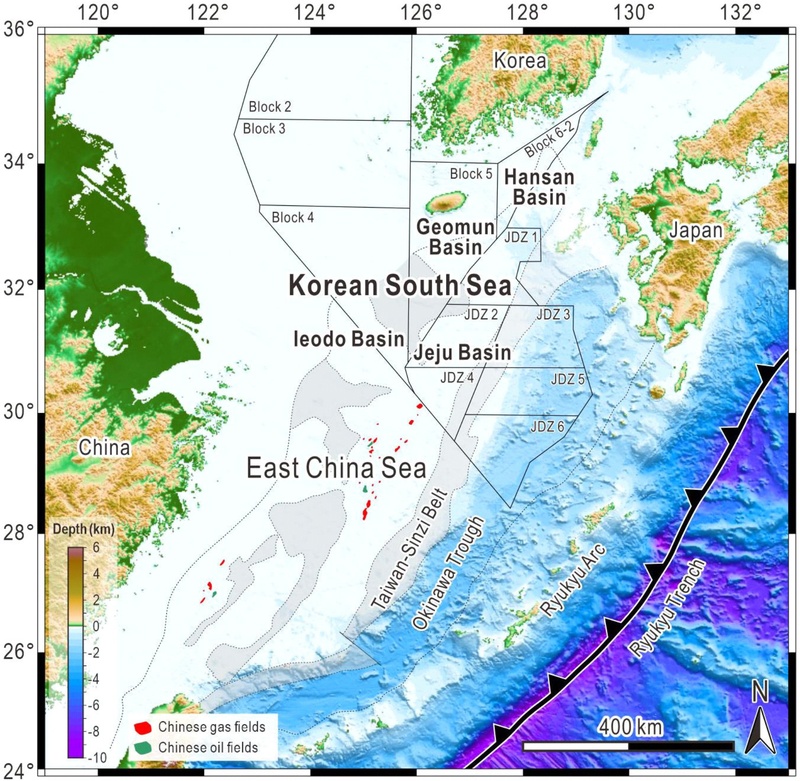
Map showing the location of the Korean South Sea (modified after Lee et al., 2026b).
한국석유공사와 대한지질학회는 남해대륙붕의 탄화수소 부존 가능성을 객관적으로 평가하기 위해 남해 전역에 보편 적용 가능한 2nd-order 및 3rd-order 층서 체계를 새롭게 정립하였다(그림 2)(Lee et al., 2026a). 본 논문은 남해 대륙붕 통합층서 체계 정립을 위해 3개년에 걸쳐 진행된 “남해대륙붕 석유부존 환경평가 용역” 연구 과제 수행동안 산·학 소속 연구진들이 겪었던 다양한 이론 및 기술적 문제들을 설명하고, 이러한 문제들의 해결과정을 소개한다.
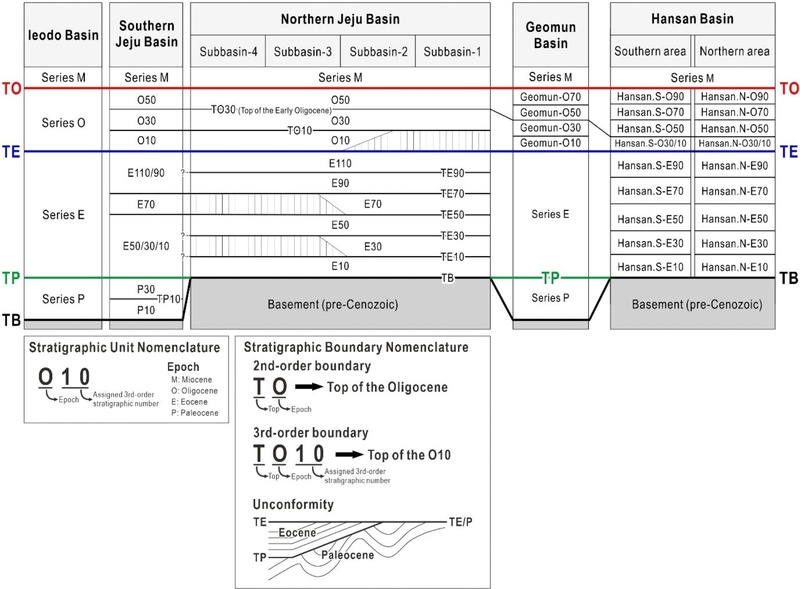
A newly suggested 2nd and 3rd-order stratigraphic framework of the Korean South Sea (GSK, 2025; modified after Lee et al., 2026a).
2. 남해대륙붕 기초 층서 정립 동안 발생한 이론적·기술적 문제
2.1. 열개분지 구조진화 이시성이 미반영된 기존 층서 체계
한국 연구진들이 과거 제안한 남해대륙붕 층서 모델들은 해역 내 모든 분지의 열개작용이 동시에 시작되고, 동시에 종료되었다는 가정을 전제로 구축되었다(Lee et al., 2006; Cukur et al., 2011; Koh et al., 2016; KNOC, 2020)(그림 3). 하지만, 최근 중국측 연구진에 의해 도출된 동중국해 대륙붕 분지들의 시층서 체계는 개별 열개분지들이 상이한 구조운동사를 가지고 있음을 보여준다(Su et al., 2014; Wang et al., 2019; Weilin et al., 2019). Lee et al. (2019)는 이어도분지의 열개동시층 형성시점이 제주분지에 앞선다는 점을 토대로 내용의 남해대륙붕 열개분지 형성의 이시성을 제안한 바 있으나, 보편적 이론체계로 받아들여지지 않았다. 이에 한국석유공사와 대한지질학회는 열개분지들의 이시적 구조운동 특성이 미반영된 기존 층서 체계를 대신할 시추공 생층서 및 방사성 동위원소 연대 기반의 새로운 시층서 체계를 정립하였다(그림 2)(GSK, 2023, 2024, 2025; Lee et al., 2026a).
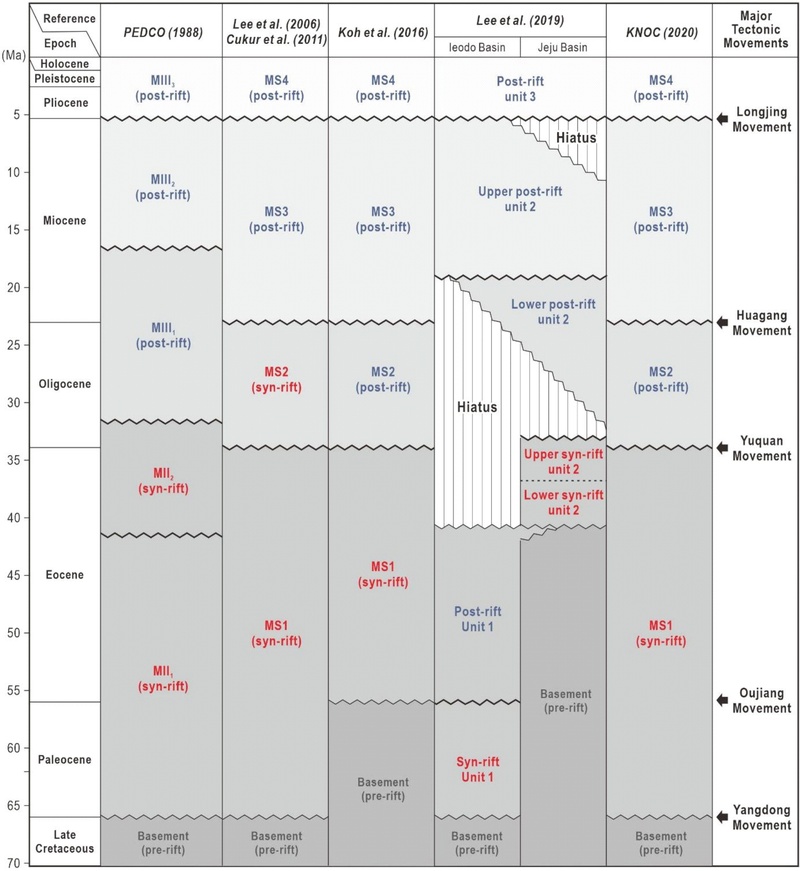
Chart showing previously suggested 2nd-order stratigraphic frameworks (modified after GSK, 2023; Lee et al., 2026a).
2.2. 한반도 주변 해역 중·신생대 표준화석 동정 및 분류 체계 부재
과거 남해대륙붕 지역에서는 회수된 시추 코어 및 코어-커팅 시료 기반의 미화석(e.g., 석회질초미화석, 유공충, 개형충, 와편모조류, 화분포자) 동정 및 생층서 체계 연구가 여러 차례 수행된 바 있으나(KIGAM, 1997; Yun et al., 1999, 2004, 2008), 표준화석 분류체계의 부재로 인해 도출된 생층서 체계는 연구진 별로 상이하였다(그림 4). 이러한 문제점을 보완하기 위해 남해대륙붕 기초 층서 체계 구축에 앞서, 한반도 주변 해역 중·신생대 생층서 체계에 대한 대대적인 리뷰가 수행되었다(Yun, 2019).
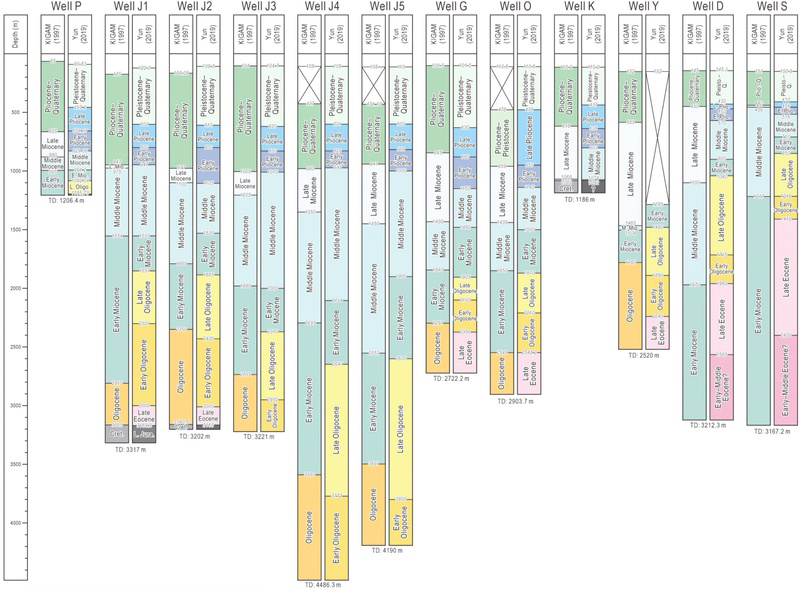
Comparison of two biostratigraphic frameworks suggested by KIGAM (1997) and Yun (2019).
본 연구진은 Yun (2019)가 제안한 시추공 생층서 체계를 토대로, 신생대 세(epoch) 간의 경계면들을 탄성파 반사단면 상에 도시하고, 이들을 대비하여 남해대륙붕 전역에 적용될 수 있는 광역 시층서 체계를 구축하였다(GSK, 2025; Lee et al., 2026a).
2.3. 동중국해 해역과의 층서 체계 불일치
본 연구진은 합치된 시추공 생층서 시대면을 기반으로 에오세, 올리고세, 마이오세 그리고 마이오세 이후에 퇴적된 4개의 2nd-order 시층서 단위를 정의하였다(GSK, 2023). 과거 한국측에 의해 수행된 제주분지 퇴적중심지 탐사시추는 얕은 시추심도로 인해 분지 최하부층 연대를 정확히 특정할 수 없었다. 이로 인해 분지 최하부층의 연대는 시추공상에서 복원된 가장 오래된 연대인 에오세로 추정되었다 (그림 5a). 그에 반해, 중국은 효율적 탐사시추 위치 선정과 시추심도 설계를 통해 시후분지 충전층 전체의 신뢰성 높은 생층서 및 저어콘 절대연령을 도출하였다. 이를 통해 확인된 가장 오래된 동중국해 대륙붕 분지 충전물의 연대는 후기 백악기 혹은 팔레오세로 한국 측 영역에서 추정된 연대보다 오래된 것으로 확인되었다(Su et al., 2014; Suo et al., 2015; Wang et al., 2019; Weilin et al., 2019; Xu et al., 2024).
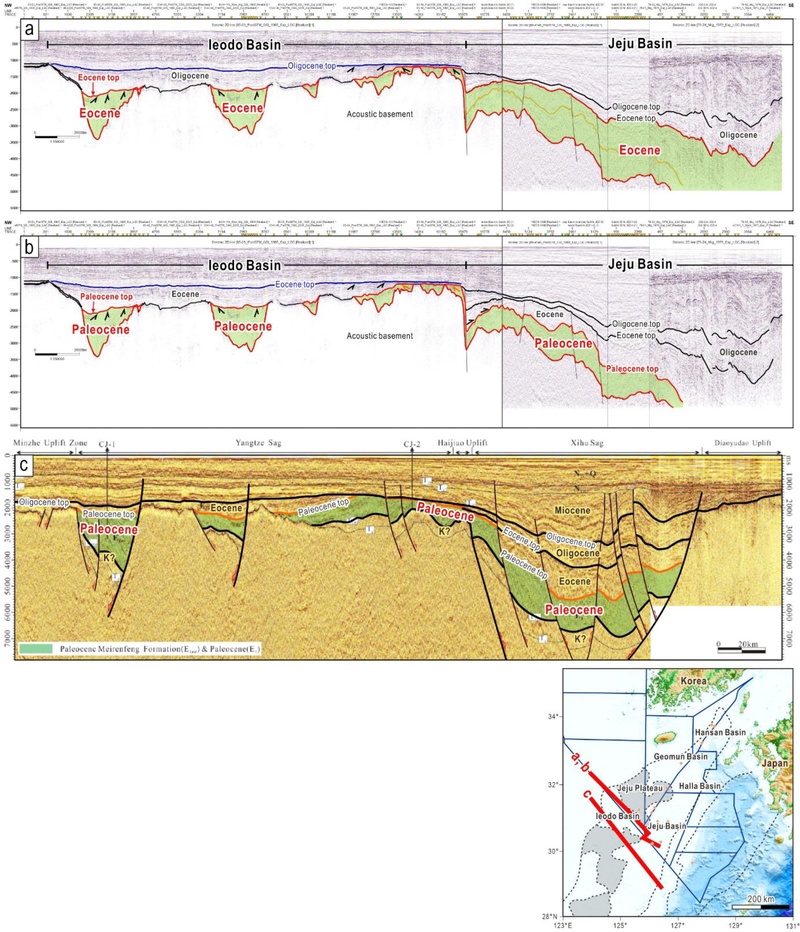
Comparison of the stratigraphic concepts between the Korean South Sea and East China Sea. (a) Initial 2nd-order stratigraphic interpretation of the Jeju and Ieodo basins in the Korean South Sea. (b) Revised 2nd-order stratigraphic interpretation of the Ieodo-Jeju basins. Note that the age of the lowermost stratigraphic sequence was changed from the Eocene to Paleocene. (c) Stratigraphic interpretation from the East China Sea based on the well biostratigraphy and zircon ages (modified after Xu et al., 2024).
본 연구진은 중국 해역에서 도출된 창지앙분지(Changjiang Basin)의 미화석 및 저어콘 절대연령 분석 결과를 토대로 창지앙분지와 동일한 충전물을 공유하는 이어도분지의 충전물이 팔레오세에 퇴적된 것으로 재정의 하였다(GSK, 2024). 2D 탄성파 반사자료를 활용하여 이어도분지 팔레오세 충전물과 제주분지의 최하부 층과의 대비가 수행되었으며, 이를 통해 시추자료가 회수되지 않았던 제주분지 최하부층의 절대연령이 팔레오세로 재정의되었다(그림 5b). 신규 정의된 팔레오세층 상부면과 시추공 Y에서 회수된 최후기 팔레오세 현무암(56.9±6.9 Ma)과의 대비를 통해 팔레오세 상부면 해석에 대한 교차검증이 수행되었다. 이러한 팔레오세 층서 재정의를 통해 연구진은 한국 및 중국 해역 간 층서체계 불일치 문제를 해소하였다(그림 5b, 5c).
2.4. 상이한 탐사 규격 및 후처리 방법에서 기인한 탄성파 반사법 자료 간 품질 차이
남해대륙붕에서 취득된 2D 탄성파 자료의 대부분은 1970-80년대에 취득된 것으로, 당시 대용량 계산용 컴퓨팅 파워의 한계로 오늘날 상업적으로 보편화된 중합 전 자료(Pre-stack Seismic Gathers) 기반의 전산처리 기법을 적용할 수 없었다. 특히 다양한 모델링 기반의 잡음 및 다중반사파 제거(Modeling based Noise Suppression and De-multiples)나 완전파형역산(Full-waveform Inversion) 등 특수 속도모델 구축 및 영상화 기법은 활용되지 못하였다.
당시 대부분의 전산처리는 1960-80년대 일반적인 전산처리 방식인 중합 후(Post-stack) 단계에서 수행되었는데, 수심 약 80 m의 해저면과 하부 부정합면 등 강한 반사면에서 발생하는 다중반사파 에너지는 탄성파 영상 품질 저하의 주요 원인으로 작용하였다. 중합 후 라돈 필터(Post-stack Radon filter) 등 현재 기술 대비 비교적 단순한 다중반사파 제거 기법들로는 탄성파 신호 손상을 감수해야 했고 약 0.1초 주기로 반복되는 해저면 다중반사파(Water Bottom Multiples)를 효과적으로 제거하지 못하였다. 또한 정확한 지하지질 속도를 알 수 없는 상황에서 부정합면 등 강한 반사면에서 발생하는 다중반사파(Interbed Multiples)는 더욱 처리되기가 어려웠다. 한편 다양한 잡음(noise) 제거 기법들의 적용과 더불어 중합(stacking)은 지하 지질구조를 확인할 수 있는 보편적인 방법이면서 매우 효과적인 노이즈 제거 기법으로 활용되었다. 그러나, 결과적으로 대부분의 탄성파 중합 단면에서 보이는 강한 잔여 잡음(residual noises)은 잔여 다중반사파(Residual Multiples)와 함께 탄성파상 해석 신뢰도를 저하시키는 요인이 되었다(그림 6a, 6b). 또한, 1971년부터 수차례에 걸쳐 취득된 남해대륙붕 2D 탄성파 자료들은 취득 연도별로 탐사규격(Seismic Acquisition Parameters)에 차이가 있어 탄성파 신호의 진폭 수준이 매우 상이하였으며, 잡음 및 다중반사파 제거 기법들의 적용 정도에 따라 잔여 잡음과 다중반사파의 수준(Levels of Residual Noises and Multiples)이 매우 다양하였다(그림 6c). 이는 해석자가 탄성파 단면으로부터 통합적인 지하 지질구조를 인지하는 것조차 어렵게 만드는 한계로 작용하였다. 이러한 한계를 극복하기 위해 한국석유공사는 지하지질구조 주요 관심 구간(interesting interval)을 중심으로 서로 다른 탄성파 진폭 수준을 균일화하고 자료 내 잔존하는 잡음과 다중반사파 일부를 억제하여 탄성파 반사면의 해상도 및 연속성을 개선하는 등 구조해석용 중합 후 컨디셔닝(Post-stack Conditioning for Structural Interpretation)을 수행하였다(그림 6d). 이러한 재처리 과정은 구조해석의 신뢰도를 높이는데 기여하였다.
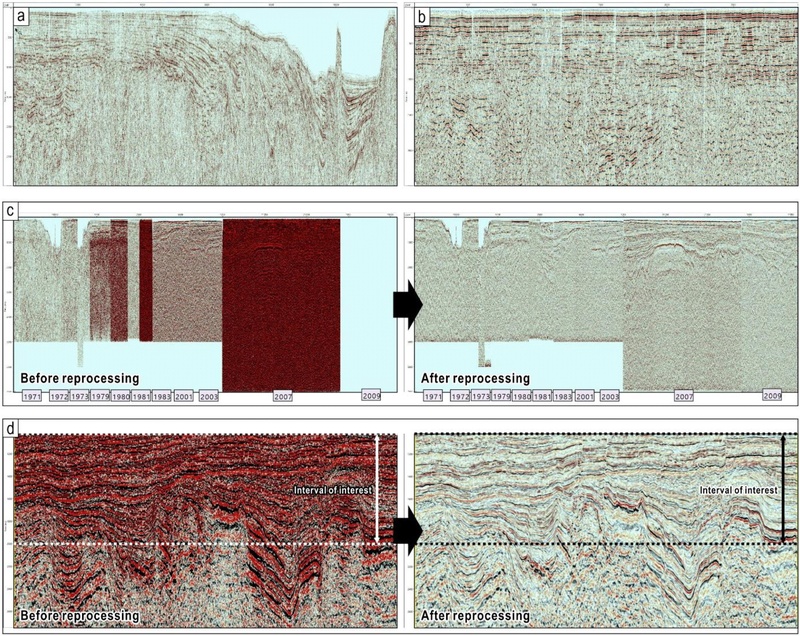
(a), (b) Seismic reflection profiles showing strong residual noise and multiples before reprocessing. (c) Seismic reflection profiles illustrating decrease in amplitude level among different seismic vintages. (d) Seismic reflection profiles showing comparison of pre- and post-conditioning results for structural interpretation.
2.5. 상이한 탄성파 측선 밀도에서 기인한 영역별 도면 해상도 차이
과거 남해대륙붕 해역에서의 탄성파 반사법 탐사는 탄화수소 유망성이 상대적으로 높은 지역을 대상으로 우선 수행되었다. 그로 인해 탐사가 집중된 장소(e.g., JDZ 2소구, JDZ 4소구 서편, 제5광구 남동편, 제6-2광구)의 경우 획득된 2D 탄성파 자료 밀도가 매우 높으나, 탐사의 우선순위에서 벗어나 있던 해역(e.g., 제5광구 서편, JDZ 1소구, JDZ 3소구, JDZ 4소구 동편, JDZ 5소구, JDZ 6소구)의 경우 획득된 자료의 밀도가 상대적으로 매우 낮다(그림 7). 3D 탄성파 탐사 역시 석유 유망성이 높은 지역 위주로 수행되었기에, 남해대륙붕 전역을 대상으로 시간구조도, 등시선도, 단층분포도와 같은 도면 제작시, 지역별로 결과물 해상도의 차이가 두드러진다.
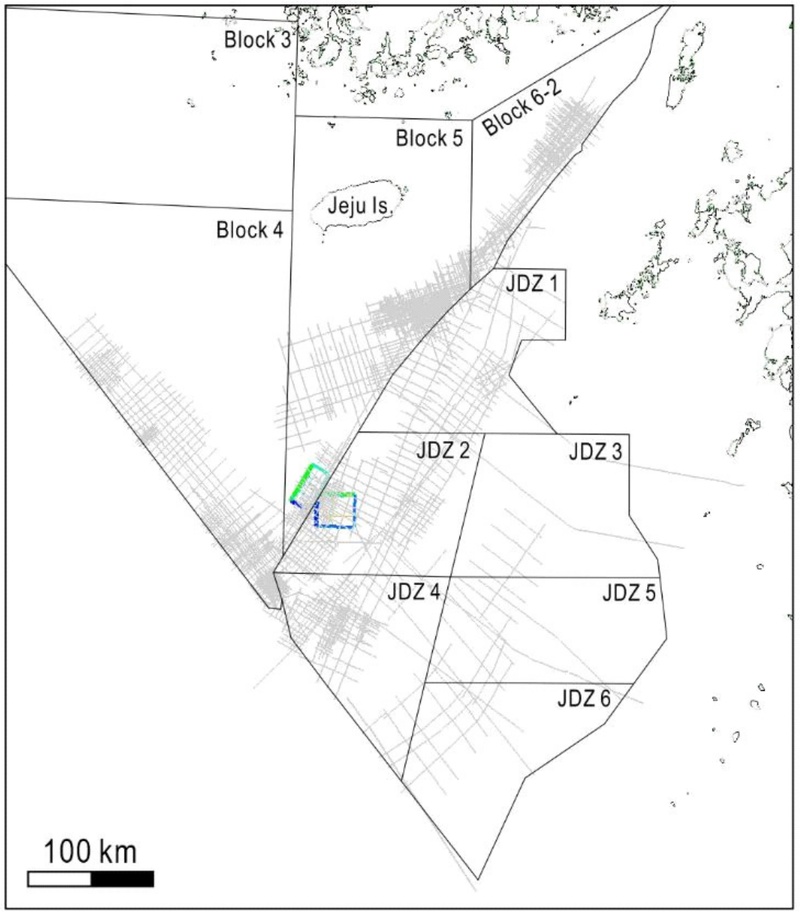
Map showing tracklines of the 2D seismic reflection data and volumes of the 3D seismic reflection data.
지역별 도면 해상도 차이는 퇴적층후 및 단층의 공간적 분포 양상 평가의 신뢰도를 떨어뜨리는 요인으로 작용한다. 이러한 리스크의 극복을 위해 2D 탄성파 반사자료와 기계학습 기반의 외삽을 활용한 3D 탄성파 볼륨 제작과 같은 방법이 수행되었으나, 2D 탄성파 측선 간의 먼 이격 거리로 인해 생성된 3D 볼륨의 품질은 다소 불량하다(GSK, 2023; Lee et al., 2025). 결국 이러한 문제의 근본적 해결을 위해서는 추가적인 2D 탄성파 탐사를 통한 지역별 측선 밀도의 균일화가 요구된다.
2.6. 신규 취득 3D 탄성파 자료와 시추공 간 대비 불일치
시추공 G 및 O와 탄성파 자료와의 연결을 위해 사용되었던 TDR (Time-Depth Relationship)은 상대적으로 저해상도의 2D 탄성파 자료로부터 추출된 탄성파 트레이스와 시추공 합성탄성파(synthetic seismogram)와의 매칭 작업을 통해 제작되었다. 이러한 TDR을 통해 신규 취득된 고해상 3D 탄성파 자료와 시추공 간의 연결 작업이 수행되었지만, TDR 제작을 위해 활용된 실제 탄성파 트레이스 해상도의 한계로 인해 3D 탄성파 자료 내에서 하나의 정확한 반사면과 시추공 시대면이 매칭되지 않았다.
이러한 문제를 해결하기 위해 연구진은 신규 획득된 3D 탄성파 자료로부터 탄성파 트레이스를 추출하였으며, 이와 시추공 합성탄성파와의 매칭 작업을 다시 수행하였다. 이를 통해 개선된 TDR이 도출되었으며, 시추공 G 및 O의 생층서 시대경계면의 위치가 소폭 조정되었다(그림 8).
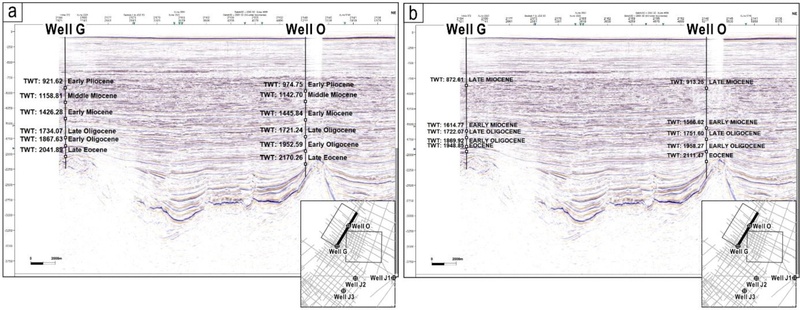
Selected 3D seismic reflection profiles showing original (a) and adjusted (b) well-top position of the Well G and Well O.
2.7. 공식 퇴적분지 영역 및 명명체계 부재
남해대륙붕 해역에는 제주분지와 이어도분지 외에도 정식 해저지형 명명체계를 따르지 않는 열개 소분지들이 다수 산재되어 있다(그림 9a, 9b, 9c). 해저지형의 명명에는 일반적으로 해당 해역에 대해 영토주권을 행사하는 국가의 인근 육상 지명이 사용된다. 동해 및 서해 지역에서는 한국해양과학기술원과 한국해양조사원의 주도하에 해저지형에 대한 한국식 명명 작업이 광범위하게 수행되었으나, 남해대륙붕의 경우 시추공 명을 차용한 도미분지, 소라분지, 드래곤분지와 같은 비공식 분지 명명체계와 후피지아오융기대, 소코트라분지와 같은 주변국 명명체계가 무분별하게 원칙 없이 사용되어 왔다(Lee et al., 2006, 2014, 2019; Cukur et al., 2011; Koh et al., 2016; KNOC, 2020; GSK, 2025).
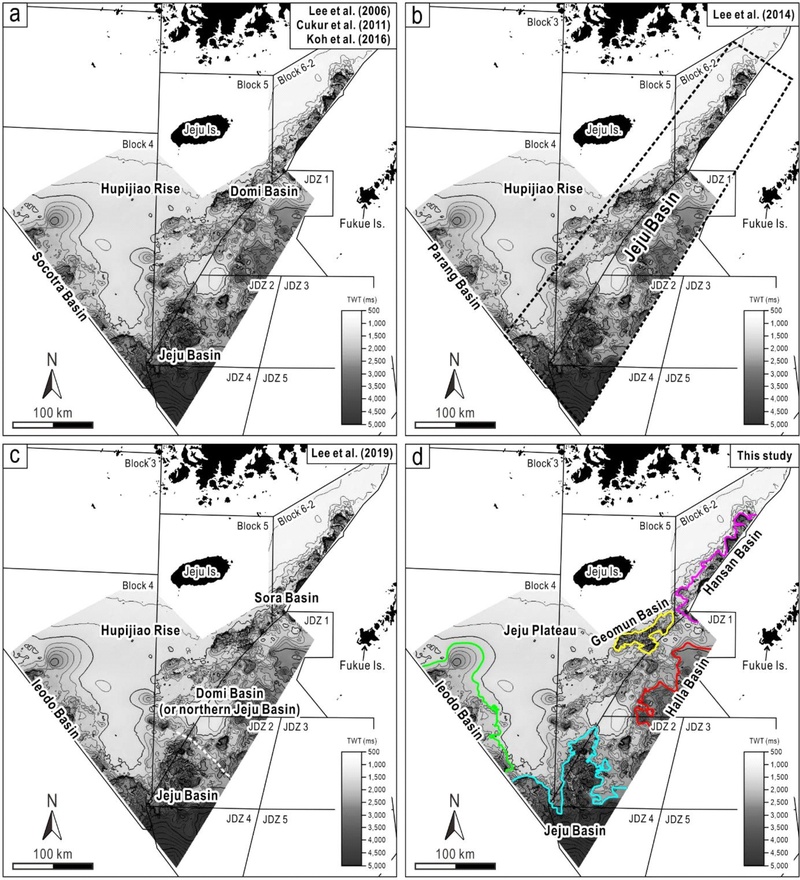
Maps showing comparison of the names and boundaries of the rift basins, used in the previous studies and this study. Note that the background is the time-structural map of the acoustic basement.
본 산학협력 연구는 남해대륙붕 퇴적분지 고질적 해저지형 명명체계 상의 문제를 해결하기 위해 분지 경계단층 재해석 및 분지명 공모를 수행하였다. 공모를 통해 총 6개의 해저지형명이 새로이 부여되었으며, 2025년 대한지질학회 추계지질과학연합학술대회의 특별세션(세션명: 한일 JDZ와 남해대륙붕 석유부존 유망성 연구 성과)을 통해 학계에 제안되었다(Jeon et al., 2025; Kim et al., 2025; Paik et al., 2025). 기존 도미분지 및 소라분지로 불리었던 퇴적분지는 경상남도 통영시에 포함된 한산도의 지명을 사용하여 ‘한산분지’로 새롭게 명명되었으며, 그 영역은 제6-2광구 해역과 후쿠에섬 북쪽에 위치한 기반암 저지대들을 포함하는 것으로 재정의되었다(그림 9d). 드래곤분지로 불리던 제주도 남단 제5광구 해역의 퇴적분지는 전라남도 여수시에 포함된 거문도의 지명을 사용하여 ‘거문분지’로 새롭게 명명되었으며, 그 영역은 제5광구 시추공 Y가 위치한 소분지로 재정의되었다(그림 9d). 또한, 기존에 명칭이 정해지지 않았었던, JDZ 1소구 내 위치한 퇴적분지는 제주도 한라산의 명칭을 활용하여 ‘한라분지’로 새롭게 명명되었으며, 그 영역은 JDZ 1소구와 JDZ 2소구 최북단에 위치한 기반암 저지대로 재정의되었다(그림 9d). 제주도 남단에 위치한 암초인 이어도의 명칭을 사용한 이어도분지의 영역은 제4광구 북서부에 존재하는 3개의 기반암 저지대로 재정의되었다. 대한민국 제주도의 지명을 활용한 제주분지의 영역은 제4광구 남동, 제5광구의 남부, JDZ 2소구의 서부 및 JDZ 4소구 전역에 걸쳐 존재하는 기반암 저지대로 재정의되었다(그림 9d). 마지막으로 후피지아오융기대(Hupijiao Rise)로 불리었던 이어도분지와 제주분지 사이의 기반암 고지대는 제주도에서부터 연장된 대륙지각의 일부라는 점을 감안하여 제주대지(Jeju Plateau)로 새롭게 명명되었다(그림 9d).
3. 결 론
본 논문에서는 남해대륙붕 통합층서 체계 정립을 위해 산·학 소속 연구진들이 겪었던 다양한 이론 및 기술적 문제들 그리고 이를 해결해 나가는 과정이 소개되었다. 남해대륙붕 기초 층서 정립을 위한 연구를 수행하며 연구진이 겪었던 이론 및 기술적 주요 문제들은 다음과 같다: 1) 열개분지 구조진화 이시성이 미반영된 기존 층서 체계, 2) 한반도 주변 해역 중·신생대 표준 화석 동정 및 분류체계 부재, 3) 인접한 동중국해 해역과의 층서 체계 불일치, 4) 상이한 탐사규격 및 후처리 방법에서 기인한 탄성파 반사법 자료 간 품질 차이, 5) 상이한 탄성파 측선 밀도에서 기인한 영역별 도면 해상도 차이, 6) 신규 취득 3D 탄성파 자료와 시추공간 대비 불일치, 7) 공식 퇴적분지 영역 및 명명체계의 부재.
한반도 주변 해역에서 향후 수행될 연구에서도 다양한 이론 및 기술적 이슈들이 발생할 수 있다. 만일 이러한 이슈들과 해결 과정을 소개하는 본 논문과 같은 기술보고 문헌들이 지속적으로 출판된다면, 국내 연구진의 해양 자원 개발을 위한 연구 역량은 한층 더 고도화 될 것으로 예상된다.
Acknowledgments
이 연구는 한국석유공사 “남해대륙붕 종합기술평가” 사업과 산업통상부 유전개발사업 출자, 그리고 한국연구재단(RS-2024-00446363, RS-2024-00392909)의 지원을 받아 수행되었습니다. 논문의 심사과정에서 유익한 조언을 주신 두 분의 심사위원과 편집위원, 편집위원장께 감사드립니다.
References
-
Cukur, D., Horozal, S., Kim, D.C. and Han, H.C., 2011, Seismic stratigraphy and structural analysis of the northern East China Sea Shelf Basin interpreted from multi-channel seismic reflection data and cross-section restoration. Marine and Petroleum Geology, 28, 1003-1022.
[https://doi.org/10.1016/j.marpetgeo.2011.01.002]

- Geological Society of Korea, 2023, Report on Assessment of Petroleum Reserve Environment in the Continental Shelf of South Sea. Korea National Oil Corporation (KNOC) report, 170 p (in Korean).
- Geological Society of Korea, 2024, Report on Assessment of Petroleum Reserve Environment in the Continental Shelf of South Sea. Korea National Oil Corporation (KNOC) report, 218 p (in Korean).
- Geological Society of Korea, 2025, Report on Assessment of Petroleum Reserve Environment in the Continental Shelf of South Sea. Korea National Oil Corporation (KNOC) report, 326 p (in Korean).
- Jeon, J., Paik, S., Han, S.R., Woo, A., Bae, S., Lim, D. and Jung, H., 2025, Current Status of E&P Business On The South Sea, And Its Way Forward. 2025 Joint Fall Meeting of Korean Geological Societies and the 80th General Assembly of the Geological Society of Korea. (Abstracts), Jeju, October 28-31, p. 354 (in Korean).
- Kim, G.B., Lee, J.H., Lee, J.H., Je, Y.H., Yoon, S.H., Paik, S., Han, S.R., Woo, A. and Lim, D., 2025, Stratigraphy and Depositional Environment for Hydrocarbon Potential Assessment of the Korean South Sea. 2025 Joint Fall Meeting of Korean Geological Societies and the 80th General Assembly of the Geological Society of Korea. (Abstracts), Jeju, October 28-31, p. 356 (in Korean).
- KIGAM, 1997, Report on assessment of integrated technology in continental shelf of Korea (East China Sea Shelf Basin I). Korea Institute of Geoscience and Mineral Resources (KIGAM) Research Report (KOR009000153), 338 p (in Korean).
- KNOC, 2020, Report for hydrocarbon potential assessment in Korean South Sea. Korea National Oil Corporation (KNOC) report, 172 p (in Korean).
-
Koh, C., Yoon, S., Lee, D. and Yoo, H., 2016, Tectonic evolution and depositional environments of Jeju and Socotra basins in the southernmost continental shelf of the South Sea, Korea. Journal of the Geological Society of Korea, 52, 355-371 (in Korean with English abstract).
[https://doi.org/10.14770/jgsk.2016.52.3.355]
-
Lee, C., Shinn, Y.J., Han, H.C. and Ryu, I.C., 2019, Structural evolution of two-stage rifting in the northern East China Sea Shelf Basin. Geological Journal, 54, 2229-2240.
[https://doi.org/10.1002/gj.3292]
-
Lee, G.H., Kim, B., Shin, K.S. and Sunwoo, D., 2006, Geologic evolution and aspects of the petroleum geology of the northern East China Sea shelf basin. American Association of Petroleum Geologists Bulletin, 90, 237-260.
[https://doi.org/10.1306/08010505020]
-
Lee, G.H., Lee, B., Kim, H.J., Lee, K. and Park, M.H., 2014, The geological CO2 storage capacity of the Jeju Basin, offshore southern Korea, estimated using the storage efficiency. International Journal of Greenhouse Gas Control, 23, 22-29.
[https://doi.org/10.1016/j.ijggc.2014.01.014]
- Lee, J.H., Lee, J.H., Je, Y.H., Yoon, S.H., Paik, S., Han, S.R., Woo, A., Jeon, J.H., Lim, D., Lim, S., Choi, J., Kim, E. and Kim, G.B., 2026a, 2025 Stratigraphic manual of the Korean South Sea. Geosciences Journal, in review.
- Lee, J.H., Yoon, W.S., Paek, C.S., Lee, J.H., Je, Y.H., Kim, G.B., Paik, S. and Yoon, S.H., 2026b, Reconstruction of depositional system based on seismic facies analysis of the Paleogene sedimentary deposits in the northern Jeju Basin, the Korean South Sea. Journal of the Geological Society of Korea, 62, 23-40 (in Korean with English abstract).
-
Lee, J.W., Lee, M.J., Min, D.J. and Cho, Y., 2025, Reviving Legacy Seismic Data via Machine Learning Technique Part 2: Estimating 3D Seismic Volumes from 2D Seismic Lines with VQ-VAE. IEEE Transactions on Geoscience and Remote Sensing, 63, 1-21.
[https://doi.org/10.1109/TGRS.2025.3567596]
- Paik, S., Jeon, J., Han, S.R., Woo, A., Bae, S., Lim, D. and Jung. H., 2025, Petroleum systems of the South Sea of Korea and recent exploration trends in neighboring countries. 2025 Joint Fall Meeting of Korean Geological Societies and the 80th General Assembly of the Geological Society of Korea. (Abstracts), Jeju, October 28-31, p. 355 (in Korean).
-
Su, J., Zhu, W., Chen, J., Ge, R., Zheng, B. and Min, B., 2014, Cenozoic inversion of the East China Sea Shelf Basin: implications for reconstructing Cenozoic tectonics of eastern China. International Geology Review, 56, 1541-1555.
[https://doi.org/10.1080/00206814.2014.951004]
-
Suo, Y.H., Li, S.Z., Zhao, S.J., Somerville, I.D., Yu, S., Dai, L.M., Xu, L.Q., Cao, X.Z. and Wang, P.C., 2015, Continental margin basins in East Asia: Tectonic implications of the Meso-Cenozoic East China Sea pull-apart basins. Geological Journal, 50, 139-156.
[https://doi.org/10.1002/gj.2535]
-
Wang, B., Doust, H. and Liu, J., 2019, Geology and petroleum systems of the East China Sea Basin. Energies, 12, 4088.
[https://doi.org/10.3390/en12214088]
-
Weilin, Z., Kai, Z., Xiaowei, F., Chunfeng, C., Minqiang, Z. and Shunli, G., 2019, The formation and evolution of the East China Sea Shelf Basin: A new view. Earth-Science Reviews, 190, 89-111.
[https://doi.org/10.1016/j.earscirev.2018.12.009]
-
Xu, H., Shen, W., Qin, D., Liu, Y., Zhang, B., Lin, C. and Wang, X., 2024, Age dating of Paleocene Meirenfeng Formation and its significance for the hydrocarbon source rocks in the East China Sea basin. Marine and Petroleum Geology, 160, 106663.
[https://doi.org/10.1016/j.marpetgeo.2023.106663]
- Yun, H., 2019, Biostratigraphy of the JDZ V-3 and Okdom-1 wells with comparison to neighboring areas. Korea Institute of Geoscience and Mineral Resources (KIGAM) report, 151 p (in Korean).
- Yun, H., Byun, H., Oh, J., Park, Y., Jang, J., Park, O. and Sim, E., 2008, Integrated stratigraphic research of the Block 6-2 in the continental shelf of Korea. Korea National Oil Corporation (KNOC) report, 113 p (in Korean).
- Yun, H., Lee, J., Park, Y., Kang, S., Kang, M. and Kim, H., 2004, Biostratigraphy of the Korea-Japan Joint Development Zone, offshore Korea. Korea National Oil Corporation (KNOC) report, 106 p (in Korean).
- Yun, H., Yi, S., Yi, S., Kim, J.-H., Byun, H.S., Kim, G.-H. and Park, D.B., 1999, Biostratigraphy and paleoenvironment of the Cheju sedimentary basin based on materials from exploration wells, Geobuk-1 and Okdom-1. Journal of the Paleontological Society of Korea, 15, 43-94 (in Korean with English abstract).